

Calisthenics for Retirees: Safe Low-Impact Guide (Age 65+)
Retirement is the perfect season to invest in your body. With more free time, less stress, and a renewed focus on well-being, bodyweight training can transform the way you move, sleep, and feel. This guide to calisthenics for retirees will walk you through safe, low-impact exercises that protect joints, support bone density, and help you stay independent well into your 70s, 80s, and beyond.
Whether you are a complete beginner or returning to exercise after a break, the principles here focus on gentle progression, quality movement, and longevity, not intensity.
Why Calisthenics for Retirees Works So Well
After age 65, adults can lose up to 1–2% of muscle mass per year — a condition known as sarcopenia. Strength training is the single most effective way to slow this process. Calisthenics uses your bodyweight as resistance, which means:
- No gym membership required — you can train at home, in a park, or on a cruise ship.
- Joint-friendly movement patterns — you control the range of motion and tempo.
- Functional carryover — exercises mirror daily tasks like standing up, reaching, and climbing stairs.
- Balance and coordination improvements — crucial for preventing falls, which affect 1 in 4 seniors annually.
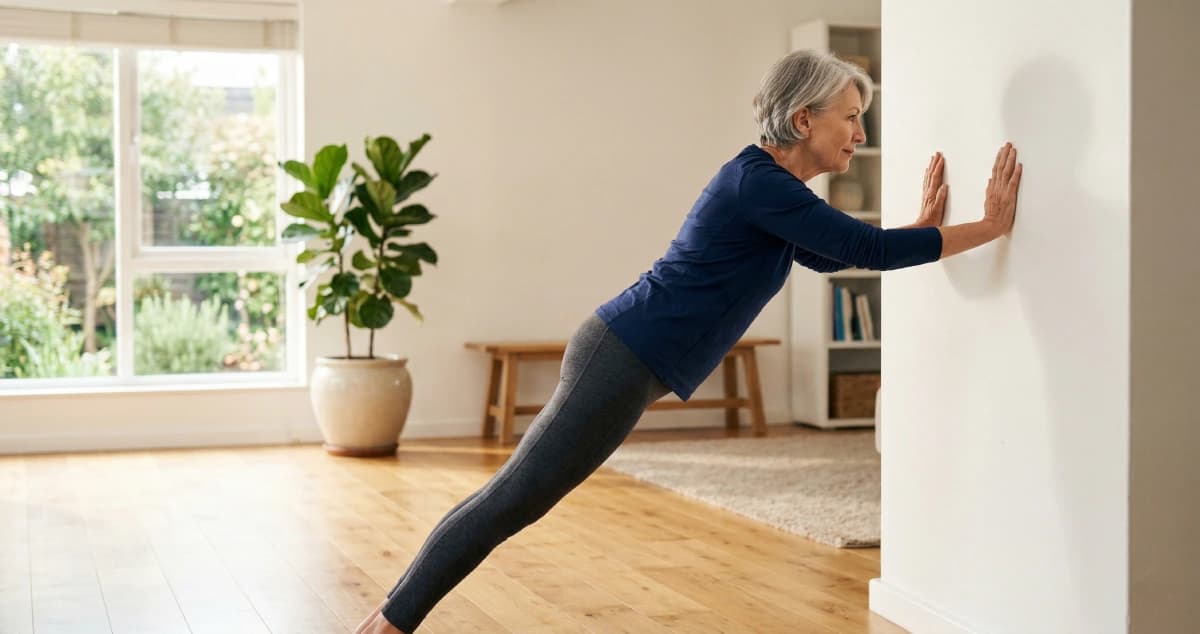
Unlike heavy weightlifting, calisthenics naturally scales to your current ability. A wall push-up and a floor push-up use the same mechanics — only the load changes. For a broader overview of gentle training principles, see our guide to safe calisthenics exercises for seniors.
Before You Begin: Medical Clearance and Self-Assessment
Before starting calisthenics for retirees programs, schedule a check-up with your physician, especially if you have cardiovascular conditions, osteoporosis, recent surgeries, or balance issues. Ask specifically about:
- Heart rate limits during exertion
- Safe ranges of motion for any existing joint replacements
- Medications that may affect blood pressure when transitioning between positions
Once cleared, do a simple self-assessment: Can you stand from a chair without using your hands? Can you walk 10 minutes comfortably? Can you raise both arms overhead? These baseline markers help you choose the right starting level.
The Foundational Movement Categories
A well-rounded program for retirees covers five movement patterns. If you're brand new to training, our article on how to start calisthenics as a beginner lays out the same patterns in more detail.
1. Squat Pattern (Legs and Hips)
- Sit-to-stand: From a sturdy chair, stand up and sit down slowly — 2 sets of 8 reps.
- Supported squats: Hold a countertop or doorframe, lower halfway, return.
2. Push Pattern (Chest, Shoulders, Triceps)
- Wall push-ups: Stand arm's length from a wall, lower chest toward it, press back — 2 sets of 10.
- Incline push-ups on a kitchen counter as you progress.
3. Pull Pattern (Back and Posture)
- Doorway rows: Grip both sides of a doorframe, lean back, pull chest toward hands.
- Band-assisted pulls if you have a resistance band.
4. Hinge Pattern (Glutes and Lower Back)
- Glute bridges: Lie on your back, knees bent, lift hips for 2 seconds, lower slowly.
5. Core and Balance
- Dead bug: Lie on back, slowly extend opposite arm and leg.
- Single-leg stand: Hold a chair, balance on one foot for 15–30 seconds per side.
A Sample Weekly Schedule
Here is a gentle three-day-per-week template for calisthenics for retirees:
Monday — Full Body (20 min)
- 5 min warm-up: shoulder rolls, marching in place, ankle circles
- Sit-to-stand: 2 × 8
- Wall push-ups: 2 × 10
- Doorway rows: 2 × 8
- Glute bridges: 2 × 10
- Single-leg stand: 2 × 20s each side
Wednesday — Mobility Focus (15–20 min)
- Gentle walking 10 minutes
- Cat-cow stretch, thoracic rotations
- Hip flexor stretch, calf stretch, neck mobility
- Consider pairing this with our mobility and flexibility routine for fresh ideas.
Friday — Full Body + Balance (20 min)
- Repeat Monday's session
- Add 2 minutes of tandem stance (heel-to-toe) holding a wall
Rest 60–90 seconds between sets and stop any exercise that causes sharp pain.
Posture: The Hidden Fountain of Youth
Decades of desk work and reading can create rounded shoulders and a forward head. These patterns compress the chest, reduce lung capacity, and cause neck pain. Dedicate 5 minutes a day to corrective work — our guide to fix rounded shoulders with corrective exercises is an excellent companion to your calisthenics practice. Even small posture gains restore confidence and improve breathing during exercise.
Common Mistakes to Avoid
- Skipping warm-ups — cold joints and tendons are injury-prone after 65.
- Holding your breath — always exhale on effort, inhale on release.
- Chasing intensity too soon — add one rep per week, not per session.
- Ignoring recovery — sleep, hydration, and protein (aim for 1.0–1.2 g per kg of bodyweight daily) drive adaptation.
- Training through sharp pain — dull muscle soreness is normal; joint pain is not.
When to Work with a Certified Coach
If you have significant balance concerns, chronic pain, or simply want a personalized plan, working with a trainer who holds a Calisthenics Instructor Certification or specialization in Special Populations Considerations can accelerate your progress safely. Coaches are also invaluable after age 70 for gait analysis and fall-prevention protocols.
Staying Consistent for the Long Haul
The most powerful aspect of calisthenics for retirees is sustainability. Three 20-minute sessions a week, done for 52 weeks, produces measurable gains in strength, balance, and bone density. Pair it with daily walking, a protein-rich diet, and seven hours of sleep, and you have a formula endorsed by geriatricians worldwide.
Your Next Step
Start tomorrow with just two exercises: ten wall push-ups and eight sit-to-stands. That's it. Build the habit first — progression takes care of itself. Calisthenics for retirees isn't about doing more; it's about doing what matters, consistently, for the next twenty years of your life.
Your best decade of movement can still be ahead of you.