

How to Fix Flat Feet (Fallen Arches): Exercises & Strengthening Guide
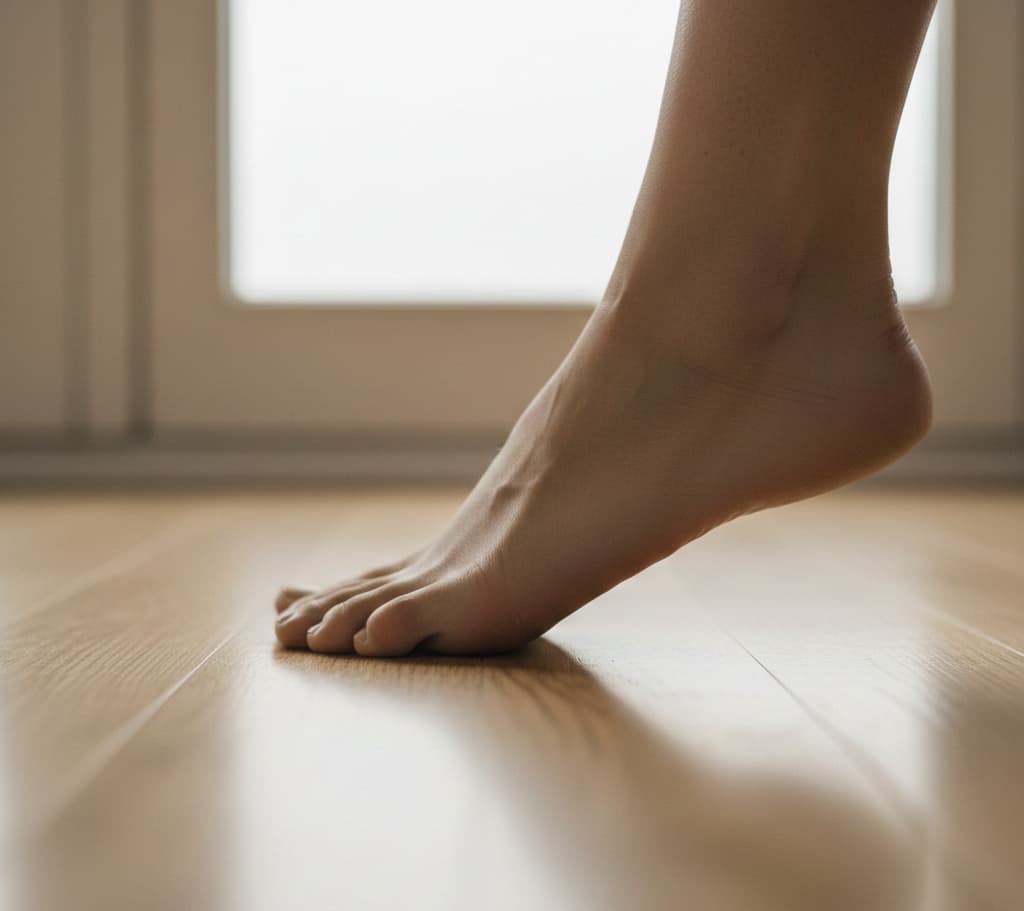
Flat feet — also called fallen arches or pes planus — affect roughly 20–30% of the population. If your arches collapse when you stand, you may experience foot fatigue, knee pain, or reduced balance during calisthenics movements. The good news: unless you have a structural (rigid) flat foot, targeted exercises can rebuild your arch strength and restore proper foot mechanics over time.
This guide covers the anatomy behind flat feet, how to assess yourself, and a complete corrective exercise protocol you can follow at home with no equipment.
Understanding Flat Feet: Anatomy and Causes
What Are Flat Feet?
Your foot has three arches: the medial longitudinal arch (the most visible arch on the inside of the foot), the lateral longitudinal arch (outer side), and the transverse arch (across the midfoot). When we talk about "flat feet," we're referring primarily to a collapsed medial longitudinal arch.
This arch is supported by a network of muscles, tendons, and ligaments — most importantly the tibialis posterior tendon, the plantar fascia, and the intrinsic foot muscles (small muscles within the foot itself). When these structures weaken or become overstretched, the arch drops.
Flexible vs. Rigid Flat Feet
Before starting any corrective protocol, you need to know which type you have:
- Flexible flat feet — Your arch disappears when standing (weight-bearing) but reappears when you sit or stand on your toes. This is the most common type and responds well to exercise-based correction.
- Rigid flat feet — Your arch is absent regardless of loading position. This is often caused by structural bone abnormalities (tarsal coalition), severe arthritis, or long-term tendon damage. Rigid flat feet typically require medical evaluation and may need orthotic or surgical intervention.
Quick test: Sit down and look at your foot from the inside. If you see an arch, then stand up — if it flattens, you have flexible flat feet. If there is no arch in either position, consult a healthcare professional before following this protocol.
Common Causes
- Tibialis posterior weakness or dysfunction — This is the primary dynamic arch support muscle; weakness allows the arch to collapse
- Weak intrinsic foot muscles — The small muscles within the foot that maintain arch shape during standing and walking
- Genetics — Some people inherit looser ligaments or bone structures that predispose them to flat feet
- Prolonged use of supportive footwear — Overly cushioned shoes can prevent foot muscles from developing strength
- Obesity or rapid weight gain — Increased load on under-conditioned arches
- Prolonged standing on hard surfaces — Leads to fatigue-related arch collapse
- Previous ankle or foot injuries — Sprains or fractures that alter foot mechanics
Self-Assessment: Do You Have Flat Feet?
Test 1: The Wet Footprint Test
- Wet the bottom of your foot
- Step onto a dark piece of paper or cardboard
- Step off and examine the print
- Normal arch: You'll see a clear curve along the inside of the foot, with the forefoot and heel connected by a narrow band
- Flat foot: The entire sole appears with no inward curve — the midfoot print is as wide as the forefoot
- High arch: Only the heel and ball of the foot appear, with very little or no connection between them
Test 2: Arch Height Check (Navicular Drop Test)
- Sit in a chair with your foot flat on the floor
- Find the navicular bone — the bony bump on the inside of your foot, roughly halfway between your ankle and big toe
- Note its height from the floor (you can mark it against a piece of paper)
- Now stand up fully and check the height again
A drop of more than 10 mm suggests significant arch collapse and is a strong indicator of flexible flat feet.
Test 3: Single-Leg Heel Raise
- Stand on one foot near a wall for balance
- Rise up onto your toes
If you cannot perform a single-leg heel raise, or if your heel deviates outward (everts) rather than moving straight up, this indicates tibialis posterior weakness — a key contributor to fallen arches.
When to See a Professional
Seek evaluation from a podiatrist or physiotherapist if you experience:
- Pain in the arch, heel, or ankle that worsens with activity
- Visible swelling along the inner ankle
- Inability to rise onto your toes on one leg
- A rigid flat foot (no arch in any position)
- Flat feet that developed suddenly in adulthood
How Flat Feet Affect Calisthenics
Flat feet don't just cause foot pain — they create a chain reaction up the entire lower body that affects your training:
- Squats: Arch collapse causes the knees to cave inward (valgus), reducing power output and increasing knee injury risk. If you struggle with knee cave during pistol squats or deep squats, weak arches may be the root cause.
- Balance movements: A collapsed arch reduces the foot's ability to grip the ground, making single-leg work, handstands, and L-sits less stable.
- Ankle dorsiflexion: Flat feet are often accompanied by restricted ankle mobility, which limits squat depth and creates compensations up the chain. This is closely related to tight hip flexors and anterior pelvic tilt.
- Running and plyometrics: Over-pronation from flat feet increases stress on the shin (tibial stress), knee, and hip, raising the risk of shin splints and plantar fasciitis.
- Standing posture: Arch collapse contributes to internal rotation of the entire leg, which can drive lower crossed syndrome and chronic lower back pain.
The Fix: A Complete Arch Strengthening Protocol
This protocol is divided into three phases. Start with Phase 1 and add each subsequent phase as you progress. All exercises require no equipment unless noted.
Phase 1: Activate and Strengthen the Arch (Weeks 1–4)
The goal of this phase is to wake up the intrinsic foot muscles and the tibialis posterior — the primary arch supporters.
1. Short Foot Exercise (Foot Doming)
Target: Intrinsic foot muscles, medial longitudinal arch
- Sit in a chair with your foot flat on the floor
- Without curling your toes, try to shorten your foot by drawing the ball of your foot toward your heel — imagine lifting the arch from the inside
- Your toes should remain flat on the ground; the arch should visibly rise
- Hold for 5–10 seconds per rep
- Key cue: Think about "doming" the arch — the movement is subtle but you should see the arch lift
Perform 3 sets of 10 reps per foot, 2x daily. Progression: Once comfortable seated, perform standing, then single-leg.
2. Towel Scrunches
Target: Toe flexors, intrinsic foot muscles
- Place a towel flat on the floor
- Sit with your foot on the edge of the towel
- Using only your toes, scrunch the towel toward you
- Spread your toes, then scrunch again
- Continue until the entire towel has been pulled under your foot
Perform 3 sets per foot, 1x daily. Progression: Add a small weight (book, water bottle) on the far end of the towel for resistance.
3. Toe Yoga (Big Toe Independence)
Target: Intrinsic foot muscles, neuromuscular control
- Sit or stand with your foot flat
- Lift only your big toe while keeping the other four toes pressed into the floor
- Then reverse: press the big toe down and lift the other four toes
- Alternate back and forth
Perform 3 sets of 10 reps each direction, 1x daily. Progression: Increase speed while maintaining control.
4. Tibialis Posterior Activation (Resisted Inversion)
Target: Tibialis posterior
- Sit on the floor with your legs extended
- Loop a resistance band around the inside of your forefoot, anchored to a stable object on your opposite side
- Slowly turn your foot inward (inversion) against the band's resistance
- Control the return to neutral
- Key cue: The movement comes from the ankle, not the hip — keep your leg still
Perform 3 sets of 15 reps per foot, 3x per week. Progression: Increase band resistance.
Phase 2: Build Strength and Stability (Weeks 3–8)
Once you can perform the short foot exercise consistently, layer in these strength-building movements.
5. Single-Leg Calf Raises with Arch Focus
Target: Gastrocnemius, soleus, tibialis posterior, arch stabilizers
- Stand on one foot on the edge of a step (heel hanging off)
- Activate the short foot position before beginning
- Rise up onto your toes, focusing on pushing through the big toe side
- Lower slowly below the step level for a full stretch
- Key cue: Avoid letting your ankle roll outward — keep weight centered or slightly toward the big toe
Perform 3 sets of 12–15 reps per foot, 3x per week. Progression: Add weight (backpack, dumbbell) once you reach 15 reps easily.
6. Heel Walk
Target: Tibialis anterior, dorsiflexors
- Stand and lift both forefeet off the ground so you're balanced on your heels
- Walk forward for 20–30 steps, keeping toes off the ground
- Maintain an upright posture throughout
Perform 3 sets of 20–30 steps, 3x per week. Progression: Increase distance or add slow backward heel walking.
7. Marble Pickups (Toe Dexterity)
Target: Intrinsic foot muscles, fine motor control
- Place 10–20 small objects (marbles, pebbles, small balls) on the floor
- Pick each one up with your toes and place it in a bowl or cup
- Use different toes — not just the big toe
Perform 1–2 sets per foot, 3x per week. Progression: Use smaller objects or increase count.
8. Single-Leg Balance with Arch Engagement
Target: Foot stabilizers, ankle proprioception, tibialis posterior
- Stand on one foot on a firm surface
- Activate the short foot position throughout
- Maintain balance for 30–60 seconds
- Key cue: Focus on feeling the three points of contact — big toe, little toe, heel — and actively maintain the arch
Perform 3 sets of 30–60 seconds per foot, daily. Progression: Close your eyes, stand on an unstable surface (folded towel, balance pad), or perform slow single-leg squats while maintaining the arch.
Phase 3: Mobility, Integration, and Daily Habits (Ongoing)
9. Ankle Dorsiflexion Mobilization
Target: Ankle joint, soleus, Achilles tendon
- Stand in a split stance facing a wall, front foot about 10 cm from the wall
- Keep your front heel on the ground and drive your knee forward over your toes toward the wall
- You should feel a deep stretch in the back of the ankle
- Hold for 2–3 seconds, return, and repeat
Perform 3 sets of 15 reps per side, daily. Progression: Move the foot further from the wall as mobility improves. Aim for the knee to pass 12–15 cm past the toes.
10. Plantar Fascia Release
Target: Plantar fascia, foot sole tension
- Stand or sit with a tennis ball, lacrosse ball, or frozen water bottle under your foot
- Roll slowly along the length of the arch, from heel to ball of foot
- Pause on tender spots and apply gentle pressure for 15–20 seconds
- Key cue: Moderate pressure — this should feel like a deep massage, not pain
Perform 2–3 minutes per foot, daily or as needed.
11. Toe Spacer/Splay Practice
Target: Transverse arch, toe alignment
- Spread your toes as wide as possible and hold for 5 seconds
- Alternatively, use silicone toe spacers for 10–15 minutes during rest periods
- This helps counteract years of narrow footwear compression
Perform 3 sets of 10 reps, or wear spacers during rest, 1x daily.
Barefoot Training Considerations
Training barefoot is one of the most effective ways to strengthen your feet — but transition gradually:
- Start with indoor barefoot time: Walk around your house barefoot for 30–60 minutes daily
- Perform your foot exercises barefoot: All exercises in this protocol should be done without shoes
- Add barefoot calisthenics gradually: Begin with warm-ups and light bodyweight exercises (squats, lunges) barefoot, then gradually increase volume
- Consider minimalist footwear: Shoes with a wide toe box, zero drop, and minimal cushioning allow your foot to work naturally while providing basic protection
- Avoid going fully barefoot on hard surfaces too quickly: The transition should take 4–8 weeks to avoid overloading tissues that haven't adapted yet
Want to understand foot and lower leg anatomy in depth? Check out our Anatomy & Physiology course for detailed coverage of the musculoskeletal system, including how the foot's 26 bones and 30+ muscles work together to create the arch.
When Do You Need Orthotics?
Not everyone can fix flat feet with exercise alone. Here's a framework:
Exercise alone is likely sufficient if:
- You have flexible flat feet (arch returns when non-weight-bearing)
- Your flat feet developed gradually from disuse or footwear habits
- You have no pain or only mild fatigue
- You're under 40 and have no history of tendon injury
Consider orthotics (alongside exercise) if:
- You have moderate-to-severe pain during daily activities
- Your tibialis posterior tendon is damaged or inflamed (posterior tibial tendon dysfunction)
- You need immediate symptom relief while building strength
- You have a partial rigid component to your flat feet
Medical evaluation is necessary if:
- You have rigid flat feet
- Pain is worsening despite 8+ weeks of consistent exercise
- You have visible swelling or deformity
- Flat feet appeared suddenly in adulthood
Orthotics and exercise are not mutually exclusive. Many people benefit from temporary orthotic support while building the muscle strength needed to eventually reduce reliance on external support.
Sample Weekly Schedule
Daily (5–10 minutes):
- Short foot exercise: 3 x 10 per foot
- Single-leg balance with arch engagement: 3 x 30–60 seconds per foot
- Plantar fascia release: 2–3 minutes per foot
3–4x per week (10–15 minutes):
- Towel scrunches: 3 sets per foot
- Toe yoga: 3 x 10 per foot
- Tibialis posterior activation: 3 x 15 per foot
- Single-leg calf raises: 3 x 12–15 per foot
- Heel walks: 3 x 20–30 steps
- Ankle dorsiflexion mobilization: 3 x 15 per side
Ongoing:
- Barefoot time: 30–60 minutes daily indoors
- Toe splay practice or spacers during rest periods
- Incorporate short foot activation into warm-ups before training
Timeline: How Long Does It Take?
Correcting flat feet is a gradual process. Here's what to expect:
- Weeks 1–2: Improved awareness of foot position; you can consciously activate the short foot position
- Weeks 3–6: Noticeable improvement in single-leg balance and calf raise control; reduced foot fatigue
- Weeks 6–12: Measurable increase in arch height (navicular height); improved squat mechanics and reduced knee valgus
- Months 3–6: Significant structural adaptation; the arch begins to hold its shape during standing without conscious effort
- Months 6–12: Long-term neuromuscular adaptation; reduced or eliminated need for orthotics in flexible flat foot cases
Consistency is the key factor. A 10-minute daily routine will produce better results than sporadic 30-minute sessions.
Common Mistakes to Avoid
- Curling the toes during the short foot exercise — The movement should come from the intrinsic muscles of the arch, not from gripping with the toes
- Starting with too much barefoot time — Transition gradually over 4–8 weeks to avoid plantar fascia overload or stress reactions
- Ignoring ankle mobility — Limited dorsiflexion forces compensation through the midfoot, worsening arch collapse
- Relying solely on orthotics — Custom insoles provide passive support but don't strengthen the arch; they should supplement, not replace, active training
- Training through pain — Arch fatigue is expected, but sharp pain in the arch, heel, or inner ankle is a signal to reduce intensity and seek evaluation
- Neglecting the tibialis posterior — Many flat foot protocols focus only on toe exercises; the tibialis posterior is the most important dynamic arch support and must be trained directly
- Expecting overnight results — Tendons and ligaments adapt slowly; meaningful structural changes take 3–6 months of consistent work
Connection to the Kinetic Chain
Flat feet don't exist in isolation — they influence (and are influenced by) the entire lower body. Correcting your arches often improves:
- Knee alignment — Less valgus stress during squats and lunges
- Hip function — Reduced internal rotation at the hip, which is linked to rounded shoulders and forward head posture
- Lower back health — A stable base reduces compensatory lumbar extension, addressing a component of anterior pelvic tilt
- Overall calisthenics performance — Better ground connection improves force production in squats, pistol squats, and any standing skill
Flat feet also frequently appear alongside duck feet (excessive external foot rotation) — both stem from poor foot and lower-limb alignment, and correcting one often supports the other.
If you've been working on other postural corrections but haven't addressed your feet, this may be the missing link.
Conclusion
Flat feet are one of the most correctable postural issues — provided you have flexible flat feet and commit to consistent training. The protocol above targets every layer of the problem: intrinsic foot muscles, the tibialis posterior, ankle mobility, and neuromuscular control.
Start with the self-assessment tests to confirm your flat foot type. If you have flexible flat feet, begin with Phase 1 exercises and progress through the protocol over 8–12 weeks. Combine your foot work with barefoot time and short foot activation during your regular calisthenics warm-ups.
Your feet are the foundation of every standing movement you perform. Strengthen them, and everything above improves.
References
- Kulig, K., Reischl, S. F., Pomrantz, A. B., et al. (2009). Nonsurgical management of posterior tibial tendon dysfunction with orthoses and resistive exercise: a randomized controlled trial. Physical Therapy, 89(1), 26–37.
- Mulligan, E. P., & Cook, P. G. (2013). Effect of plantar intrinsic muscle training on medial longitudinal arch morphology and dynamic function. Manual Therapy, 18(1), 55–60.
- Okamura, K., Kanai, S., Hasegawa, M., et al. (2020). Effect of electromyographic biofeedback on learning the short foot exercise. Journal of Back and Musculoskeletal Rehabilitation, 33(6), 1003–1010.
- McKeon, P. O., Hertel, J., Bramble, D., & Davis, I. (2015). The foot core system: a new paradigm for understanding intrinsic foot muscle function. British Journal of Sports Medicine, 49(5), 290.
- Richie, D. H. (2007). Effects of foot orthoses on patients with chronic posterior tibial tendon dysfunction. Journal of the American Podiatric Medical Association, 97(1), 19–30.
- Ridge, S. T., Olsen, M. T., Bruening, D. A., et al. (2019). Walking in minimalist shoes is effective for strengthening foot muscles. Medicine & Science in Sports & Exercise, 51(1), 104–113.
- Unver, B., Erdem, E. U., & Akbas, E. (2019). Effects of short-foot exercises on foot posture, pain, disability, and plantar pressure in pes planus. Journal of Sport Rehabilitation, 29(4), 436–440.