

Calisthenics Body Transformation: Real Results at 30, 60 & 90 Days
Introduction: What a Calisthenics Transformation Really Looks Like
You have seen the dramatic before-and-after photos online. Someone goes from zero training to a chiseled physique in seemingly no time. But what does a calisthenics body transformation actually look like week by week? And what can you realistically expect when starting from scratch?
The truth is that calisthenics delivers real, lasting results, but the timeline differs from what social media suggests. Bodyweight training reshapes your body progressively: first through neurological adaptations, then muscular endurance, and finally visible changes in muscle definition and body composition.
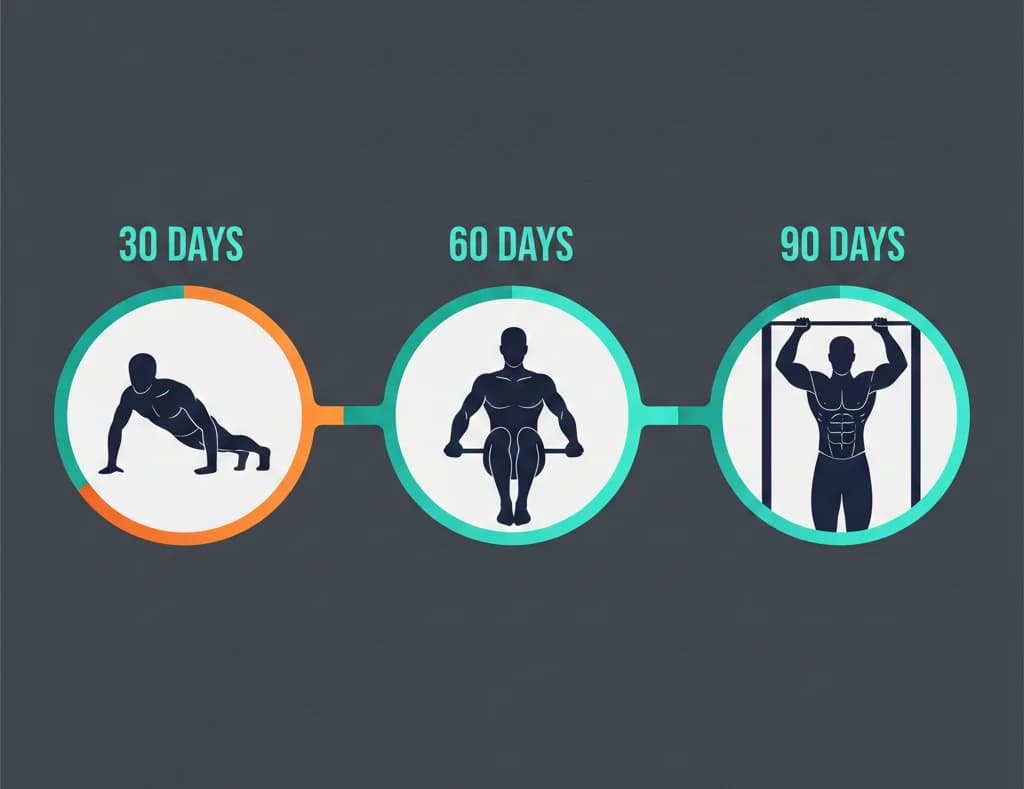
This guide breaks down exactly what happens to your body at the 30-day, 60-day, and 90-day marks. Whether you are following our Complete 30-Day Beginner Program or designing your own routine, these milestones will help you set realistic expectations and stay motivated through the process.
What This Guide Covers:
- The science behind how your body adapts to calisthenics training
- Specific physical and performance changes at each milestone
- How to measure and track your transformation accurately
- Factors that speed up or slow down your results
- Realistic before-and-after expectations without the hype
The Science Behind Calisthenics Body Adaptations
Before diving into the timeline, it helps to understand how your body changes with consistent bodyweight training. Calisthenics triggers three distinct types of adaptation:
Neural Adaptations (Weeks 1-4)
Your nervous system is the first to respond. Within the first few weeks, your brain gets better at recruiting muscle fibers and coordinating movement patterns. This is why beginners often see rapid strength gains before any visible muscle growth. You are not building new muscle yet. Your body is learning to use the muscle you already have more efficiently.
Muscular Adaptations (Weeks 4-12)
Once your nervous system has adapted, true muscle growth (hypertrophy) begins. Calisthenics exercises create mechanical tension and metabolic stress across multiple muscle groups simultaneously. Unlike isolation exercises, compound bodyweight movements like push-ups, pull-ups, and squats stimulate several muscles at once, leading to balanced, functional development.
Metabolic Adaptations (Ongoing)
As you build lean muscle, your resting metabolic rate increases. Each pound of muscle burns roughly 6-7 calories per day at rest compared to 2 calories per pound of fat. Over time, this shift in body composition creates a compounding effect where your body becomes more efficient at burning calories even outside of workouts.
Days 1-30: The Foundation Phase
The first 30 days are where most people either build a lasting habit or give up. Understanding what is normal during this period is critical for staying the course.
What You Will Feel
Week 1-2:
- Significant muscle soreness (DOMS), especially in the chest, shoulders, and legs
- Fatigue after workouts that may last 24-48 hours
- Improved mood and energy levels from endorphin release
- Better sleep quality within the first week
Week 3-4:
- Soreness decreases noticeably as your muscles adapt
- Exercises that felt impossible begin to feel manageable
- Increased energy throughout the day
- Growing confidence in your movement patterns
Strength Changes at 30 Days
This is where calisthenics delivers its first exciting results. Most beginners see significant strength improvements:
| Exercise | Typical Starting Point | 30-Day Progress |
|---|---|---|
| Push-ups | 5-10 reps (or knee push-ups) | 15-25 full push-ups |
| Squats | 10-15 bodyweight squats | 25-35 squats with better depth |
| Plank hold | 15-30 seconds | 45-90 seconds |
| Pull-ups | 0 (or assisted) | 1-3 full pull-ups |
| Lunges | 5-8 per leg | 12-15 per leg |
Important: These numbers assume consistent training 3-4 times per week. Your starting point will vary based on your current fitness level and training history.
Visible Changes at 30 Days
Let's be honest: dramatic visible changes in 30 days are uncommon for most people. Here is what you can realistically expect:
- Improved posture from strengthened core and back muscles
- Slight muscle definition in the shoulders and arms, especially if you carry less body fat
- Reduced bloating if you have also improved your nutrition
- Clothes fitting slightly differently around the shoulders and waist
- Body weight may stay the same or even increase slightly as you build muscle while losing fat
The mirror may not show dramatic changes yet, but the performance improvements are real and measurable. This is the phase where trusting the process matters most.
Key Nutrition Considerations for the First 30 Days
Your nutrition during this phase significantly impacts your results. Focus on:
- Protein intake: Aim for 1.6-2.2 grams per kilogram of body weight daily to support muscle repair
- Hydration: Drink at least 2-3 liters of water per day, more on training days
- Caloric balance: If fat loss is your goal, maintain a moderate caloric deficit (300-500 calories). If muscle gain is the priority, eat at maintenance or a slight surplus
For a detailed nutrition approach, check out our guide on losing weight with calisthenics and proper diet.
Days 31-60: The Visible Progress Phase
This is where things start getting exciting. The neural foundation you built in month one now supports real muscular growth and visible changes.
What Changes Between Day 30 and Day 60
Muscular Development:
- Noticeable increase in shoulder width and upper back thickness
- Chest muscles begin to show more definition, especially the upper chest
- Arms develop visible tone, particularly the triceps (from pushing movements) and biceps (from pulling movements)
- Core muscles start to show through, especially the obliques and upper abdominals
- Legs develop more shape and definition in the quadriceps and calves
Body Composition:
- Measurable reduction in body fat percentage (typically 2-4% with proper nutrition)
- Waist circumference decreases by 1-3 centimeters
- Chest and shoulder measurements increase by 1-2 centimeters
- Weight on the scale may not change much, but your body is recomposing
Performance Milestones at 60 Days
Your strength gains continue to accelerate:
| Exercise | Typical 60-Day Progress |
|---|---|
| Push-ups | 25-40 reps, or moving to diamond/archer push-ups |
| Squats | Pistol squat progressions or jump squats |
| Plank hold | 90-120 seconds, or advanced plank variations |
| Pull-ups | 5-8 full pull-ups |
| Dips | 8-12 parallel bar dips (from 0 at day 1) |
| L-sit | 5-15 second holds |
At this point, you should be exploring progressive overload techniques to continue challenging your body. Simply doing more reps of basic exercises will eventually plateau. You need to progress to harder variations.
The "Other People Notice" Moment
Around the 45-60 day mark, something significant happens: other people start commenting on your physique. Friends, family, and coworkers begin noticing changes that you may have been too close to see yourself. This external validation is a powerful motivator, but do not become dependent on it. Your progress is real whether or not others comment on it.
Common feedback you may hear:
- "Have you been working out?"
- "Your posture looks really good"
- "Your arms look bigger"
- "You seem more confident"
Training Adjustments for Month Two
To keep progressing, your training should evolve:
- Increase exercise difficulty rather than just adding reps. Move from regular push-ups to decline or diamond push-ups
- Add skill work like handstand holds against a wall or pull-up progressions
- Incorporate tempo training with slow eccentric (lowering) phases of 3-4 seconds
- Reduce rest periods from 90 seconds to 60 seconds between sets
Days 61-90: The Transformation Phase
The third month is where the compounding effect of consistent training becomes undeniable. Your body has adapted to the demands of calisthenics, and the results are now clearly visible.
Visible Transformation at 90 Days
Upper Body:
- Well-defined shoulders with visible deltoid separation
- Chest development that is noticeable in fitted clothing
- Back width from pull-ups and rows that creates a V-taper silhouette
- Arm definition with visible bicep and tricep shape
- Forearm development from gripping exercises
Core:
- Visible abdominal definition (depending on body fat percentage)
- Strong oblique lines framing the midsection
- A noticeably flatter, tighter stomach
- Improved waist-to-shoulder ratio
Lower Body:
- Defined quadriceps, especially visible when walking up stairs
- Shapely calves from calf raises and jump training
- Firmer glutes from squats, lunges, and hip bridges
- Overall improved leg proportions
Strength Transformation at 90 Days
| Exercise | Typical 90-Day Progress |
|---|---|
| Push-ups | 40+ reps, or working on one-arm push-up progressions |
| Pull-ups | 8-15 full pull-ups, or weighted pull-ups |
| Dips | 15-20 dips, or exploring ring dips |
| Pistol squats | Working toward full pistol squats |
| Muscle-ups | Beginning transition training |
| Handstand | 10-30 second wall-assisted holds |
| L-sit | 15-30 second holds |
If you started with our 30-Day Beginner Program, by day 90 you may be ready for the Intermediate Program.
Body Composition Changes at 90 Days
With consistent training and proper nutrition, typical results include:
- Body fat reduction: 4-8% decrease from starting point
- Lean muscle gain: 2-4 kg of new muscle mass
- Waist reduction: 3-6 cm decrease in circumference
- Chest increase: 2-4 cm increase in circumference
- Significant improvement in how clothes fit, especially around the shoulders, chest, and waist
Reality check: These numbers represent averages for someone training consistently 3-4 times per week with adequate nutrition and sleep. Your individual results will vary based on the factors discussed in the next section.
Factors That Affect Your Transformation Timeline
Not everyone progresses at the same rate. Here are the key variables that influence how quickly you will see results:
Starting Point and Training History
If you have previous training experience (even years ago), you benefit from "muscle memory." Satellite cells in your muscles retain nuclei from prior training, allowing faster regrowth. Someone returning to fitness after a break may see results 2-3 times faster than a true beginner.
Conversely, if you are significantly overweight, the visual transformation may take longer to become apparent even though internal health improvements begin immediately.
Age
- Teens and 20s: Highest natural testosterone and growth hormone levels. Fastest visible results, typically noticeable within 4-6 weeks
- 30s and 40s: Slightly slower progress but still very achievable. May need 6-8 weeks for visible changes. Recovery becomes more important
- 50s and beyond: Progress is absolutely possible but takes longer. Focus on consistency over intensity. Visible changes may take 8-12 weeks. See our guide on calisthenics for seniors for age-appropriate modifications
Nutrition and Diet
Training is only half the equation. Your diet determines whether your body has the building blocks to repair and grow muscle:
- Protein timing and quantity directly impact muscle protein synthesis
- Overall calorie intake determines whether you lose fat, maintain, or build muscle
- Micronutrient adequacy (vitamins, minerals) supports recovery and hormone production
- Hydration affects performance, recovery, and even the appearance of muscle definition
A poor diet can cut your visible results in half. A dialed-in nutrition plan can accelerate them significantly. For specific nutrition strategies, see our guide on losing weight with calisthenics and diet.
Sleep and Recovery
Sleep is when your body does most of its repair and muscle-building work:
- 7-9 hours per night is the target for optimal recovery
- Growth hormone release peaks during deep sleep
- Poor sleep increases cortisol, which promotes fat storage and muscle breakdown
- Rest days are not optional. Overtraining slows progress more than undertraining
Consistency and Training Frequency
This is the single biggest factor. Someone training 3 times per week consistently for 90 days will see dramatically better results than someone training 6 times per week for 3 weeks then quitting.
Minimum effective dose: 3 sessions per week, 30-45 minutes each Optimal for most people: 4 sessions per week with one active recovery day Diminishing returns above: 5-6 sessions per week without advanced recovery protocols
Genetics
Genetics influence muscle fiber composition, bone structure, metabolism, and where your body stores or loses fat. While you cannot change your genetics, they account for roughly 20-30% of the variation in results. The other 70-80% is within your control through training, nutrition, sleep, and consistency.
How to Track Your Calisthenics Transformation
Relying on the bathroom scale alone is one of the biggest mistakes beginners make. Here are the methods that actually capture your progress:
Progress Photos
The most reliable way to see visual changes:
- Take photos every 2 weeks in the same location with the same lighting
- Use three angles: front, side, and back
- Wear the same clothing (or minimal clothing) each time
- Take photos at the same time of day, ideally morning before eating
- Use consistent posing: relaxed stance, arms at sides, and one flexed pose
Body Measurements
Track these with a flexible tape measure every 2-4 weeks:
| Measurement | Where to Measure |
|---|---|
| Chest | Around the widest point, at nipple level |
| Waist | Around the narrowest point, at the navel |
| Hips | Around the widest point of the glutes |
| Upper arm | Around the peak of the flexed bicep |
| Thigh | At the midpoint between hip and knee |
| Shoulders | Around the widest point, arms relaxed at sides |
Strength Benchmarks
Test these every 4 weeks to track performance:
- Max push-ups in one set (to failure with good form)
- Max pull-ups in one set
- Max plank hold time
- Wall sit hold time
- Max bodyweight squats in 60 seconds
Record your numbers and compare. Strength gains are often the most motivating metric because they improve consistently even when visual changes are subtle.
Body Weight and Body Fat
- Weigh yourself at the same time each day (morning, after bathroom, before food)
- Track the weekly average, not daily fluctuations. Daily weight can vary by 1-2 kg due to water retention, food volume, and other factors
- If possible, use a body fat caliper or DEXA scan every 4-6 weeks for body composition data
- Remember: the scale may not move much during a body recomposition where you lose fat and gain muscle simultaneously
Workout Log
Keep a simple log of:
- Exercises performed, sets, and reps
- Progression from one variation to the next
- How exercises felt (rate of perceived exertion)
- Any personal records
This data tells the story of your transformation more accurately than any single photo.
Realistic Before and After Expectations
Let's set honest expectations based on different starting points:
Starting Point: Untrained Beginner (No Exercise History)
| Metric | Day 1 | Day 30 | Day 60 | Day 90 |
|---|---|---|---|---|
| Push-ups | 0-5 | 10-20 | 20-35 | 30-45+ |
| Pull-ups | 0 | 0-2 | 3-6 | 6-12 |
| Body fat change | Baseline | -1 to -2% | -2 to -4% | -4 to -7% |
| Muscle gain | Baseline | ~0.5 kg | ~1.5 kg | ~2.5-3 kg |
| Visual change | None | Minimal | Noticeable | Significant |
Starting Point: Overweight Beginner (20+ kg to lose)
| Metric | Day 1 | Day 30 | Day 60 | Day 90 |
|---|---|---|---|---|
| Push-ups | 0-3 (knees) | 5-15 (full) | 15-25 | 25-35 |
| Weight loss | Baseline | -2 to -4 kg | -5 to -8 kg | -8 to -12 kg |
| Waist reduction | Baseline | -1 to -2 cm | -3 to -5 cm | -5 to -8 cm |
| Visual change | None | Clothes fit better | Noticeable difference | Dramatic change |
Starting Point: Returning Athlete (Previous Training Experience)
| Metric | Day 1 | Day 30 | Day 60 | Day 90 |
|---|---|---|---|---|
| Push-ups | 10-20 | 30-40 | 40-50+ | Advanced variations |
| Pull-ups | 1-5 | 8-12 | 12-18 | 15-20+ |
| Body fat change | Baseline | -2 to -3% | -4 to -6% | -5 to -8% |
| Muscle gain | Baseline | ~1 kg | ~2-3 kg | ~3-4 kg |
| Visual change | Minimal | Noticeable | Significant | Dramatic |
Note: These ranges reflect typical outcomes with consistent training (3-4x/week) and adequate nutrition. Individual results vary. The upper ends of these ranges require dialed-in nutrition, adequate sleep, and disciplined consistency.
Common Mistakes That Slow Down Your Transformation
Avoid these pitfalls to maximize your 90-day results:
- Skipping progressions. Doing 50 easy push-ups builds endurance but not muscle. Progress to harder variations once you can do 15+ reps with good form
- Neglecting nutrition. Training without adequate protein is like building a house without bricks. Muscle cannot grow without the raw materials
- Overtraining. More is not always better. Training the same muscles daily without rest leads to overuse injuries and stalled progress
- Obsessing over the scale. Body weight is a poor measure of body composition change. Use photos, measurements, and strength tests instead
- Program hopping. Switching programs every 2 weeks prevents adaptation. Commit to one program for at least 6-8 weeks before evaluating
- Comparing yourself to others. Social media transformations often involve favorable lighting, angles, and timelines that are not representative of typical results
- Ignoring mobility work. Tight muscles limit your range of motion and reduce the effectiveness of every exercise. Spend 10 minutes on mobility and flexibility after each session
Frequently Asked Questions
Q: Can I see visible abs in 90 days of calisthenics?
A: It depends on your starting body fat percentage. Abdominal muscles become visible at roughly 12-15% body fat for men and 18-22% for women. If you start at 25% body fat, reaching visible abs in 90 days is possible with strict nutrition but ambitious. If you start at 18%, it is very achievable. Calisthenics builds strong core muscles, but revealing them requires reducing the fat layer on top through a caloric deficit.
Q: Will calisthenics make me bulky?
A: No. Calisthenics builds lean, proportional muscle. Because you are limited to your body weight as resistance, you develop functional strength without the excessive bulk that can come from heavy weight training. Most people describe a calisthenics physique as athletic, toned, and well-proportioned.
Q: How often should I train for the best transformation?
A: Three to four sessions per week is optimal for most beginners. This provides enough stimulus for growth while allowing adequate recovery. Training more frequently is not necessarily better, especially in the first 60 days when your body is still adapting. Quality of training matters more than quantity.
Q: Can I transform my body with calisthenics alone, without any equipment?
A: Yes, absolutely. Push-ups, squats, lunges, planks, and their many variations can build an impressive physique. However, adding a pull-up bar expands your exercise options significantly, especially for back and bicep development. A pull-up bar is the single most impactful equipment investment for calisthenics.
Q: What if I miss a week of training? Will I lose my progress?
A: One missed week will not erase your progress. Research shows that strength and muscle mass are largely maintained for 2-3 weeks of inactivity. After that, detraining begins gradually. If you miss a week, simply pick up where you left off. Do not try to "make up" missed sessions by doubling your volume, as this increases injury risk.
Q: Is calisthenics effective for women's body transformation?
A: Calisthenics is extremely effective for women. Women typically see significant improvements in muscle tone, posture, and body composition. Lower testosterone levels mean women build lean muscle without excessive bulk. Calisthenics is especially effective for developing the glutes, legs, and core. For specific guidance, check our article on calisthenics for women over 40.
Q: How does a calisthenics transformation compare to a gym transformation?
A: Both can deliver excellent results. Calisthenics tends to build a more balanced, athletic physique with better relative strength (strength-to-bodyweight ratio). Gym training with weights allows more targeted muscle isolation and can build larger muscles faster. Many people combine both for optimal results. See our detailed calisthenics vs. gym comparison for more.
Q: I am over 40. Is a 90-day calisthenics transformation realistic for me?
A: Absolutely. While progress may be slightly slower than for someone in their 20s, a 90-day transformation is very realistic at any age. The key adjustments are: prioritize recovery (more rest days if needed), focus on joint-friendly progressions, and be patient with the timeline. Many of the most impressive calisthenics practitioners are over 40. Consistency matters far more than age.
Your 90-Day Transformation Action Plan
Ready to start? Here is a step-by-step plan to maximize your results over the next 90 days:
Days 1-30: Build the Foundation
- Start with our Complete 30-Day Beginner Program or a similar structured routine
- Take your "before" photos and baseline measurements
- Set up a workout log to track every session
- Dial in your nutrition: adequate protein, proper hydration, balanced meals
- Establish a consistent sleep schedule (7-9 hours)
Days 31-60: Push the Intensity
- Progress to harder exercise variations using progressive overload principles
- Add skill work like handstand holds or pull-up training
- Take progress photos and measurements at day 45 and day 60
- Re-test your strength benchmarks at day 60
- Adjust nutrition based on your results so far
Days 61-90: Transform
- Move to an intermediate program if you have outgrown the beginner routine
- Focus on compound movements and advanced variations
- Reduce rest periods and increase training density
- Take final progress photos and measurements at day 90
- Compare your benchmarks, photos, and measurements to day 1
Conclusion
A 90-day calisthenics body transformation is not about overnight miracles. It is about the compounding effect of consistent effort applied over time. The first 30 days build your foundation through neural adaptations and habit formation. The second month brings visible changes that others start to notice. By day 90, you will have a genuinely transformed physique with real, functional strength to back it up.
The most important thing to remember is this: every transformation starts with day one. Whether your goal is losing fat, building muscle, improving posture, or simply feeling stronger and more confident, calisthenics can get you there. Set your expectations based on reality rather than social media highlights, track your progress consistently, and trust the process.
Your body is capable of remarkable change. Give it 90 days, and the results will speak for themselves.