

Calisthenics vs Gym: Which Is Better for Beginners?
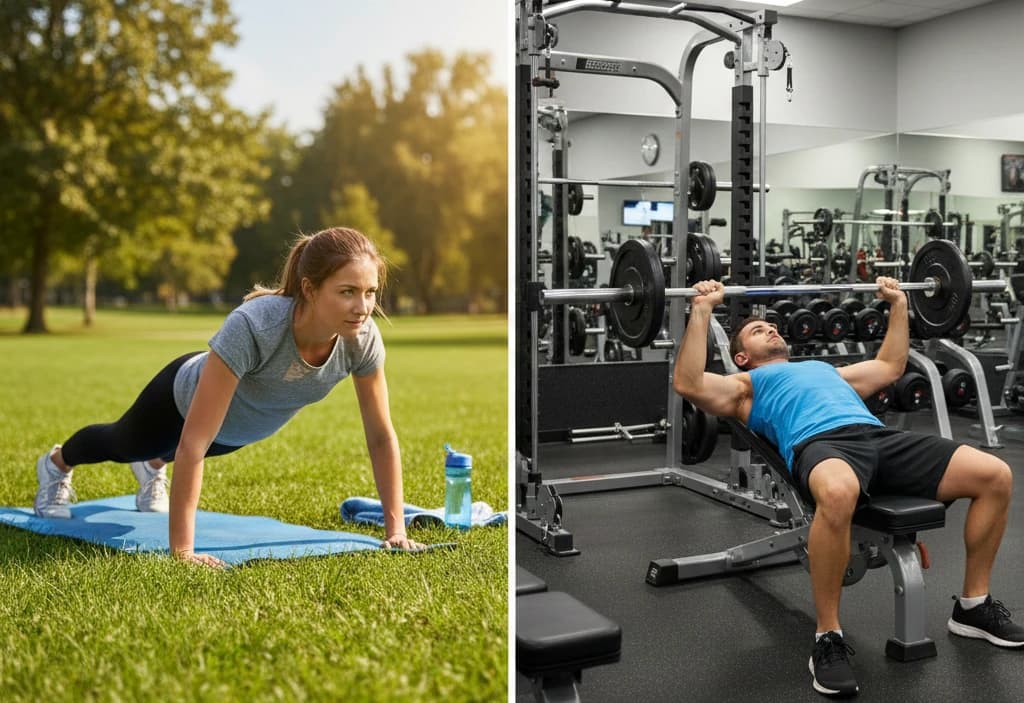
Should You Start With Calisthenics or Hit the Gym?
You've decided to get in shape. That's the hard part. But now comes the question every beginner faces: should you start with calisthenics (bodyweight training) or join a gym?
Both options can transform your body. Both build real muscle and strength. But they work differently, cost differently, and suit different lifestyles. If you pick the wrong one, you're more likely to quit within the first few months.
This guide breaks down every factor that matters to a beginner so you can make a confident, informed decision and actually stick with it.
What this guide covers:
- Cost comparison (free vs gym membership)
- Equipment you actually need
- Muscle building potential for beginners
- Flexibility and mobility benefits
- Convenience and accessibility
- Injury risk for new trainees
- Whether you can combine both
- A clear verdict based on your situation
Quick answer: For most beginners, calisthenics is the easier, cheaper, and more sustainable way to start. But gym training is a better fit if you want maximum muscle size or need the structure of a gym environment. Read on for the full breakdown.
Cost Comparison: Free vs Gym Membership
The biggest practical difference between calisthenics and gym training is the price of entry.
Calisthenics Costs
Minimum to start: $0
You can begin a calisthenics program with zero equipment. Push-ups, squats, lunges, planks, and dozens of other exercises need nothing but a floor.
Recommended starter kit: $30-80
- Pull-up bar (doorframe): $25-40
- Resistance bands (for assisted pull-ups): $15-30
- Exercise mat (optional): $10-20
Total ongoing cost: $0 per month
After the initial purchase, you never pay again. No membership fees, no renewal traps, no cancellation hassles.
Gym Membership Costs
Budget gyms: $10-30 per month ($120-360 per year)
- Planet Fitness, Crunch, and similar chains
- Basic equipment, often crowded during peak hours
Mid-range gyms: $30-70 per month ($360-840 per year)
- Better equipment selection and less crowding
- May include classes
Premium gyms: $80-200+ per month ($960-2,400+ per year)
- Equinox, boutique studios
- Top-tier equipment and amenities
Hidden costs to factor in:
- Sign-up and annual fees ($20-50)
- Gas and commute time
- Gym clothes and shoes
- Locker or towel rental at some gyms
- Personal trainer sessions ($40-100+ per session)
The Bottom Line on Cost
Over your first year, calisthenics costs $30-80 total. A mid-range gym costs $400-900+ including fees. Over five years, you could save thousands with bodyweight training.
For beginners testing the waters, calisthenics lets you start for almost nothing and scale up only when you're committed.
Equipment Needed
Starting Calisthenics
Day one (no equipment):
- Push-ups, squats, lunges, planks, mountain climbers, burpees, glute bridges
Month one (minimal equipment):
- Pull-up bar for pull-ups, chin-ups, and hanging exercises
- Resistance bands for assisted movements and warm-ups
Month three and beyond (optional upgrades):
- Gymnastic rings ($30-60) for rows, dips, and advanced work
- Parallettes ($25-50) for L-sits and handstand training
- Weighted vest ($50-100) when bodyweight gets easy
Everything fits in a closet. You can train in your living room, a park, a hotel room, or your backyard.
Starting at the Gym
What the gym provides:
- Barbells, dumbbells, and plates
- Bench press, squat rack, cable machines
- Leg press, lat pulldown, and dozens of isolation machines
- Cardio equipment (treadmills, bikes, rowing machines)
What you still need to buy:
- Gym bag
- Athletic shoes ($60-120)
- Workout clothes
- Water bottle
- Optional: lifting gloves, wrist wraps, belt ($30-80)
The gym gives you access to more equipment variety, which is useful for targeting specific muscles. But you're always dependent on the gym being open, available, and accessible.
Muscle Building: Calisthenics vs Weights for Beginners
This is the question most beginners care about most. Here's the honest answer.
The Truth About Beginner Gains
As a beginner, both methods build muscle effectively. Your body is primed to grow during the first 6-12 months of training regardless of the method. This "newbie gains" period is when you'll see the fastest results of your training career.
Research published in the Journal of Strength and Conditioning Research shows that bodyweight training and weight training produce comparable upper-body muscle and strength gains in beginners when volume and effort are matched.
Where Calisthenics Excels
Upper body development: Push-ups, pull-ups, and dips are among the most effective muscle-building exercises in existence. They work multiple muscle groups simultaneously and build real-world functional strength.
Core strength: Every calisthenics exercise engages your core for stabilization. You'll develop visible abs and a strong midsection without doing a single crunch.
Proportional physique: Bodyweight training naturally builds a balanced, athletic body. You won't overdevelop one area while neglecting another.
Where Gym Training Excels
Leg development: This is the gym's biggest advantage. Barbell squats, leg press, and deadlifts load your legs far beyond what bodyweight alone can achieve. Calisthenics athletes can build strong, functional legs, but maximum leg size requires heavy external resistance.
Isolation work: If you want to specifically target your biceps, rear delts, or calves, machines and dumbbells make it easy. Calisthenics relies on compound movements, which are efficient but less precise.
Simpler progressive overload: At the gym, getting stronger means adding weight to the bar. In calisthenics, progression involves changing leverage, angle, or tempo, which requires more knowledge.
Realistic Beginner Results (First 6 Months)
Calisthenics:
- 5-10 lbs of lean muscle gain
- Visible improvement in muscle definition
- Noticeably stronger in everyday activities
- Can perform 10+ push-ups, 3-5+ pull-ups
- Body fat reduction (with proper diet)
Gym training:
- 8-15 lbs of muscle gain (including water/glycogen)
- Noticeable size increase, especially in arms and legs
- Measurable strength gains on all lifts
- More overall mass, potentially less definition
- Body composition improvement (with proper diet)
The takeaway: Beginners will build an impressive physique with either method. The gym has a slight edge for total muscle mass. Calisthenics has an edge for lean, defined aesthetics.
Flexibility and Mobility
Flexibility might not be the first thing on your mind as a beginner, but it plays a huge role in how your body feels and performs long-term.
Calisthenics and Mobility
Bodyweight training naturally improves flexibility because the exercises demand full range of motion.
Examples:
- Deep squats build hip and ankle mobility
- Pull-ups develop shoulder flexibility
- Pike push-ups stretch the hamstrings
- L-sits open up the hip flexors
- Handstand work improves overhead shoulder mobility
Many calisthenics programs include dedicated mobility warm-ups, and the training itself doubles as flexibility work. You're building strength through a full range of motion rather than in a fixed path.
Gym Training and Mobility
Weight training doesn't inherently improve flexibility, and in some cases, it can reduce it.
Common issues for gym beginners:
- Tight hip flexors from prolonged sitting (which heavy squats alone won't fix)
- Limited shoulder mobility from bench press focus
- Shortened muscles if stretching is neglected
The fix: Gym-goers who add dedicated mobility work (10-15 minutes before or after sessions) can maintain and improve flexibility. But most beginners skip it.
Verdict on Mobility
Calisthenics integrates mobility naturally. Gym training requires you to add it separately. For beginners who want to feel athletic and move well, not just look strong, calisthenics has a clear advantage here.
Convenience and Accessibility
For beginners, the easier it is to work out, the more likely you are to stay consistent. Consistency is everything.
Calisthenics: Train Anywhere, Anytime
- No commute. Your workout is wherever you are.
- No schedule restrictions. Train at 5 AM or 11 PM, it doesn't matter.
- No waiting for equipment. The floor is always free.
- Travel-friendly. Your workout comes with you on vacation, business trips, anywhere.
- No gym intimidation. Beginners often feel self-conscious in gyms. At home or in a park, that pressure disappears.
- Weather-proof. Rain or snow outside? Train in your living room.
Time per workout: 30-45 minutes (that's it, no commute added)
Gym Training: More Equipment, More Friction
- Commute required. Average round trip: 20-40 minutes.
- Fixed hours. Most gyms open early and close by 10-11 PM.
- Equipment wait times. Monday evening? Good luck getting a bench.
- Packing a gym bag. Clothes, shoes, water bottle, towel.
- Intimidation factor. Many beginners feel out of place among experienced lifters.
Time per workout: 75-100 minutes total (including commute, changing, and waiting)
The Time Math
If you train 3 times per week, the gym adds roughly 2-3 extra hours per week to your routine compared to calisthenics. Over a year, that's 100-150 hours spent commuting and waiting instead of living your life.
For busy beginners, the convenience of bodyweight training is often the deciding factor for long-term adherence.
Injury Risk Comparison
Starting a new training program always carries some risk. But the risks differ significantly between methods.
Calisthenics: Lower Risk Overall
Why calisthenics is safer for beginners:
- Self-limiting load. You can't lift more than your own bodyweight, which prevents the most common beginner mistake: going too heavy.
- Natural movement patterns. Pushing, pulling, and squatting are movements your body was designed for.
- No spinal compression. Unlike heavy squats and deadlifts, bodyweight exercises don't load your spine with external weight.
- Gradual progression. Moving from incline push-ups to regular push-ups is a gentle jump. Moving from 95 lbs to 135 lbs on a bench press is a much bigger relative increase.
- Built-in stabilizer training. Every calisthenics exercise trains the small stabilizing muscles that protect your joints.
Common calisthenics injuries (usually minor):
- Wrist strain from poor warm-up
- Shoulder irritation from too much volume too fast
- Elbow tendinitis from overuse (usually in intermediate trainees, not beginners)
Gym Training: Higher Risk for Beginners
Why gyms carry more risk for new trainees:
- Ego lifting. Beginners often load too much weight to keep up with others or impress.
- Poor form under heavy load. A push-up with bad form is uncomfortable. A deadlift with bad form can herniate a disc.
- Machine misuse. Improper machine setup can strain joints in unnatural directions.
- No spotter culture. Many beginners train alone and get pinned under a barbell.
- Rapid load increases. Adding plates is easy, which tempts beginners to progress faster than their joints can adapt.
Common gym injuries for beginners:
- Lower back strain from deadlifts or squats with poor form
- Shoulder impingement from bench press
- Knee issues from improper squat mechanics
- Muscle strains from lifting too heavy, too soon
Verdict on Safety
Both methods are safe when done correctly. But calisthenics is significantly more forgiving of beginner mistakes. There's no barbell to drop on your chest and no heavy load to wrench your back. For beginners training without a coach, bodyweight training is the safer choice.
Can You Combine Both?
Absolutely. And for many people, a hybrid approach is the best long-term solution.
How Beginners Can Combine Both
Option 1: Start with calisthenics, add gym later
This is the approach we recommend most often. Spend your first 2-3 months building a foundation with bodyweight training. Learn proper movement patterns, develop baseline strength, and build the habit of training consistently. Then, if you want, add gym sessions for specific goals (like heavier leg training).
Option 2: Gym with calisthenics finishers
Use the gym for your main compound lifts (squats, deadlifts, overhead press) and finish each session with bodyweight work (pull-ups, dips, push-up variations, core work). This gives you the loading advantage of weights plus the functional benefits of calisthenics.
Option 3: Alternate training days
- Monday: Calisthenics upper body (push-ups, pull-ups, dips)
- Wednesday: Gym lower body (squats, deadlifts, leg press)
- Friday: Calisthenics full body
This gives you the best of both worlds without overcomplicating your schedule.
Why Starting With Calisthenics Makes Sense
Even if you plan to join a gym eventually, a few months of calisthenics first will:
- Build body awareness and control
- Develop stabilizer muscles that prevent gym injuries
- Teach you movement patterns that transfer directly to barbell exercises
- Give you baseline fitness so you're not starting from zero at the gym
- Save money while you decide if fitness is a long-term commitment
The Verdict: Who Should Choose What
Choose Calisthenics If You...
- Are brand new to fitness and want a low-risk starting point
- Have a tight budget or don't want ongoing membership costs
- Value convenience and want to train at home, in a park, or while traveling
- Prefer a lean, athletic physique over maximum bulk
- Are interested in learning bodyweight skills (muscle-ups, handstands, levers)
- Want a training method you can sustain for decades
- Feel intimidated by the gym environment
- Have a busy schedule and can't afford commute time
Choose the Gym If You...
- Want to build maximum muscle size, especially in your legs
- Prefer a simple progression system (add weight to the bar each week)
- Are motivated by the social gym environment and energy
- Want access to personal trainers for hands-on guidance
- Have a gym conveniently close to your home or workplace
- Have specific strength goals (bench press X lbs, squat X lbs)
- Budget isn't a concern and you value equipment variety
Our Honest Recommendation for Most Beginners
Start with calisthenics.
Here's why: the biggest challenge for any beginner isn't choosing the perfect program. It's staying consistent long enough to see results. Calisthenics removes almost every barrier to consistency:
- No cost barrier. You can start tonight.
- No time barrier. A full workout takes 30-45 minutes with zero commute.
- No intimidation barrier. Train in private until you're confident.
- No injury barrier. Bodyweight exercises are forgiving of beginner mistakes.
- No equipment barrier. Your body is the gym.
Once you've built the habit, developed a baseline of strength, and decided that fitness is part of your life, you can always add gym training, buy more equipment, or go hybrid.
The worst decision is the one that leads to quitting. The best decision is the one you'll actually stick with.
Frequently Asked Questions
Is calisthenics enough to build muscle as a beginner?
Yes. Beginners gain muscle rapidly from any form of resistance training, and calisthenics provides more than enough stimulus. Push-ups, pull-ups, dips, and squats target every major muscle group. You can expect to gain 5-10 lbs of lean muscle in your first 6 months with a solid bodyweight program and proper nutrition.
Can I get big with just bodyweight exercises?
You can build an impressive, muscular physique with calisthenics, especially in your upper body. For maximum overall size, particularly in the legs, you'll eventually benefit from adding external resistance (weighted vest, gym work, or both). But as a beginner, bodyweight alone is more than enough.
Is the gym better for losing weight?
No. Fat loss is driven primarily by your diet (caloric deficit), not your training method. Both calisthenics and gym training burn calories and preserve muscle during a cut. Choose the method you enjoy more, because consistency matters far more than the specific exercises you do.
What if I can't do a single pull-up or push-up?
That's completely normal and not a reason to avoid calisthenics. Every exercise has easier progressions. Can't do a push-up? Start with wall push-ups or incline push-ups. Can't do a pull-up? Start with dead hangs and resistance-band-assisted pull-ups. A good beginner program starts where you are and builds you up gradually.
How many times per week should a beginner train?
Three times per week is the sweet spot for most beginners, regardless of whether you choose calisthenics or the gym. This gives you enough training stimulus while allowing proper recovery between sessions. As you adapt, you can increase to 4-5 sessions per week.
Do I need a personal trainer to start at the gym?
It's not strictly necessary, but it's strongly recommended for beginners. A few sessions with a qualified trainer can teach you proper form on key exercises and help you avoid common mistakes that lead to injury. If cost is a concern, even 2-3 sessions to learn the basics is valuable.
Is calisthenics harder than gym training?
It depends on the level. For beginners, basic calisthenics exercises (push-ups, squats, planks) are very approachable. Gym machines can also be beginner-friendly since they guide your movement path. The gym has a simpler progression model (add weight), while calisthenics requires learning new exercise variations to progress. Both become challenging as you advance.
Can I switch from calisthenics to gym (or vice versa) later?
Absolutely. The strength and muscle you build with one method transfers to the other. Many people start with calisthenics, join a gym later, and find they're already stronger than most beginners because of the foundation they built. Similarly, gym-goers who try calisthenics bring their strength with them, though they may need to develop body control and stabilization.
How long until I see visible results?
With consistent training (3x per week) and reasonable nutrition:
- 2-4 weeks: You feel stronger and more energetic
- 4-8 weeks: Clothes fit differently, others start noticing
- 8-12 weeks: Visible muscle definition and clear physical changes
- 6 months: Significant transformation
These timelines apply equally to calisthenics and gym training.
What should I eat as a beginner?
Nutrition is similar for both methods. Focus on:
- Protein: 1.6-2.0g per kg of bodyweight daily (chicken, fish, eggs, legumes, Greek yogurt)
- Whole foods: Vegetables, fruits, whole grains, healthy fats
- Adequate calories: Eat at maintenance or a slight surplus if your goal is muscle gain
- Hydration: At least 2-3 litres of water daily
You don't need supplements to start. A balanced diet covers everything a beginner needs.
Ready to Start? Here's Your Next Step
If calisthenics sounds like the right fit, don't overthink it. Start today.
Our 30-Day Beginner Calisthenics Program is designed specifically for complete beginners. No equipment required for the first week. Clear daily workouts. Progressive difficulty that builds real strength without overwhelming you.
Thousands of beginners have used this program to build their first pull-up, see their first muscle definition, and build a training habit that lasts.
Start the Free 30-Day Program and take the first step toward a stronger, healthier you.
Looking for a deeper dive into how calisthenics compares to gym training for building muscle specifically? Read our detailed Calisthenics vs Gym: Which Is Better for Building Muscle? guide.