

How to Fix Winged Scapula: Exercises & Stretches
Introduction
Winged scapula is one of the most visible and functionally limiting shoulder dysfunctions in calisthenics athletes. If you've ever noticed your shoulder blade protruding from your back during push-ups, handstands, or even while standing at rest, you may be dealing with scapular winging. The condition affects your ability to press, push, and stabilize overhead—movements that are foundational to bodyweight training.
The good news is that most cases of winged scapula are caused by muscular weakness rather than nerve damage, which means they respond well to targeted corrective exercises. This guide covers the anatomy behind scapular winging, how to assess yourself, the most effective exercises and stretches to fix it, and a structured 4-week corrective routine you can start today.
What Is Winged Scapula?
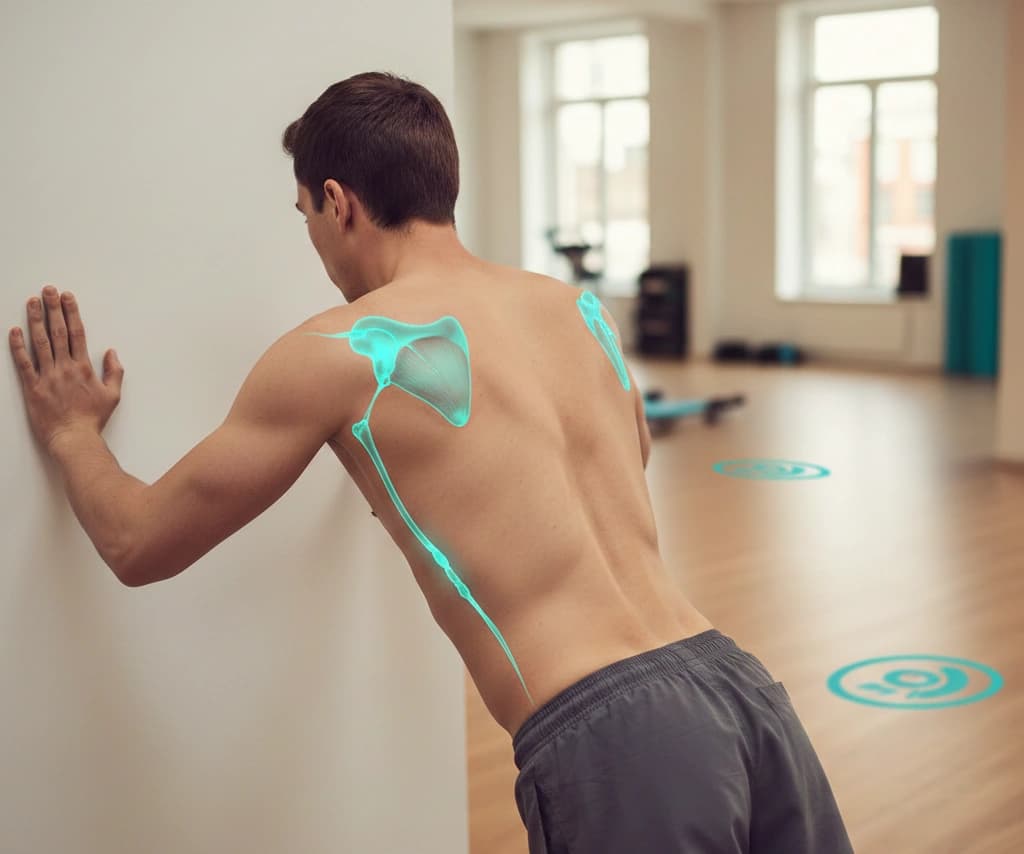
Winged scapula (scapula alata) occurs when the medial border or inferior angle of the shoulder blade lifts away from the ribcage instead of lying flat against it. In a healthy shoulder, the scapula glides smoothly along the thoracic wall during arm movements. When winging is present, the scapula loses this stability and tilts or rotates outward.
Anatomy: The Key Players
Understanding the muscles involved helps clarify why winging occurs:
-
Serratus anterior: This is the primary muscle responsible for holding the scapula against the ribcage. It originates on the upper eight or nine ribs and inserts along the entire medial border of the scapula. When it contracts, it protracts (pulls forward) and upwardly rotates the scapula. Weakness in the serratus anterior is the most common cause of winged scapula.
-
Long thoracic nerve: This nerve innervates the serratus anterior. It runs a long, superficial course from the cervical spine (C5-C7) along the chest wall, making it vulnerable to stretch injuries and compression. Damage to this nerve leads to serratus anterior paralysis and medial winging.
-
Trapezius (middle and lower fibers): The middle and lower trapezius retract and depress the scapula. Weakness here, often from spinal accessory nerve dysfunction, can cause lateral winging where the scapula shifts outward.
-
Rhomboids: These muscles work with the middle trapezius to retract the scapula. While less commonly the primary cause, rhomboid weakness can contribute to poor scapular positioning.
Types of Scapular Winging
-
Medial winging: The medial (inner) border of the scapula lifts off the ribcage. This is the most common type and is typically caused by serratus anterior weakness or long thoracic nerve palsy.
-
Lateral winging: The inferior angle or lateral border protrudes. This is less common and is usually associated with trapezius weakness or spinal accessory nerve injury.
Self-Assessment: Do You Have Winged Scapula?
Before starting a corrective program, it helps to confirm whether scapular winging is actually present. Here are three simple tests you can perform at home:
1. Wall Push-Up Test
- Stand facing a wall at arm's length.
- Place both hands on the wall at shoulder height.
- Slowly perform a push-up against the wall.
- Have someone observe your shoulder blades from behind, or film yourself.
- What to look for: If one or both shoulder blades lift away from your ribcage as you push, that indicates winging.
2. Standing Observation
- Stand relaxed with arms at your sides.
- Have someone look at your back from behind.
- What to look for: One or both shoulder blades visibly protruding, particularly along the medial border. Compare left and right sides.
3. Forward Flexion Test
- Stand with arms at your sides.
- Slowly raise both arms forward and overhead.
- Have someone watch from behind.
- What to look for: The scapula should upwardly rotate and stay flush against the ribcage. If it wings outward during the movement, the serratus anterior is likely underperforming.
Note: Mild asymmetry between left and right scapulae is normal. Winging that is visible at rest, occurs with light movements, or causes pain or weakness warrants attention.
Common Causes of Winged Scapula
1. Weak Serratus Anterior
This is the most frequent cause in calisthenics athletes. The serratus anterior is often underdeveloped because many pushing exercises (standard push-ups, bench press) do not challenge the full range of scapular protraction. Without deliberately training the "plus" portion of a push-up—where the shoulder blades spread apart at the top—the serratus anterior remains weak.
2. Long Thoracic Nerve Injury
The long thoracic nerve can be damaged by:
- Repetitive overhead movements (common in sports and manual labor)
- Direct trauma to the chest or shoulder
- Carrying heavy loads on the shoulders (e.g., heavy backpacks)
- Surgical procedures near the chest wall
- Viral infections (Parsonage-Turner syndrome)
Nerve-related winging typically presents suddenly and may be accompanied by noticeable weakness in overhead pushing.
3. Poor Push-Up and Pressing Form
Performing push-ups with the shoulder blades pinched together (retracted) throughout the entire movement prevents the serratus anterior from activating at the top of the press. Over time, this creates a pattern where the scapula never learns to protract under load.
4. Muscle Imbalances
Tight pectoralis minor muscles can anteriorly tilt the scapula, while weak lower trapezius and rhomboids fail to provide adequate posterior stabilization. This combination creates a dysfunctional scapular position that mimics or worsens winging.
5. Thoracic Spine Stiffness
A rigid upper back limits scapular movement. When the thoracic spine cannot extend or rotate properly, the scapula compensates by winging away from the ribcage during arm movements.
Corrective Exercises for Winged Scapula
The following exercises target the serratus anterior, lower trapezius, and scapular stabilizers. Start with the easier variations and progress as strength improves.
1. Serratus Punches (Scapular Protraction)
This is the single most important exercise for fixing winged scapula. It isolates the serratus anterior in its primary action: protracting the scapula.
How to perform:
- Lie on your back with knees bent and one arm extended straight up toward the ceiling, holding a light dumbbell or no weight.
- Without bending your elbow, push your hand toward the ceiling by driving your shoulder blade forward off the floor.
- You should feel the muscles along the side of your ribcage engage.
- Slowly lower the shoulder blade back to the floor.
- Perform 3 sets of 12-15 repetitions per side.
Progression: Increase weight gradually. You can also perform this standing with a resistance band anchored behind you.
2. Push-Up Plus
This builds on the standard push-up by adding full scapular protraction at the top—the "plus" that most people skip.
How to perform:
- Start in a standard push-up position.
- Perform a push-up as normal.
- At the top, push further by spreading your shoulder blades apart and rounding your upper back slightly. Your torso should rise an extra 1-2 inches.
- Hold the protracted position for 2 seconds, then lower into the next rep.
- Perform 3 sets of 10-12 repetitions.
Regression: Perform on knees or against a wall if full push-ups are too challenging.
3. Wall Slides with Protraction
Wall slides improve scapular upward rotation and overhead mobility, and adding protraction at the top activates the serratus anterior.
How to perform:
- Stand with your back against a wall, feet about 6 inches from the wall.
- Place the backs of your hands and forearms against the wall, elbows bent at 90 degrees.
- Slowly slide your arms up the wall overhead while maintaining contact.
- At the top, push your hands into the wall and protract your shoulder blades (push them apart).
- Slowly slide back down.
- Perform 3 sets of 10-12 repetitions.
4. Bear Crawl Hold (Quadruped Protraction)
This teaches the serratus anterior to stabilize in a weight-bearing position.
How to perform:
- Start on all fours with wrists under shoulders and knees under hips.
- Lift your knees 1-2 inches off the ground.
- Push actively through your hands, spreading your shoulder blades apart so your upper back rounds slightly.
- Hold this position for 20-30 seconds while breathing normally.
- Perform 3-4 sets.
Progression: Slowly add forward and backward crawling while maintaining scapular protraction.
5. Prone Y Raises
These strengthen the lower trapezius, which works with the serratus anterior to control scapular position.
How to perform:
- Lie face down on the floor or a bench with arms hanging down.
- Raise both arms overhead at a 45-degree angle (forming a Y shape), thumbs pointing up.
- Squeeze your lower trapezius (think: pull shoulder blades down toward your hips) as you lift.
- Hold for 3 seconds at the top, then lower slowly.
- Perform 3 sets of 12-15 repetitions.
6. Banded Serratus Slide
This uses a resistance band to provide progressive resistance through scapular protraction.
How to perform:
- Loop a resistance band around your upper back, holding one end in each hand.
- Get into a push-up position (or kneeling push-up).
- Push through your hands to fully protract your shoulder blades against the band's resistance.
- Hold for 3 seconds, then relax your shoulder blades back.
- Perform 3 sets of 10-12 repetitions.
7. Forearm Wall Slides (Serratus Slide)
A gentler variation that is excellent for beginners or warm-ups.
How to perform:
- Stand facing a wall with your forearms flat against it, elbows at shoulder height.
- Slowly slide your forearms up the wall while pushing into it.
- Focus on protracting your shoulder blades (pushing them apart) as your arms rise.
- Slide back down with control.
- Perform 3 sets of 10-15 repetitions.
Stretches for Winged Scapula
Tight muscles can pull the scapula out of position. These stretches address the most common contributors to scapular winging.
1. Pec Minor Stretch (Doorway Stretch)
A tight pectoralis minor anteriorly tilts and downwardly rotates the scapula, worsening winging.
How to perform:
- Stand in a doorway with your forearm against the frame, elbow at 90 degrees and slightly above shoulder height.
- Step forward with one foot until you feel a stretch deep in the front of your shoulder and upper chest.
- Keep your core engaged—do not arch your lower back.
- Hold for 30-45 seconds, then switch sides.
- Perform 2-3 times per side.
Tip: Raising your elbow higher targets the lower fibers of the pec minor more effectively.
2. Levator Scapulae Stretch
The levator scapulae elevates and downwardly rotates the scapula. When tight, it restricts the upward rotation needed for healthy overhead movement.
How to perform:
- Sit or stand tall.
- Turn your head 45 degrees to the right (looking toward your armpit).
- Drop your chin toward your chest.
- Place your right hand gently on the back of your head to increase the stretch.
- You should feel the stretch on the back-left side of your neck, near the shoulder blade.
- Hold for 30 seconds, then switch sides.
- Perform 2-3 times per side.
3. Thoracic Spine Extension (Foam Roller)
A stiff thoracic spine limits scapular movement and contributes to compensatory winging.
How to perform:
- Place a foam roller perpendicular to your spine at mid-back level.
- Lie back over the roller with knees bent and feet flat on the floor.
- Support your head with your hands behind your neck.
- Gently extend backward over the roller, opening your chest toward the ceiling.
- Hold for 5 seconds, then return to neutral.
- Move the roller up or down slightly and repeat at 3-4 different positions along your mid-back.
- Perform 10-15 total extensions.
4. Lat Stretch (Side-Lying or Doorway)
Tight latissimus dorsi can restrict scapular upward rotation and protraction.
How to perform:
- Stand next to a doorframe and grab it with your near hand at about head height.
- Step away and let your body lean, feeling a stretch along the side of your torso and under your arm.
- Rotate your torso slightly away from the door to deepen the stretch.
- Hold for 30 seconds, then switch sides.
- Perform 2-3 times per side.
5. Cat-Cow for Thoracic Mobility
This classic movement mobilizes the entire spine and encourages scapular protraction and retraction through their full range.
How to perform:
- Start on all fours with wrists under shoulders and knees under hips.
- Inhale: Drop your belly, lift your chest and tailbone, and let your shoulder blades retract (cow position).
- Exhale: Round your spine fully, tuck your chin, and push your shoulder blades apart as far as possible (cat position).
- Move slowly through 10-15 cycles, emphasizing maximum protraction during the cat phase.
Programming: 4-Week Corrective Routine
Consistency is key. This program progresses from activation and awareness (weeks 1-2) to loaded strengthening (weeks 3-4). Perform the routine 4-5 days per week.
Weeks 1-2: Activation and Mobility
Goal: Wake up the serratus anterior, improve thoracic mobility, release tight muscles.
Daily routine (15-20 minutes):
- Foam roller thoracic extensions: 10-15 reps across 3-4 positions
- Cat-cow with emphasis on protraction: 15 cycles
- Pec minor doorway stretch: 30 seconds x 2 per side
- Levator scapulae stretch: 30 seconds x 2 per side
- Serratus punches (no weight): 3 x 15 per side
- Forearm wall slides: 3 x 12
- Bear crawl hold: 3 x 20-second holds
Weeks 3-4: Strengthening and Integration
Goal: Build serratus anterior strength under load, integrate scapular control into compound movements.
Daily routine (20-25 minutes):
- Foam roller thoracic extensions: 10 reps across 3 positions
- Pec minor doorway stretch: 30 seconds x 2 per side
- Levator scapulae stretch: 30 seconds x 2 per side
- Serratus punches (with light dumbbell or band): 3 x 12 per side
- Push-up plus: 3 x 10-12
- Wall slides with protraction: 3 x 10
- Prone Y raises: 3 x 12
- Banded serratus slide: 3 x 10
- Bear crawl hold: 3 x 30-second holds
Beyond Week 4
Once winging visually improves and you can maintain scapular protraction during push-ups:
- Continue performing push-up plus as a warm-up before pressing workouts.
- Incorporate serratus punches 2-3 times per week as maintenance.
- Focus on proper scapular mechanics during all pushing and overhead movements.
- Reassess every 4 weeks using the wall push-up test.
Integrating Scapular Health into Calisthenics Training
Fixing winged scapula is not just about isolated corrective exercises—it also requires adjusting how you perform your regular calisthenics movements.
Push-Ups
Always complete the full range of motion, including full protraction at the top. If you've been doing push-ups with pinched shoulder blades, this will feel unfamiliar at first. The serratus anterior should fire at the top of every rep.
Handstands
Active shoulders in a handstand means pushing the floor away and protracting the scapulae. Practice elevated protraction holds (feet on a box, hands on the floor, push the floor away) to build this pattern.
Dips
Allow the shoulder blades to protract naturally at the bottom of a dip rather than forcefully pinching them together. Focus on controlled depression and protraction throughout the range.
Plank Variations
Planks offer an excellent opportunity to train scapular protraction under load. Push the floor away actively rather than sinking between your shoulder blades. This applies to forearm planks, high planks, and planche progressions.
When to See a Doctor
While most cases of winged scapula respond to conservative treatment, certain presentations require medical evaluation:
- Sudden onset: Winging that appears suddenly after an injury, surgery, or illness may indicate nerve damage requiring medical assessment.
- Progressive weakness: If overhead pushing or lifting becomes increasingly difficult despite consistent corrective work, consult a professional.
- Pain: Scapular winging itself is often painless, but associated shoulder pain, neck pain, or radiating symptoms (numbness, tingling) down the arm warrant evaluation.
- No improvement after 6-8 weeks: If a structured corrective program produces no visible improvement, a physical therapist or orthopedic specialist can assess for nerve involvement or structural issues.
- Bilateral winging: Winging that affects both shoulder blades simultaneously is less common and may indicate a systemic condition.
A healthcare professional may use electromyography (EMG) or nerve conduction studies to determine whether the long thoracic nerve or spinal accessory nerve is involved. In rare cases of confirmed nerve injury that does not recover, surgical options such as nerve transfer or muscle transfer (pectoralis major transfer) may be considered.
Conclusion
Winged scapula is a common but fixable condition for most calisthenics athletes. The root cause is usually a weak serratus anterior that fails to anchor the shoulder blade against the ribcage. By systematically strengthening this muscle through serratus punches, push-up plus variations, and protraction-focused exercises—while releasing tight pectorals and improving thoracic mobility—you can restore proper scapular mechanics and eliminate winging.
Start with the 4-week corrective routine outlined above, be consistent, and pay attention to your scapular position during every pushing and overhead movement. Progress takes time, but most people see meaningful improvement within 4-8 weeks of dedicated work. If symptoms persist or worsen, seek evaluation from a qualified physical therapist or sports medicine professional. Your shoulder health is the foundation for everything you do in calisthenics—invest in it now.
FAQ
How long does it take to fix winged scapula?
Most people with muscular (non-neurological) scapular winging see noticeable improvement within 4-8 weeks of consistent corrective exercise. Full resolution may take 3-6 months depending on the severity and how well you integrate proper scapular mechanics into your regular training.
Can I still train calisthenics with winged scapula?
Yes, but you should modify your training. Avoid exercises that aggravate the condition or reinforce poor scapular positioning. Focus on full protraction during push-ups, reduce overhead volume temporarily if it causes pain, and prioritize your corrective routine alongside regular training.
Is winged scapula painful?
Scapular winging itself is often painless, especially in mild cases. However, the underlying dysfunction can lead to secondary issues such as shoulder impingement, rotator cuff strain, and neck tension, which can cause pain over time.
What causes winged scapula in calisthenics athletes?
The most common cause is serratus anterior weakness from not training full scapular protraction during pushing movements. Athletes who perform push-ups with shoulder blades pinched together, or who neglect protraction-focused exercises, are particularly susceptible.
Do I need surgery for winged scapula?
Surgery is rarely needed. It is typically reserved for cases where nerve damage (long thoracic nerve palsy) has been confirmed and does not recover after 12-24 months of conservative treatment. The vast majority of calisthenics-related scapular winging resolves with targeted strengthening exercises.
🎓 Want to become a certified instructor?
Learn the science behind it with our FREE Calisthenics Instructor Certification: anatomy, kinesiology and program design in 15 lessons. Create a free account and earn your certificate!