

Pull-Up Muscles Worked: Complete Anatomy Guide for Athletes
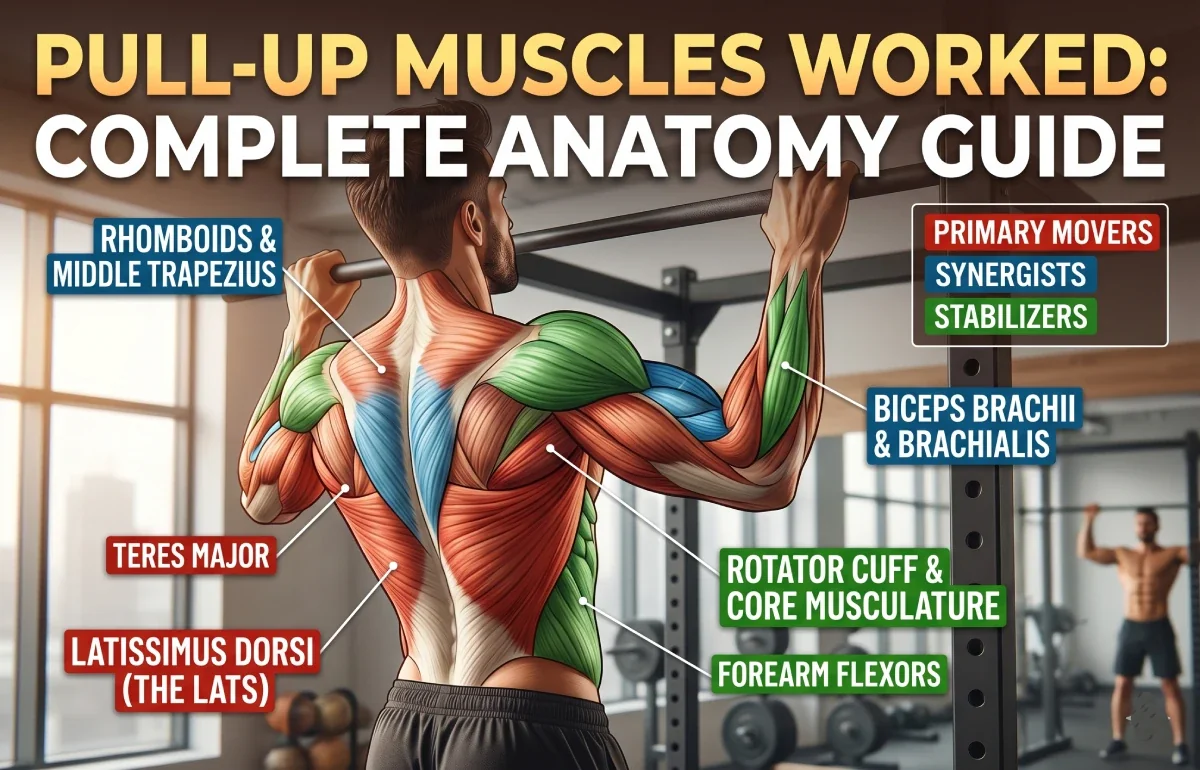
The pull-up is arguably the most revealing exercise in calisthenics — it demands coordinated strength from nearly every muscle above your waist. Understanding the pull-up muscles worked during each phase of the movement gives you the blueprint to train smarter, fix weak links, and unlock advanced skills like muscle-ups and one-arm pull-ups. This anatomy guide breaks down every muscle group involved, from the powerhouse latissimus dorsi to the smallest stabilizers in your rotator cuff.
Whether you're chasing your first rep or refining advanced variations, knowing which tissues produce force (and which hold everything together) is the foundation of efficient progression.
Primary Pull-Up Muscles Worked: The Prime Movers
The bulk of force during a pull-up comes from a handful of large, powerful muscles. These prime movers generate the pulling action that lifts your bodyweight vertically.
Latissimus Dorsi (The Lats)
The latissimus dorsi is the undisputed star of the pull-up. This large, fan-shaped back muscle originates along your thoracolumbar fascia and inserts on the humerus, meaning it directly pulls your arm down and back toward your torso — exactly the motion of a pull-up. Well-developed lats create the coveted V-taper physique and produce most of the upward force during each rep.
Biceps Brachii and Brachialis
Your biceps flex the elbow while the brachialis — a deeper muscle often overlooked — contributes significant elbow flexion force. Grip orientation changes their contribution: chin-ups (supinated grip) load the biceps more heavily, while pull-ups (pronated grip) shift emphasis toward the brachialis and back.
Teres Major
Often called the "lat's little helper," the teres major assists in shoulder extension and adduction. It's a key pull-up muscle worked throughout the concentric phase.
Secondary Pull-Up Muscles Worked: Synergists and Assistants
Beyond the prime movers, several synergists contribute to the movement and become more involved as you progress to advanced variations.
Rhomboids and Middle Trapezius
These scapular retractors pull your shoulder blades together, creating the strong, packed position needed at the top of the pull-up. Without adequate rhomboid and mid-trap strength, the bar-to-chest position feels impossible.
Lower Trapezius
The lower traps depress the scapulae — a critical action for healthy shoulder mechanics. Weak lower traps are a common reason athletes experience shoulder pain during pulling work.
Posterior Deltoids
The rear delts contribute to shoulder extension and horizontal abduction, particularly during wide-grip variations and archer pull-ups. Our guide on pull-up variations from beginner to advanced explores how different grips shift emphasis across these muscles.
Pectoralis Major (Sternal Head)
Surprisingly, the lower fibers of your chest assist in shoulder extension during the pulling phase. This is why strong pullers often have well-developed chests even without dedicated pressing work.
Stabilizing Pull-Up Muscles Worked: The Supporting Cast
The stabilizers don't move your body through space, but they keep your joints safe and your force transmission efficient. Neglecting them is how most pull-up injuries begin.
Rotator Cuff
The four rotator cuff muscles (supraspinatus, infraspinatus, teres minor, subscapularis) stabilize the glenohumeral joint throughout the entire rep. They're small but non-negotiable for longevity.
Core Musculature
Your rectus abdominis, obliques, and transverse abdominis prevent excessive lumbar extension and keep the body in a rigid, efficient line. Hollow-body positioning dramatically improves force transfer — the stronger your core, the more of your pulling force reaches the bar.
Forearm Flexors and Grip
Your flexor digitorum profundus, flexor carpi ulnaris, and surrounding forearm musculature keep you attached to the bar. Grip endurance is often the first thing to fail, especially during high-volume sets or weighted work.
How Grip Variations Change the Pull-Up Muscles Worked
Different grips redistribute muscular demand:
- Pronated (overhand): emphasizes lats, teres major, brachialis, and rear delts
- Supinated (chin-up): increases biceps contribution and allows slightly more load
- Neutral: balances the two and is typically the most shoulder-friendly
- Wide grip: biases the upper lats and reduces biceps involvement
- Close grip: shifts emphasis toward the lower lats and arms
Understanding these shifts helps you build a complete program. The science of calisthenics muscle hypertrophy explains how to apply these variations for maximum muscle growth.
Training Applications for Calisthenics Athletes
Knowing the pull-up muscles worked is only useful if you apply it. Here's how to translate anatomy into results:
- Fix weak links first. If you stall in the bottom half, strengthen scapular control with dead hangs and scapular pulls. If you plateau at the top, prioritize bicep and mid-back work.
- Progressive overload matters. Whether you're a beginner tackling the 8-week plan to get your first pull-up or ready to commit to a 30-day pull-up program to go from zero to 10 reps, consistent load increases are non-negotiable.
- Add weight once bodyweight is easy. A structured weighted pull-up program for strength accelerates hypertrophy and creates elite-level pulling capacity.
- Balance pulling with pressing. Shoulder health depends on training antagonists equally.
Conclusion: Train the Whole Chain
The pull-up isn't a single-muscle exercise — it's a full-chain movement that recruits your back, arms, shoulders, core, and forearms in precise coordination. When you understand every pull-up muscle worked, you can diagnose sticking points, design smarter programs, and build a body that performs as impressively as it looks.
Want to coach others and deepen your mastery of human movement? Explore our Anatomy, Kinesiology, and Calisthenics Instructor Certification courses to build the expertise that sets elite trainers apart.
🎓 Want to become a certified instructor?
Learn the science behind it with our FREE Calisthenics Instructor Certification: anatomy, kinesiology and program design in 15 lessons. Create a free account and earn your certificate!