

Best Home Workout Equipment for Calisthenics in 2026 (Tested & Ranked)
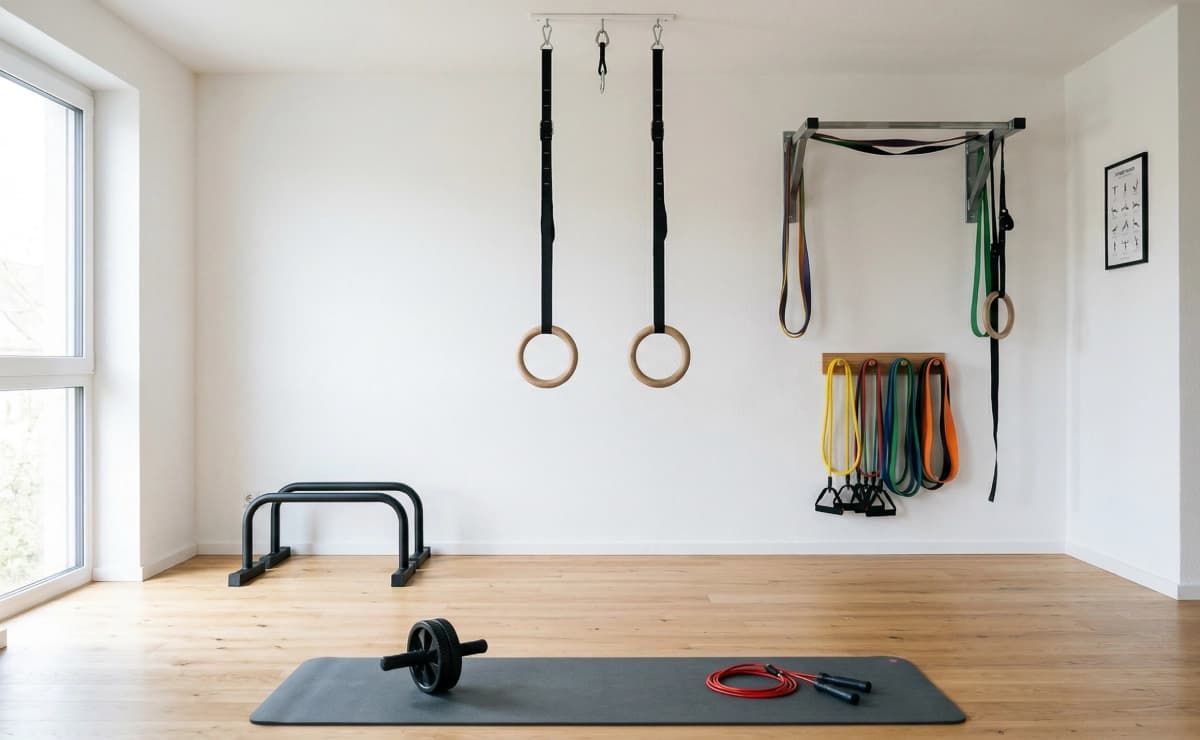
Disclosure: This post contains affiliate links. If you purchase through these links, we may earn a small commission at no extra cost to you. We only recommend equipment we genuinely stand behind.
Calisthenics is built on the idea that your body is the only machine you need. And that's true — you can build serious strength with zero equipment. But a handful of well-chosen tools can dramatically expand what's possible at home, unlock harder progressions faster, and reduce injury risk along the way.
This guide cuts through the noise. We evaluated each piece of equipment based on biomechanical value, build quality, space efficiency, and return on investment — the same standards we apply in our Calisthenics Instructor Certification. Whether you're a complete beginner or an advanced athlete chasing muscle-ups and planche progressions, there's something here for every level.
What to Look for Before You Buy
Before we get into recommendations, keep these principles in mind:
- Movement pattern coverage: Good equipment fills gaps in your bodyweight training — typically pulling movements, which are hard to train without any tools.
- Progressive overload potential: The best tools grow with you. Avoid single-use gadgets that cap out at beginner level.
- Space and portability: Most home athletes are working with limited space. Compact, multi-use tools win every time.
- Joint safety: Cheap equipment with poor grip, unstable bases, or incorrect angles puts your wrists, elbows, and shoulders at risk.
1. Pull-Up Bar — The Non-Negotiable
Best for: Pull-ups, chin-ups, hanging leg raises, scapular pulls, bar muscle-up progressions
If there is one single piece of equipment every calisthenics athlete needs, it's a pull-up bar. Horizontal pulling is the most undertrained movement pattern in bodyweight training, and no amount of floor work replaces it.
Doorframe Pull-Up Bar (Wall-Mounted Style)
A wall-mounted or door-frame pull-up bar is the most space-efficient option available. Look for one with multiple grip positions (wide, narrow, neutral) to vary muscle recruitment across the back, biceps, and rear deltoids.
What to look for:
- Weight capacity of at least 150 kg (330 lbs) for safety margin
- Foam or rubber grip padding to protect the wrists
- Multiple grip angles — neutral grip (palms facing each other) is especially joint-friendly for beginners
→ Check price and reviews on Amazon
Freestanding Pull-Up Station
If you can't mount anything into a wall, a freestanding power tower gives you pull-ups, dips, and knee raises in one footprint. They're bulkier but excellent value for apartment athletes.
→ Check price and reviews on Amazon
Coach's Note: New to pull-ups? Start with scapular pulls and dead hangs before attempting full reps. This builds the shoulder stability that protects your rotator cuff — something we cover in depth in our Rotator Cuff Prevention Guide.
2. Gymnastic Rings — The Most Versatile Tool You'll Ever Own
Best for: Ring dips, ring rows, ring push-ups, muscle-ups, front lever progressions, support holds
Gymnastic rings are the single highest-value purchase a calisthenics athlete can make after a pull-up bar. Unlike fixed bars, rings are unstable by design — this instability forces your stabilizer muscles (especially the shoulder girdle and core) to work overtime, producing greater muscle activation with lower absolute load.
Research consistently shows that ring exercises like ring push-ups and ring dips produce significantly higher muscle activation in the pectorals, triceps, and anterior deltoid compared to their fixed-surface equivalents.
What to look for:
- Wooden rings (32 mm diameter) for optimal grip and wrist comfort — plastic can become slippery when your hands sweat
- Adjustable straps of at least 4.5 m (15 ft) to hang from pull-up bars, beams, or trees
- Load-rated buckles — look for a tested capacity of 300 kg or higher
→ Check price and reviews on Amazon
Beginner tip: Start with ring rows and ring push-ups with feet on the floor before moving to dips. The instability is deceptive — even athletes who can do 20 floor push-ups often find ring push-ups humbling on day one.
3. Parallettes — Unlock Your Pushing Progressions
Best for: L-sit, tuck planche, push-up variations, handstand work, dip progressions
Parallettes (also called "p-bars" or "dip bars") elevate your hands off the floor, giving you two critical advantages: wrist-neutral positioning and greater range of motion in pushing movements.
Floor push-ups force the wrists into 90° extension, which becomes a limiting factor for many athletes. Parallettes allow a more neutral wrist angle, reducing joint stress and letting you train longer without discomfort. They also allow your chest to dip below hand level, increasing pec stretch and muscle recruitment.
For L-sits and planche progressions, parallettes are simply essential — floor variations limit hip clearance and compress the wrists uncomfortably.
Low Parallettes (Floor Level)
Ideal for L-sits, planche work, and push-up variations. Keep them under 20 cm in height for the most stability.
→ Check price and reviews on Amazon
High Parallettes (Dip Height)
Better for dip progressions, pseudo-planche push-ups, and athletes who struggle with wrist flexibility. Height of 40–50 cm is the sweet spot.
→ Check price and reviews on Amazon
4. Resistance Bands — The Most Underrated Training Tool
Best for: Assisted pull-ups, band pull-aparts, face pulls, mobility work, warm-up activation
Resistance bands are frequently dismissed as "beginner tools." That's a mistake. Elite calisthenics athletes use them daily — not just for assistance, but for band pull-aparts, shoulder health maintenance, and as accommodating resistance to overload the strong end of a movement's range.
Their greatest value for home athletes is assisted pull-up training. Looping a band around the bar and placing your knee or foot in it allows you to do full pull-up volume before you have the strength for unassisted reps — which research shows is the most effective way to build toward your first unassisted pull-up.
What to look for:
- A set of multiple resistance levels (light, medium, heavy, extra heavy)
- 100% latex construction for durability
- Flat loop style (not tube-style) for bar work
→ Long loop bands (pull-up assist) on Amazon
→ Short loop bands (mobility & activation) on Amazon
5. Ab Wheel — Core Strength You Can't Fake
Best for: Rollouts, pike rollouts, plank holds, core anti-extension training
The ab wheel rollout is one of the most effective core exercises in existence — and it directly transfers to calisthenics skills like the front lever, planche, and hollow body hold. Unlike crunches or sit-ups, rollouts train anti-extension, which is how the core functions in virtually every real athletic movement.
If you're working toward a front lever or any advanced static hold, rollout training belongs in your program.
What to look for:
- Wide wheel base for stability at beginner level
- Rubber grip handles to protect the wrists
- Non-slip wheel coating for use on hardwood or tile
→ Check price and reviews on Amazon
Programming note: Start with kneeling rollouts. Only progress to standing rollouts once you can fully extend and return without your lower back dropping.
6. Jump Rope — The Forgotten Conditioning Tool
Best for: Cardiovascular conditioning, coordination, warm-up, double-unders
Calisthenics athletes often neglect conditioning. A jump rope solves this in the smallest possible footprint. A 10-minute jump rope session burns roughly as many calories as an 8-minute mile run, while also developing coordination, ankle stiffness, and timing — qualities that directly transfer to plyometric calisthenics movements.
For 2026, weighted jump ropes and speed cables have become accessible at every price point.
What to look for:
- Adjustable cable length (size it to your height — when you stand on the centre of the rope, handles should reach your armpits)
- Ball-bearing handle rotation for smooth double-unders
- A weighted option (150–300 g) if you want to build shoulder endurance simultaneously
→ Check price and reviews on Amazon
7. Yoga / Exercise Mat — The Foundation of Floor Work
Best for: Stretching, mobility work, floor push-ups, core exercises, warm-up and cool-down
You don't need an expensive mat — but you do need a good one. A thin, slippery mat causes hand and foot sliding during push-up variations, disrupts balance in mobility work, and provides inadequate joint cushioning for kneeling movements.
What to look for:
- Minimum 6 mm thickness for joint cushioning
- Non-slip textured surface (top and bottom)
- At least 180 cm × 60 cm — larger is better for tall athletes
- Easy to clean (sweat-resistant coating)
→ Check price and reviews on Amazon
8. Foam Roller — Recovery That Actually Works
Best for: Self-myofascial release, thoracic mobility, hip flexor work, pre-training activation
Tight hip flexors and restricted thoracic mobility are the two most common movement limiters we see in calisthenics athletes at every level (see our guides on tight hip flexors and anterior pelvic tilt). A foam roller, used for 5–10 minutes before training, consistently improves range of motion and reduces post-training soreness.
What to look for:
- High-density EVA foam — softer rollers compress quickly and lose effectiveness
- Textured surface (grid or knobbed) for deeper tissue work
- 90 cm length for full thoracic spine coverage
→ Check price and reviews on Amazon
Quick Reference: Equipment by Goal
| Goal | Must-Have | Nice to Have |
|---|---|---|
| First pull-up | Pull-up bar, Resistance bands | Gymnastic rings |
| Muscle-up | Pull-up bar, Gymnastic rings | — |
| L-sit / Planche | Parallettes, Ab wheel | Gymnastics rings |
| Front lever | Pull-up bar, Ab wheel | Resistance bands |
| General strength (beginner) | Pull-up bar, Resistance bands, Mat | Parallettes |
| General strength (intermediate) | Pull-up bar, Rings, Parallettes | Ab wheel, Jump rope |
| Mobility & Recovery | Mat, Foam roller | Resistance bands |
Budget Breakdown
You don't need everything at once. Here's how to build your setup progressively:
Starter kit (~$50–80): Pull-up bar + Resistance bands + Exercise mat
Intermediate kit (~$150–200): Add Gymnastic rings + Ab wheel + Foam roller
Full home gym (~$250–350): Add Parallettes + Jump rope + Freestanding dip station
Final Thoughts
The best equipment is the equipment you'll actually use consistently. Start simple — a pull-up bar and a set of resistance bands will unlock more progress than a room full of machines gathering dust. As your training advances and you start chasing skills like the muscle-up, L-sit, or front lever, add tools that specifically serve those progressions.
Every piece of equipment in this guide has a clear biomechanical purpose. None of it is filler. Buy what fits your current level, train consistently, and revisit this list as your goals evolve.
Want to take your training further? Our free Calisthenics Certification covers programming, progressive overload, anatomy, and coaching methodology — everything you need to train smarter and reach your goals faster.
Related reading:
🎓 Want to become a certified instructor?
Learn the science behind it with our FREE Calisthenics Instructor Certification: anatomy, kinesiology and program design in 15 lessons. Create a free account and earn your certificate!