

Rotator Cuff Exercises for Calisthenics Athletes: Prevention & Strengthening
The rotator cuff is the group of four muscles that stabilize the shoulder joint. In calisthenics, these muscles work under enormous demand — every pull-up, push-up, dip, ring movement, and handstand requires them to function correctly. When they're weak or imbalanced, the shoulder joint becomes unstable and vulnerable to impingement, tendon tears, and chronic pain.
This isn't theoretical. Rotator cuff injuries are the most common upper body injury in calisthenics, particularly as athletes progress to rings, muscle-ups, and overhead pressing variations. The good news: they're largely preventable with the right training.
The Four Rotator Cuff Muscles
Understanding what each muscle does explains why targeted training is necessary:
- Supraspinatus: Initiates shoulder abduction (arm raising to the side); most commonly injured in impingement
- Infraspinatus: External rotation; primary target in most shoulder prehab programs
- Teres Minor: External rotation and adduction; works alongside infraspinatus
- Subscapularis: Internal rotation; the largest and strongest of the four; often neglected
Most calisthenics athletes have strong internal rotators (push-ups, dips develop subscapularis and pectoralis) and relatively weak external rotators (infraspinatus, teres minor). This imbalance is what causes impingement and eventual injury.
Why Calisthenics Loads the Rotator Cuff Heavily
Unlike machine-based gym work, calisthenics movements are largely unstable. When you do a ring push-up, the rings can move in any direction — the rotator cuff has to actively stabilize the glenohumeral joint throughout. Ring dips, ring push-ups, and planche work create exceptional rotator cuff demands. This is actually good for development, but only if the foundation is already there.
Beginners who jump into ring training without rotator cuff strength are the most at-risk group for injury. If you're also experiencing shoulder pain during push-ups or pressing movements, see our dedicated guide to fixing shoulder pain in push-ups.
8 Essential Rotator Cuff Exercises
Add these to your warm-up (exercises 1–4) and as supplemental work after training (exercises 5–8).
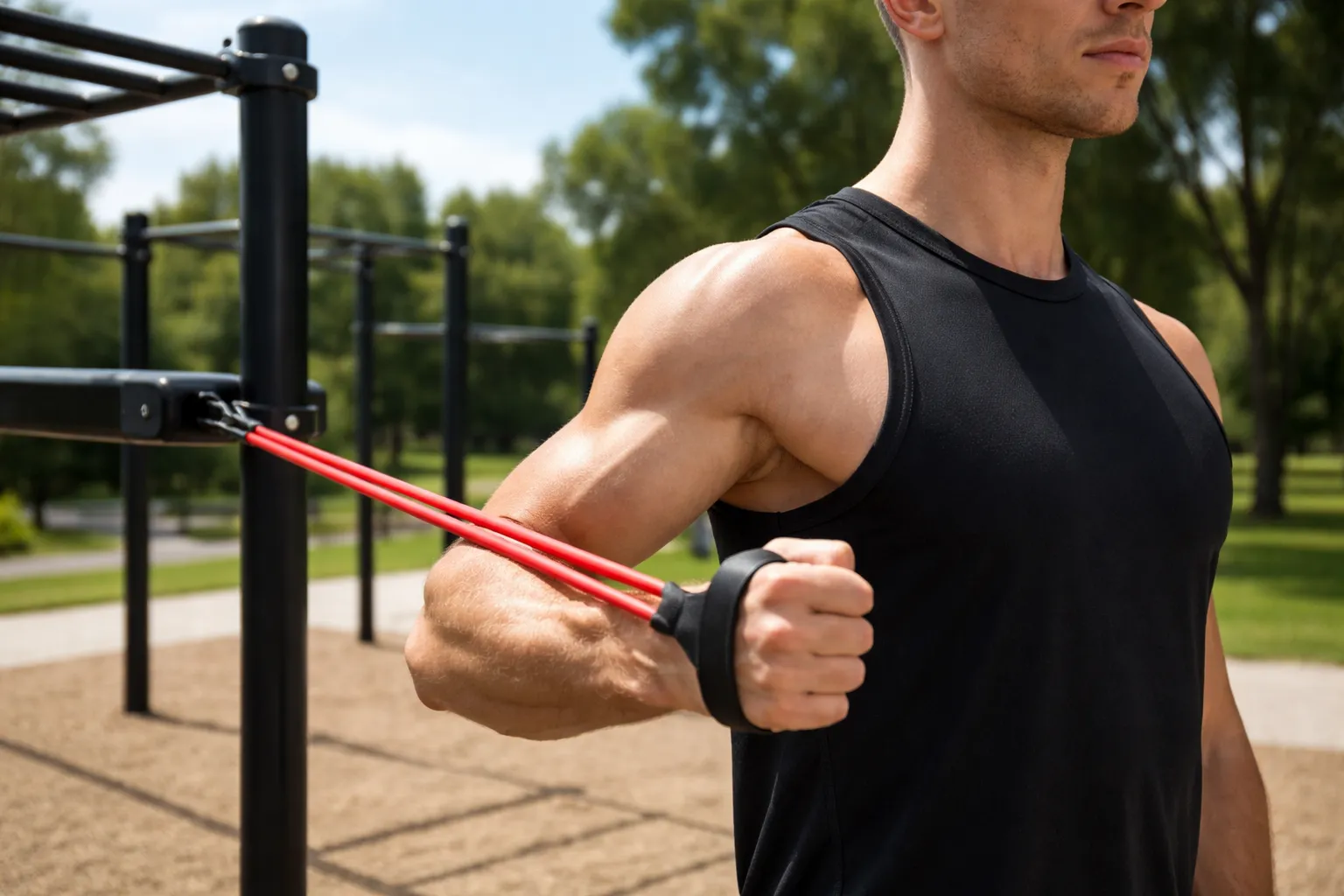
1. Band External Rotation (Elbow at Side)
The most fundamental rotator cuff exercise. Targets infraspinatus and teres minor.
- Attach a light resistance band at elbow height
- Stand sideways to the anchor, elbow bent at 90°, upper arm pinned to your side
- Hold a small towel between your elbow and side (keeps the upper arm fixed)
- Rotate forearm away from your body (externally), return with control
- 3 × 15–20 reps each arm, light resistance — this is not a strength exercise, it's a patterning and endurance exercise
2. Band External Rotation (Arm at 90° Abduction)
Targets the infraspinatus and supraspinatus in the position they're most functional for overhead work.
- Attach band at shoulder height
- Stand sideways, raise arm to shoulder height, elbow bent at 90° (goalpost position)
- Rotate forearm upward (external rotation) from pointing forward to pointing toward ceiling
- Return with control
- 3 × 12–15 reps each side
3. Face Pulls
Trains the posterior rotator cuff, rear delts, and external rotators simultaneously — one of the best shoulder health exercises available.
- Use a band anchored at head height or slightly higher
- Pull toward your face with elbows flared high (think: pulling the band apart toward your ears)
- At end position, hands should be at ear level with elbows above shoulders
- External rotate maximally at end range
- 3 × 20–25 reps, light-moderate resistance, every training day
Face pulls are so effective that many coaches recommend doing them every single session.
4. Wall Slides
Combines shoulder external rotation, serratus activation, and thoracic extension in one movement. Perfect pre-workout prep.
- Stand with back flat against a wall, arms at 90° (goalpost)
- Keeping forearms against the wall, slide arms overhead as far as possible without losing wall contact
- Return slowly
- 2 × 10 reps
If your forearms can't maintain wall contact, your thoracic spine and shoulder external rotation range need work — do this daily.
5. Side-Lying External Rotation
The isolated, strength-building version. Important for building actual rotator cuff muscle hypertrophy.
- Lie on your side, lower arm folded under your head
- Hold a light dumbbell (1–4 kg) with the top arm, elbow bent at 90°, upper arm against your side
- Rotate the forearm up toward the ceiling, hold 1 second
- Lower slowly over 3 seconds
- 3 × 12 reps each side, 2–3× per week
The slow eccentric is where most of the rotator cuff strengthening happens — don't rush the return.
6. Cuban Press
A complex exercise that trains the full rotator cuff through combined external rotation and overhead pressing. Used extensively by gymnasts and overhead athletes.
- Hold light dumbbells (2–4 kg), arms at sides
- Raise elbows to shoulder height (like an upright row)
- Rotate forearms up to 90° (externally rotate — elbows stay at shoulder height)
- Press straight overhead
- Reverse the motion
- 3 × 8–10 reps
Don't go heavy — the value is in full range rotator cuff activation, not load.
7. Prone Y-T-W
Targets the entire rotator cuff plus lower/middle trapezius.
- Lie face down on the floor or a bench
- Y position: Arms overhead at 30° angle, thumbs pointing up, lift off floor and hold 2 seconds
- T position: Arms directly out to sides, thumbs pointing up, lift and hold 2 seconds
- W position: Elbows bent at 90°, pull back like a rowing motion, hold 2 seconds
- 3 rounds through all three positions, 10 reps each
8. Sleeper Stretch (Posterior Capsule)
Tight posterior shoulder capsule is extremely common in pushing-dominant athletes and causes anterior humeral head migration — the exact mechanism of impingement.
- Lie on your side, bottom arm extended at shoulder height
- Bend the bottom elbow to 90°, forearm pointing up
- Use the top hand to gently push the forearm down (internally rotating the shoulder)
- You feel a deep stretch in the back of the shoulder
- Hold 30–45 seconds each side
- 3 rounds per side, daily if needed
Note: Only do this if you have limited shoulder internal rotation (test: scratch the back test — difficulty reaching upper back). If your internal rotation is already fine, skip it.
The 2-Minute Daily Shoulder Routine
For athletes who train daily, this minimum routine done every day prevents the cumulative imbalance that leads to injury:
- Band external rotation (elbow at side): 20 reps each arm
- Face pulls: 25 reps
- Wall slides: 10 reps
That's it. 2 minutes. The athletes who do this consistently almost never develop chronic shoulder problems.
Programming: Where These Fit
Pre-workout (warm-up): Exercises 1, 3, 4 (band external rotation, face pulls, wall slides)
Post-workout (supplemental work): Exercises 5, 6, 7 (2–3× per week)
Daily mobility: Exercise 8 (sleeper stretch, if needed)
Full shoulder prehab session (1× per week, 15 minutes): All 8 exercises in sequence
Signs Your Rotator Cuff Needs Attention
Address these proactively before they become injuries:
- Shoulder clicking or grinding during arm circles or pull-ups
- Pain at the front of the shoulder during the bottom of a dip or push-up
- Weakness or inability to raise the arm to the side against resistance
- Upper trap constantly tight despite massage — this is often the upper trap compensating for weak rotator cuff
- Difficulty sleeping on one shoulder (sign of impingement)
The Training Volume Balance
The most important preventive measure is volume balance: match your pushing with pulling. For a broader look at shoulder injury prevention and rehabilitation within a structured program, our Calisthenics Injury Prevention & Rehabilitation course covers the full picture.
For every push-up or dip rep, do an equivalent pulling rep (row, pull-up, face pull). When pressing volume significantly exceeds pulling volume for months or years, rotator cuff imbalances become structural problems — not just training issues.
Many calisthenics athletes who develop shoulder injuries have a 3:1 or 4:1 push-to-pull ratio. The target is 1:1, and ideally slightly more pulling than pushing.
Summary
The rotator cuff is the foundation of all upper body calisthenics. Four muscles, each with a specific role, working together to stabilize the shoulder under high load and through unstable, dynamic movements. Band external rotation, face pulls, and the Y-T-W exercise — done consistently 3–5× per week — are the core of any calisthenics shoulder health program. Start this work before you have pain. Once a tear occurs, the rehabilitation path is significantly longer and harder.
🎓 Want to become a certified instructor?
Learn the science behind it with our FREE Calisthenics Instructor Certification: anatomy, kinesiology and program design in 15 lessons. Create a free account and earn your certificate!