

Golfer's Elbow vs Tennis Elbow: Which Do You Have?
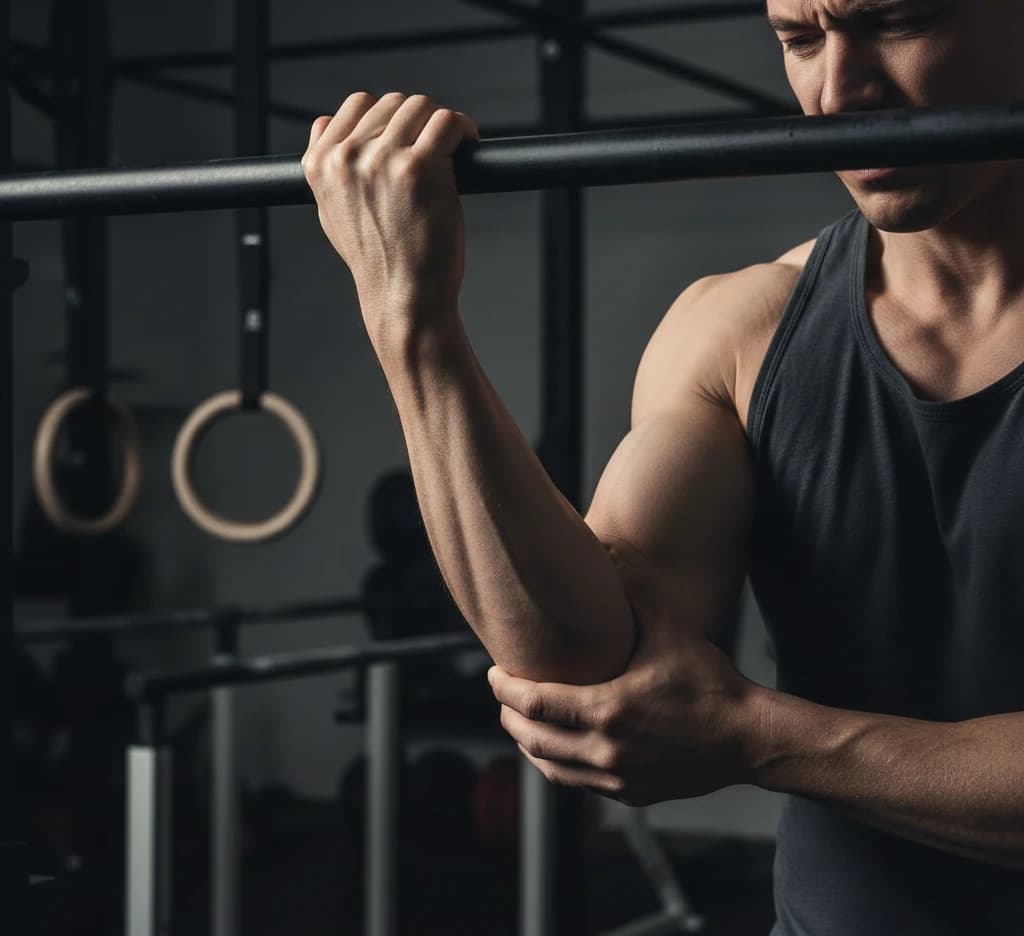
Golfer's Elbow vs Tennis Elbow: Which Do You Have?
You're midway through your pull-up set when you feel it—that nagging pain in your elbow that's been getting progressively worse. You've heard other athletes talk about "tennis elbow" and "golfer's elbow," but you're not sure which one you're dealing with. Does it even matter?
Yes, it absolutely matters. While both conditions are forms of elbow tendinopathy, they affect different parts of your elbow, are caused by different movements, and require different treatment approaches. Misidentifying your condition can lead to ineffective treatment and prolonged recovery time.
This guide will help you understand the key differences between golfer's elbow and tennis elbow, identify which one you're likely dealing with, and provide targeted treatment and prevention strategies specifically for calisthenics athletes.
Understanding the Anatomy
Before diving into the differences, it helps to understand the basic anatomy of the elbow. Your elbow is where three bones meet: the humerus (upper arm bone), radius, and ulna (the two forearm bones). On either side of the lower humerus are two bony bumps called epicondyles—and these are where the trouble starts.
The Lateral Epicondyle (outer elbow) serves as the attachment point for the forearm extensor muscles. These muscles extend your wrist and fingers.
The Medial Epicondyle (inner elbow) serves as the attachment point for the forearm flexor muscles. These muscles flex your wrist and fingers.
When these attachment points become irritated and inflamed from repetitive stress, you develop epicondylitis—the medical term for what we commonly call tennis elbow or golfer's elbow.
Tennis Elbow (Lateral Epicondylitis): The Outer Elbow Problem
Tennis elbow affects the lateral (outer) side of the elbow. Despite its name, you don't need to play tennis to develop it. The condition occurs when the extensor tendons that attach to the lateral epicondyle become damaged from repetitive gripping and wrist extension movements.
How Tennis Elbow Occurs in Calisthenics
In calisthenics, tennis elbow commonly develops from:
Overgrip Pull-Up Variations When you perform pull-ups with an overhand (pronated) grip, your forearm extensors work constantly to stabilize the wrist against the bar. High-volume pull-up training—especially programs that emphasize daily pull-ups or "grease the groove" protocols—can overload these tendons.
Muscle-Up Training The transition phase of the muscle-up places enormous stress on the forearm extensors. As you rotate over the bar, your wrists must rapidly extend while bearing significant load. Athletes who drill muscle-up transitions repeatedly are particularly susceptible.
Front Lever Progressions Holding a front lever requires intense grip engagement with the arms in full extension. The straight-arm position combined with sustained gripping stress specifically targets the extensor tendons.
Straight-Arm Strength Work Exercises like planche leans, L-sits, and back levers all require maintaining tension through extended arms while gripping. This combination is a recipe for lateral elbow stress.
False Grip Training While false grip primarily stresses the medial elbow, athletes who transition between regular and false grip frequently may develop lateral issues from the constant grip adjustment and wrist positioning.
Symptoms of Tennis Elbow
- Pain on the outside of the elbow, specifically over the lateral epicondyle
- Pain that worsens when gripping objects or making a fist
- Weakness when lifting or carrying items with the palm facing down
- Pain when extending the wrist against resistance (like pushing your hand down on a table)
- Discomfort when shaking hands
- Pain that may radiate down the outer forearm
- Tenderness when pressing directly on the lateral epicondyle
- Stiffness in the elbow, particularly in the morning
Golfer's Elbow (Medial Epicondylitis): The Inner Elbow Problem
Golfer's elbow affects the medial (inner) side of the elbow. It occurs when the flexor tendons that attach to the medial epicondyle become damaged from repetitive gripping and wrist flexion movements. Interestingly, golfer's elbow is often more common than tennis elbow among calisthenics athletes.
How Golfer's Elbow Occurs in Calisthenics
In calisthenics, golfer's elbow commonly develops from:
Chin-Ups and Underhand Grip Work The supinated (underhand) grip places significant stress on the forearm flexors. Your wrist flexors engage strongly to maintain grip position, and the biceps' insertion point near the medial elbow adds additional stress to the area.
Ring Training Rings require constant grip adjustment and stabilization. The instability demands continuous engagement of the forearm flexors. Ring dips, muscle-ups, and support holds all stress the medial elbow.
False Grip Work The false grip—essential for strict muscle-ups on rings—requires sustained wrist flexion against load. This position directly targets the forearm flexors and their attachment at the medial epicondyle.
Rope Climbing Each time you grip and pull on a rope, your forearm flexors fire intensely. The repetitive nature of rope climbing, combined with the full-body load, makes it a significant contributor to golfer's elbow.
Planche Progressions While planche stresses the entire arm, the forward lean and wrist position heavily engage the forearm flexors. Athletes spending significant time on planche leans and tuck planche holds often develop medial elbow pain.
High-Volume Dip Training During dips, your forearm flexors stabilize the wrist and help control the descent. Heavy dip volume, especially weighted dips, can overload these tendons.
Symptoms of Golfer's Elbow
- Pain on the inside of the elbow, specifically over the medial epicondyle
- Pain that may radiate down the inner forearm toward the wrist
- Weakness when gripping, especially when turning doorknobs or shaking hands
- Pain when flexing the wrist against resistance (like curling your wrist toward you)
- Stiffness in the elbow with difficulty fully extending the arm
- Numbness or tingling in the ring and pinky fingers (when the ulnar nerve is involved)
- Tenderness when pressing directly on the medial epicondyle
- Pain when making a fist
Quick Self-Diagnosis Tests
While these tests don't replace professional diagnosis, they can help you identify which condition you're likely dealing with.
Tests for Tennis Elbow
Cozen's Test
- Extend your affected arm straight in front of you, palm facing down
- Make a fist
- Have someone press down on top of your fist while you resist
- Pain at the lateral (outer) epicondyle indicates likely tennis elbow
Mill's Test
- Extend your affected arm in front of you
- Flex your wrist so your palm faces your body
- Fully extend your elbow
- Pain at the lateral epicondyle during this stretch indicates likely tennis elbow
Chair Lift Test
- Stand behind a chair
- Place your hands on the top of the chair back with palms facing down
- Try to lift the chair straight up using only arm strength
- Pain on the outer elbow indicates likely tennis elbow
Tests for Golfer's Elbow
Reverse Cozen's Test
- Extend your affected arm straight in front of you, palm facing up
- Make a fist
- Have someone push up against the bottom of your fist while you resist by flexing your wrist
- Pain at the medial (inner) epicondyle indicates likely golfer's elbow
Golfer's Elbow Stretch Test
- Extend your affected arm in front of you
- Extend your wrist so your palm faces away from you
- Use your other hand to gently pull your fingers back toward you
- Pain at the medial epicondyle during this stretch indicates likely golfer's elbow
Resisted Wrist Flexion Test
- Place your forearm on a table, palm facing up
- Let your wrist hang off the edge
- Have someone resist while you try to curl your wrist upward
- Pain at the inner elbow indicates likely golfer's elbow
Side-by-Side Comparison
| Aspect | Tennis Elbow | Golfer's Elbow |
|---|---|---|
| Location | Outside (lateral) elbow | Inside (medial) elbow |
| Medical term | Lateral epicondylitis | Medial epicondylitis |
| Affected tendons | Forearm extensors | Forearm flexors |
| Aggravating grip | Overhand/pronated | Underhand/supinated |
| Pain with | Wrist extension | Wrist flexion |
| Common calisthenics causes | Pull-ups, muscle-ups, front lever | Chin-ups, rope climbs, false grip |
| Prevalence in calisthenics | Common | More common |
Treatment Approaches
While both conditions are tendinopathies and share some treatment principles, there are important differences in how you should approach each one.
Phase 1: Acute Management (Days 1-7)
For both conditions:
Relative Rest Stop exercises that cause pain, but don't stop moving entirely. Tendons need controlled loading to heal—complete rest can actually delay recovery.
Ice Application Apply ice for 15-20 minutes, 3-4 times daily to reduce pain and inflammation. Wrap ice in a thin cloth to protect your skin.
Compression An elbow sleeve or compression band can help reduce swelling and provide support.
Modify Activities Continue training with pain-free exercises. Focus on lower body work, core training, and movements that don't aggravate the elbow.
Phase 2: Early Rehabilitation (Weeks 1-3)
Isometric Exercises
Isometrics are crucial for tendon healing. They reduce pain, maintain strength, and begin the rehabilitation process without creating the tissue damage that can occur with dynamic movements.
For Tennis Elbow:
- Wrist Extension Isometric: Rest your forearm on a table with your hand hanging off the edge, palm down. Press the back of your hand against the underside of the table (or have someone provide resistance from above). Hold for 30-45 seconds. Perform 3-5 sets, 2-3 times daily.
For Golfer's Elbow:
- Wrist Flexion Isometric: Rest your forearm on a table with your hand hanging off the edge, palm up. Press your palm against the underside of the table (or have someone provide resistance from below). Hold for 30-45 seconds. Perform 3-5 sets, 2-3 times daily.
Soft Tissue Work
- Gentle massage of the forearm muscles (not directly on the painful tendon)
- Use a lacrosse ball to work out trigger points in the forearm
- Focus on the muscle bellies, not the attachment points
Phase 3: Progressive Loading (Weeks 3-6)
Eccentric Exercises
Eccentric (lowering) exercises are the gold standard for tendinopathy rehabilitation. They stimulate collagen remodeling and tendon strengthening.
For Tennis Elbow—Tyler Twist:
- Hold a FlexBar (or rolled towel) in front of you
- Grip it with your affected arm, wrist extended
- Twist the bar with your non-affected hand while holding the affected wrist still
- Slowly release the twist, allowing your affected wrist to move into flexion
- Perform 3 sets of 15 reps, twice daily
For Tennis Elbow—Eccentric Wrist Extension:
- Support your forearm on a table, palm facing down, wrist hanging off
- Use your other hand to lift a light dumbbell (1-3 lbs) into wrist extension
- Slowly lower the weight over 5 seconds
- Perform 3 sets of 15 reps daily
For Golfer's Elbow—Reverse Tyler Twist:
- Hold a FlexBar in front of you
- Grip it with your affected arm, wrist flexed
- Twist the bar with your non-affected hand
- Slowly release, allowing your affected wrist to extend
- Perform 3 sets of 15 reps, twice daily
For Golfer's Elbow—Eccentric Wrist Curl:
- Support your forearm on a table, palm facing up, wrist hanging off
- Use your other hand to lift a light dumbbell into wrist flexion
- Slowly lower the weight over 5 seconds
- Perform 3 sets of 15 reps daily
Phase 4: Return to Training (Weeks 6+)
Gradual Reintroduction
Start with exercises that place minimal stress on the affected area:
Week 6-7 (50% volume):
- Australian rows (reduce grip intensity)
- Band-assisted pull-ups or chin-ups
- Modified push-ups
- Avoid direct stress on the healing tendon
Week 7-8 (70% volume):
- Bodyweight rows with varied grips
- Partial range pull-ups/chin-ups
- Standard push-ups
- Monitor for pain response
Week 8+ (Progressive return):
- Full range movements
- Gradually reintroduce challenging variations
- Continue monitoring 24 hours post-training
The 24-Hour Rule
After each training session, assess your elbow the next day:
- No increased pain: Continue progressing
- Mild increase that settles quickly: Maintain current level
- Significant or lasting pain: Reduce intensity and volume
Exercises to Avoid and Modify
During Recovery from Tennis Elbow
Avoid:
- High-volume overhand pull-ups
- Muscle-up transitions
- Front lever holds
- Straight-arm pressing movements
- Heavy grip work
Modify:
- Switch to neutral or underhand grips for pulling
- Use straps temporarily to reduce grip stress
- Reduce total pulling volume by 50%
- Break up sets with longer rest periods
- Avoid training to failure on pulling movements
During Recovery from Golfer's Elbow
Avoid:
- Chin-ups and underhand grip work
- False grip training
- Rope climbing
- Ring muscle-ups
- Heavy dips
Modify:
- Switch to overhand or neutral grips for pulling
- Use a standard grip instead of false grip
- Reduce ring work or switch to bar exercises
- Lower dip volume and avoid weighted dips
- Focus on push-ups instead of dips initially
Prevention Strategies
Once you've recovered—or ideally, before you ever develop these conditions—implement these prevention strategies.
1. Proper Warm-Up Protocol
Before every upper body session:
Joint Preparation (2-3 minutes)
- Wrist circles: 15 each direction
- Elbow circles: 15 each direction
- Forearm rotations (pronation/supination): 15 each
Blood Flow Work (3-4 minutes)
- Band pull-aparts: 20 reps
- Light band curls: 15 reps
- Light band tricep extensions: 15 reps
- Wrist flexion/extension with light band: 15 each
Specific Preparation (3-4 minutes)
- Wall push-ups: 15 reps
- Scapular pull-ups: 10 reps
- Dead hangs: 30 seconds
- Gradually increase grip intensity
2. Smart Volume Management
The 10% Rule Never increase weekly training volume by more than 10%. Tendons adapt more slowly than muscles—what feels manageable muscularly may be overwhelming your tendons.
Deload Weeks Schedule deload weeks every 4-6 weeks. Reduce volume by 40-50% while maintaining intensity. This allows accumulated tendon stress to dissipate.
Vary Your Grips Don't perform the same grip pattern day after day:
- Monday: Overhand grip focus
- Wednesday: Neutral grip focus
- Friday: Underhand grip focus
This distributes stress across different tendon attachments.
3. Forearm Balance Work
Many calisthenics athletes overdevelop their forearm flexors relative to their extensors. This imbalance increases injury risk.
Include These Exercises Weekly:
Reverse Wrist Curls
- Light dumbbell, 3x15-20 reps
- Slow, controlled movement
- Targets forearm extensors
Wrist Roller
- Roll in both directions
- 2-3 sets to fatigue
- Excellent for overall forearm development
Finger Extensions with Rubber Band
- Place band around all fingers
- Spread fingers against resistance
- 3x20 reps
- Balances grip-heavy training
Pronation/Supination Work
- Hold hammer or weighted bar by the handle
- Rotate forearm slowly in each direction
- 3x15 each direction
4. Recovery Practices
Sleep Aim for 7-9 hours. Tendon healing primarily occurs during sleep.
Rest Between Sessions Allow 48-72 hours between intense upper body sessions targeting the same movement patterns.
Nutrition Adequate protein intake (1.6-2.2g/kg body weight) supports tendon repair. Consider collagen supplementation, which some research suggests may support tendon health.
Hydration Tendons require adequate hydration to maintain their viscoelastic properties. Stay well-hydrated throughout the day.
Long-Term Elbow Health: Building Resilient Tendons
Once you've recovered, your goal should be building elbows that are more resilient than before.
Graduated Exposure Progressively expose your tendons to increasing loads over time. This stimulates adaptation and strengthening.
Maintain Balance Continue your forearm balance work even when healthy. Prevention is always easier than treatment.
Listen to Early Warnings Minor discomfort is a signal. Address it immediately with reduced volume and targeted exercises rather than waiting for a full-blown injury.
Periodize Your Training Build in phases of lower intensity and volume. Continuous high-intensity training without breaks leads to accumulated tendon stress.
When to Seek Professional Help
Consult a sports medicine doctor or physical therapist if:
- Pain persists beyond 4-6 weeks of self-treatment
- You experience numbness or tingling in your fingers
- There's visible swelling, redness, or warmth
- Pain is severe or suddenly worsens
- You can't perform basic daily activities
- Pain occurred after a specific traumatic event
- Symptoms affect both elbows simultaneously
A healthcare professional can provide accurate diagnosis (including ruling out other conditions), advanced treatments like corticosteroid injections or shockwave therapy, and personalized rehabilitation programs.
Conclusion
Both golfer's elbow and tennis elbow can sideline a calisthenics athlete for weeks or months—but they don't have to. By understanding which condition you're dealing with, you can target your treatment effectively and return to training faster.
Key Takeaways:
- Location matters: Tennis elbow affects the outer elbow; golfer's elbow affects the inner elbow
- Grip patterns matter: Overhand grips stress the lateral side; underhand grips stress the medial side
- Treatment differs: Use the appropriate eccentric exercises for your specific condition
- Prevention is essential: Implement warm-up protocols, volume management, and forearm balance work
- Be patient: Tendons heal slower than muscles—respect the process
Remember that these conditions develop over time through accumulated stress, and they recover the same way—gradually, with consistent effort. Take the time to identify your specific condition, follow the appropriate treatment protocol, and implement prevention strategies to keep your elbows healthy for years of training ahead.
Ready to learn more about training safely and effectively? Explore our certification courses to master proper technique and injury prevention from industry experts.