

How to Fix Ankle Stiffness for Pistol Squats and Deep Squats
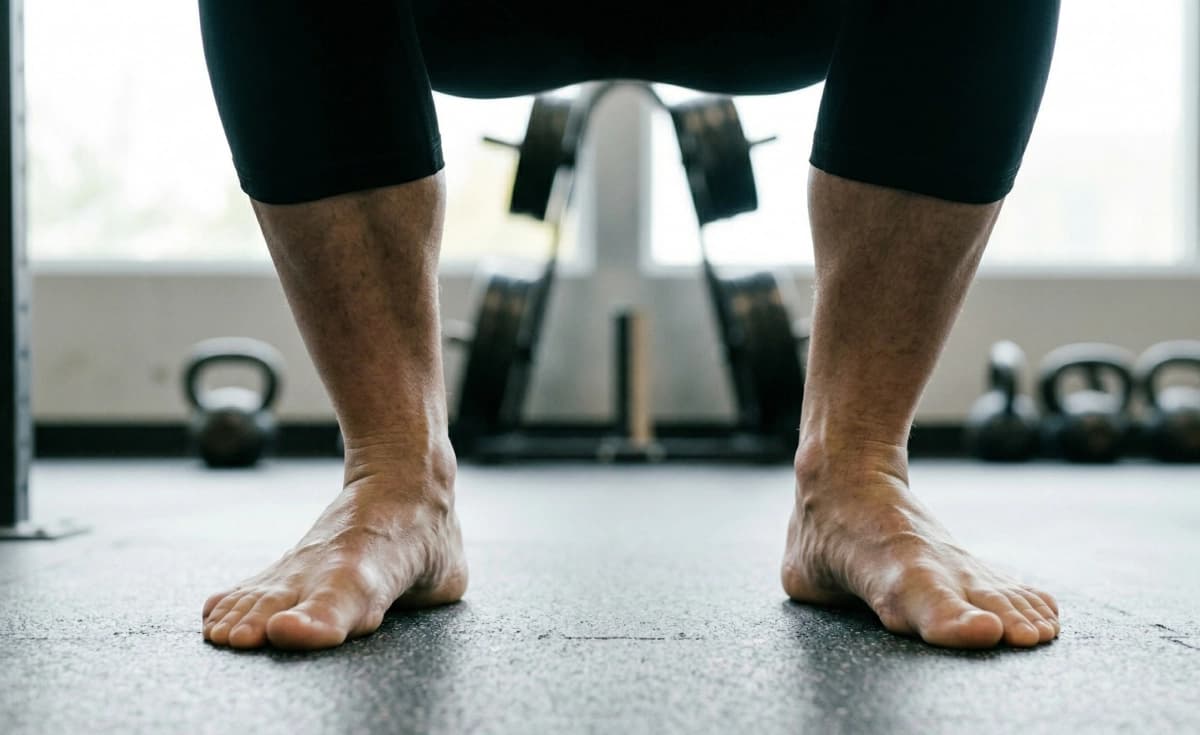
If you've tried pistol squats or deep bodyweight squats and your heel comes up, your knee dives inward, or you feel like you're going to fall backward, ankle stiffness is almost certainly the cause. Ankle dorsiflexion — the ability to move your shin forward over your foot — is one of the most critical and most neglected mobility requirements in calisthenics.
This guide explains exactly what's limiting you and gives you a concrete daily protocol to fix it.
What Is Ankle Dorsiflexion and Why Does It Matter?
Dorsiflexion is the motion where your toes come toward your shin (the opposite of pointing your foot). When you squat, your shin must travel forward over your foot. The ankle joint must allow this — if it doesn't, something else has to compensate.
The chain of compensation:
- Limited ankle dorsiflexion
- Heel lifts OR knee caves inward (valgus)
- Increased forward lean of the torso
- Excessive stress on the lower back, knees, and hips
For a pistol squat specifically, you need the knee of your working leg to track well forward of your toes while your heel stays flat on the floor. (For more on knee mechanics and fixing knee pain during squatting, see our guide to fixing knee pain while squatting.) Without at least 35–40° of dorsiflexion, this simply isn't mechanically possible.
How to Test Your Ankle Dorsiflexion
The Wall Test
- Stand facing a wall, one foot 10–12 cm from the base
- Keep your heel flat on the floor
- Drive your knee toward the wall (in line with your second toe, not caving inward)
- If your knee touches the wall with heel flat: adequate mobility
- If your heel lifts before your knee reaches the wall: restricted dorsiflexion
The target for pistol squats is to pass the wall test at 12–15 cm. Most beginners fail it at 8–10 cm.
Why Ankles Get Stiff
1. Tight Calf Muscles (Gastrocnemius and Soleus)
These are the most common culprits. They attach to the heel via the Achilles tendon. When shortened, they physically limit how far the shin can travel forward.
- Gastrocnemius (crosses the knee): tightens from chronic high-heel shoe use, steep stair climbing
- Soleus (doesn't cross the knee): a deeper, stiffer muscle that limits dorsiflexion even with a bent knee
2. Joint Capsule Restriction
The ankle joint has a fibrous capsule surrounding it. After ankle sprains, periods of immobilization, or just chronic under-use in a full range, this capsule can thicken and restrict range of motion. This is a joint restriction, not a muscle restriction, and it responds differently to treatment.
3. Achilles Tendon Stiffness
The Achilles tendon lacks the same extensibility as muscle. After years of low-range activities (walking, cycling, sitting), the tendon adapts to being used only in a shortened range.
4. Old Ankle Sprains
Lateral ankle sprains are the most common sports injury in the world, and they frequently leave behind restricted dorsiflexion — sometimes permanently if not properly rehabbed.
The Fix: A Daily Ankle Mobility Protocol
This takes 10–12 minutes and should be done daily (or at minimum 5× per week) to see real change.
Step 1: Soleus Stretch (Joint-Level Dorsiflexion)
Unlike the standard calf stretch, this targets the soleus and improves the joint range you actually use in squats.
- Stand in a lunge, front foot 10 cm from a wall
- Keep your front knee bent (this takes out the gastrocnemius)
- Drive your bent knee toward the wall while keeping your heel flat
- You should feel a deep stretch in the lower calf/Achilles area
- 3 × 45 seconds each ankle, daily
Step 2: Banded Ankle Mobilization (Joint Capsule)
This is critical if your restriction is joint-level (you can stretch the muscle but the ankle still doesn't move freely). A resistance band provides posterior-to-anterior force that gaps the joint.
- Loop a thick resistance band around a post at floor level
- Place the band around your ankle just below the bone
- Step forward to create tension in the band (band pulls backward on your ankle)
- Get into a lunge position with the banded foot forward
- Drive knee forward over toes while the band gaps the joint
- 2 × 15 reps each ankle, controlled movement
This is the most effective technique for restoring joint capsule mobility and is used by physiotherapists under the name "joint mobilization with movement."
Step 3: Weighted Ankle Dorsiflexion Stretch
Adds load to the stretch for deeper tissue change.
- Sit on the floor with legs straight, a light weight (2–4 kg) resting on the base of your toes
- Pull your toes back (dorsiflex) against the weight
- Or: perform the knee-to-wall drill with a light weight on your knee pushing it forward
- 3 × 60 seconds each ankle
Step 4: Eccentric Calf Raises (Heel Drops)
This conditions the Achilles tendon and calf through a full range, building both flexibility and strength.
- Stand on the edge of a step, heels off the edge
- Rise on both feet, then lower on one foot — slowly over 3–4 seconds
- Let the heel drop well below the step level (full stretch)
- 3 × 10 reps each ankle
This is also the primary treatment for Achilles tendinopathy — it works here for mobility as well as tendon health.
Step 5: Deep Squat Hold
Practice the position you're working toward.
- Stand with feet shoulder-width, toes out 30–45°
- Squat as deep as possible, hold something for balance if needed
- Work to get heels flat and achieve maximum depth
- 3 × 30–45 seconds of accumulated hold time
You can use a doorframe for balance — the goal is to spend time in the deep position and let it gradually improve.
Pistol Squat Progressions While You Build Mobility
Once your ankle mobility is sufficient, progressing through the full pistol squat requires its own structured approach. Our Pistol Squat Mastery course covers the complete progression from assisted variations to full unilateral depth.
You don't have to wait until you have perfect ankles to practice pistol squats. Use these progressions:
Heel-Elevated Pistol Squat
Place a 2.5 cm weight plate or book under your heel. This compensates for limited dorsiflexion and lets you practice the full movement pattern.
- Gradually reduce the heel elevation as mobility improves
Assisted Pistol Squat
Hold onto a door frame or TRX with one hand as you lower into the pistol. This shifts some weight to the upper body and reduces the ankle dorsiflexion requirement.
Negative Pistol Squat
Lower yourself down (slowly) from standing on one leg, sit down on a box, stand up with two legs. Trains the eccentric strength while the ankle mobility develops.
How Long Does Ankle Mobility Take to Improve?
This is the honest answer:
- Muscle tightness only: 3–4 weeks of daily stretching shows clear improvement
- Joint capsule restriction: 6–8 weeks with banded mobilization
- Post-sprain restriction: 8–12 weeks or more, especially if the original sprain was severe
- Structural bony block: This doesn't respond to soft tissue work — requires medical assessment
A good indicator that you're making progress: check your wall test distance every 2 weeks. It should be improving by 1–2 cm per 2 weeks of consistent work.
The Shoe Problem
Modern running shoes and dress shoes have a heel drop of 8–12 mm. Over years, this shortens the calf and Achilles by reducing the range they're used through. If you wear heeled shoes daily:
- Spend at least 30 minutes per day in flat shoes or barefoot
- Do ankle mobility work every day, not just on training days
- Consider transitioning to lower-drop footwear gradually over 3–6 months (too fast = Achilles tendinopathy)
Summary
Ankle stiffness blocking your pistol squats and deep squats is almost always caused by tight soleus/calves, a restricted joint capsule, or both. The banded ankle mobilization and soleus stretch are the highest-leverage tools. Do them daily, practice the squat progressions, and test your wall distance every two weeks. Most athletes see significant improvement within 4–8 weeks.
🎓 Want to become a certified instructor?
Learn the science behind it with our FREE Calisthenics Instructor Certification: anatomy, kinesiology and program design in 15 lessons. Create a free account and earn your certificate!