

How to Fix Duck Feet (External Rotation): Exercises & Stretches
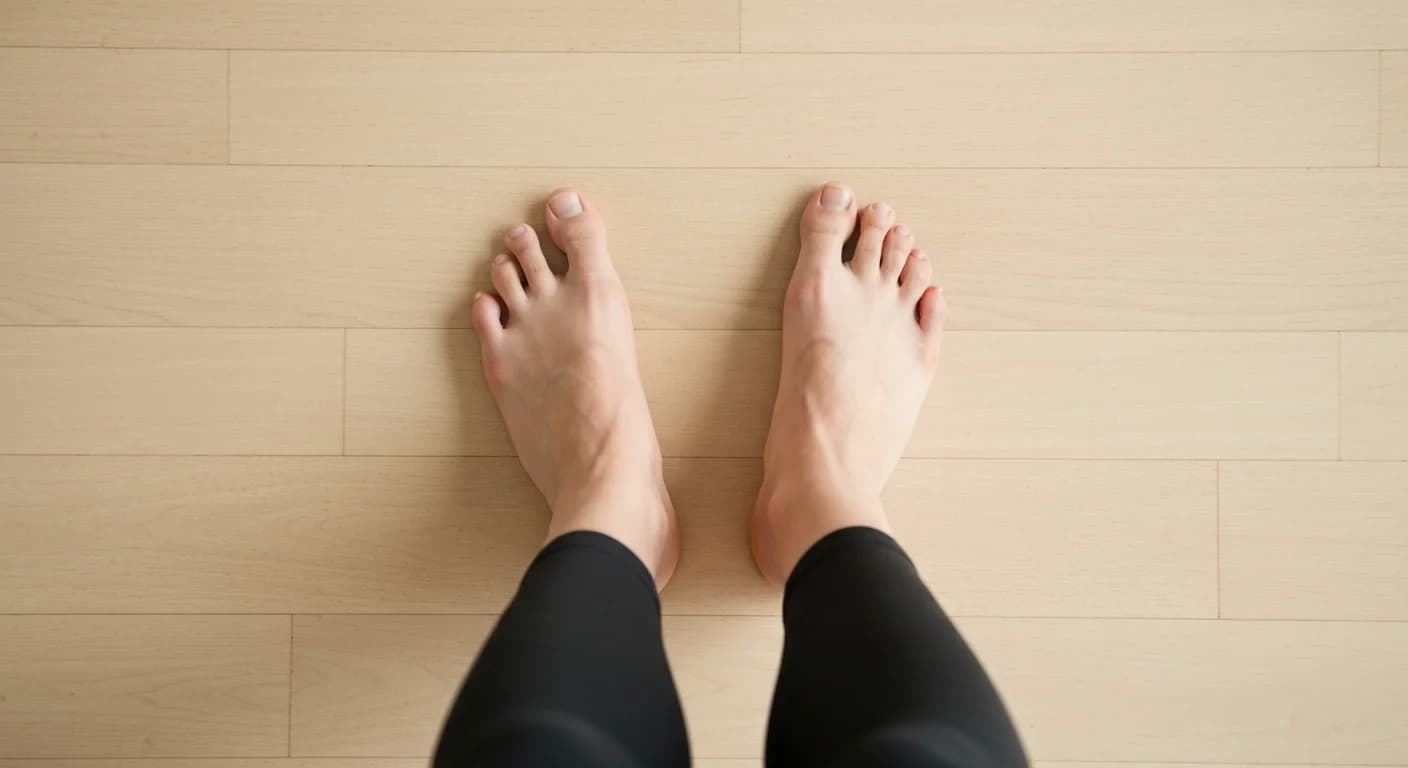
Duck feet — also called out-toeing or external foot rotation — is a postural pattern where your feet point outward when you stand or walk. While a slight outward angle (5–10 degrees) is normal, feet that splay beyond 15–20 degrees indicate an alignment issue that can affect your squat mechanics, running efficiency, and long-term joint health.
The good news: in most adults, duck feet are caused by muscular imbalances and movement habits rather than bone structure, which means targeted exercises can correct the problem. This guide covers what causes duck feet, how to assess yourself, and a complete corrective protocol you can follow at home.
What Causes Duck Feet?
Duck feet result from excessive external rotation somewhere in the kinetic chain — at the hip, tibia (shin bone), or foot itself. Understanding where your rotation is coming from is essential for choosing the right corrective approach.
Hip-Level Causes
The hip joint is the most common source of duck feet in adults:
-
Tight external hip rotators — The deep six external rotators (piriformis, obturator internus and externus, superior and inferior gemelli, and quadratus femoris) rotate the femur outward. When these muscles are chronically shortened — often from prolonged sitting with knees apart or habitual turnout — they pull the entire leg into external rotation, causing the foot to point outward.
-
Weak internal hip rotators — The gluteus medius (anterior fibers), gluteus minimus, tensor fasciae latae (TFL), and adductors contribute to internal rotation of the hip. When these muscles are weak relative to the external rotators, the hip defaults to an externally rotated resting position.
-
Tight hip flexors with external rotation bias — Chronically shortened hip flexors (particularly the iliopsoas) can alter pelvic position, and when combined with tight external rotators, they amplify the outward rotation pattern.
Tibial and Lower Leg Causes
-
External tibial torsion — The tibia can have an outward twist along its length. In adults, mild tibial torsion is common and usually not correctable through exercise, though its effects can be managed. Significant external tibial torsion (more than 30–35 degrees) is structural and may require medical evaluation.
-
Tight lateral calf structures — Tightness in the peroneal muscles (on the outside of the lower leg) can contribute to foot eversion and an outward-pointing foot position.
Foot-Level Causes
-
Pronation with compensatory toe-out — In some cases, the foot itself contributes. People with flat feet sometimes adopt an out-toed gait to create a wider base of support, compensating for poor arch stability.
-
Habitual movement patterns — Years of walking, standing, or training with externally rotated feet reinforces the neural pattern, even after the original cause has been addressed. Retraining movement patterns is a critical part of correction.
Self-Assessment: How to Check Your Foot Alignment
Before starting a corrective program, determine the severity and source of your duck feet.
Test 1: Standing Foot Angle Test
- Stand barefoot on a flat surface in your natural, relaxed stance — do not try to correct your foot position
- Have someone look at your feet from above, or take a photo
- Measure the angle between each foot and an imaginary straight line directly ahead
Interpretation:
- 0–10 degrees outward: Normal range — no correction needed
- 10–20 degrees outward: Mild duck feet — corrective exercises will help
- 20+ degrees outward: Moderate to significant — follow the full protocol below and consider professional evaluation if no improvement after 8 weeks
Test 2: Hip Rotation Range of Motion
This test determines whether tight external rotators or weak internal rotators at the hip are the primary cause.
- Lie face down on a flat surface with your knees bent to 90 degrees
- Let both lower legs fall outward (this tests internal hip rotation — the lower leg moves outward when the hip rotates inward)
- Then let both lower legs fall inward (this tests external hip rotation)
- Compare the range of motion in each direction
Interpretation:
- If your external rotation is significantly greater than your internal rotation (e.g., 50+ degrees external vs. less than 30 degrees internal), tight external rotators are likely a primary contributor
- Healthy ranges are approximately 40–45 degrees of internal rotation and 40–45 degrees of external rotation
- A significant imbalance between sides may indicate asymmetric tightness or a structural component
Test 3: The Walking Test
- Walk 15–20 steps at your normal pace along a straight line (a hallway works well)
- Film yourself from behind
- Watch how your feet land and push off
What to look for: If your feet consistently point outward during walking — particularly if the angle increases as you push off — this confirms a functional duck feet pattern. If one foot angles out significantly more than the other, the cause may be asymmetric hip tightness or a tibial torsion issue on that side.
Test 4: Tibial Torsion Check
- Sit in a chair with your knees bent at 90 degrees, feet flat on the floor
- Place your index fingers on the bony bumps on either side of each ankle (medial and lateral malleoli)
- Note the angle of the line between these two points relative to the direction of your thigh
Interpretation: The malleoli should form a line that is roughly 15–20 degrees externally rotated relative to the knee. If this angle is significantly greater (30+ degrees), you may have structural external tibial torsion, which is not correctable through exercise. In this case, focus on managing the hip component and movement retraining rather than trying to force the tibia to rotate.
When to See a Professional
Seek evaluation from a physiotherapist or orthopedic specialist if:
- Your duck feet appeared suddenly or after an injury
- You have pain in the hips, knees, or ankles associated with the rotation
- One leg is significantly more rotated than the other
- You suspect structural tibial torsion (ankle angle test above)
- No improvement after 8–12 weeks of consistent corrective exercise
How Duck Feet Affect Calisthenics Movements
Duck feet don't just look different — they create mechanical disadvantages and injury risks across your training:
-
Squats: Excessive external rotation shifts load to the outer edge of the foot and can cause the knees to track too far outward or create an unstable base. During deep squats, externally rotated femurs change the hip mechanics and reduce depth potential. Many people with duck feet compensate with anterior pelvic tilt to achieve squat depth, creating secondary issues.
-
Pistol squats: The single-leg demand exposes the rotation asymmetry. The standing leg often externally rotates as you descend, pulling the knee out of alignment and making balance significantly harder.
-
Running and walking: Out-toeing reduces push-off efficiency because force is directed laterally rather than straight ahead. This wastes energy and increases stress on the medial knee and ankle structures. Chronic duck-footed gait is associated with medial knee pain and Achilles tendon loading asymmetry.
-
Deadlifts and hip hinges: Externally rotated feet alter the position of the hips during hip hinge movements, potentially increasing stress on the SI joint and lower back.
-
Balance work: A duck-footed stance widens the base of support, which might feel more stable but actually masks underlying hip weakness. When that stability is challenged — in single-leg work, handstands, or dynamic movements — the compensations break down.
Corrective Exercises: Strengthening Internal Rotation
These exercises target the muscles responsible for internal hip rotation and hip adduction — the muscles that are typically weak in people with duck feet.
1. Side-Lying Hip Internal Rotation
Target: Internal rotators (gluteus medius anterior fibers, gluteus minimus, TFL)
- Lie on your side with hips stacked and knees bent to 90 degrees
- Keep your knees together throughout the movement
- Lift your top foot toward the ceiling by rotating at the hip — your knee stays in contact with the bottom knee as a pivot
- This is the reverse of a clamshell: the knees stay together while the feet separate
- Raise the foot as high as you can control, hold for 2 seconds, then lower slowly
Perform 3 sets of 15 reps per side, 4–5x per week. Progression: Add a resistance band around the ankles.
2. Seated Hip Internal Rotation with Band
Target: Internal hip rotators
- Sit on a chair or bench with knees bent at 90 degrees
- Loop a resistance band around one ankle, anchored to a fixed point on the same side
- Rotate your lower leg outward against the band's resistance (this internally rotates the hip — the lower leg moves outward when the hip rotates inward)
- Control the return
Perform 3 sets of 15 reps per side, 3–4x per week. Progression: Increase band resistance or add a pause at end range.
3. Quadruped Hip Internal Rotation (Fire Hydrant Reverse)
Target: Internal rotators, hip stabilizers
- Start on all fours with wrists under shoulders and knees under hips
- Keeping the knee bent at 90 degrees, rotate one thigh inward so the foot lifts toward the ceiling
- Move only at the hip — keep the pelvis stable and avoid rocking to the side
- Hold the top position for 2 seconds, then lower with control
Perform 3 sets of 12 reps per side, 3–4x per week. Progression: Add an ankle weight or resistance band.
4. Standing Internal Rotation with Band
Target: Internal rotators in a functional standing position
- Stand on one leg and loop a resistance band around the opposite ankle, anchored to a point on that same side
- Keeping the knee slightly bent, rotate the banded leg inward (the foot sweeps across the midline)
- Control the movement and avoid rotating the pelvis
- Return slowly to neutral
Perform 3 sets of 12 reps per side, 3x per week. Progression: Perform on an unstable surface to add a balance challenge.
5. Glute Medius Wall Press (Isometric)
Target: Gluteus medius (anterior fibers — internal rotation function)
- Stand sideways next to a wall, feet together
- Bend the knee closest to the wall to 90 degrees and press it firmly into the wall
- Hold for 20–30 seconds while maintaining a tall posture and level pelvis
- You should feel the outer hip of the standing leg working to stabilize, and the inner hip of the pressed leg engaging
Perform 3 sets of 20–30 second holds per side, daily. Progression: Increase hold duration to 45–60 seconds.
Stretches: Releasing Tight External Rotators
These stretches target the muscles that are pulling your legs into excessive external rotation.
6. Piriformis Stretch (Figure-Four)
Target: Piriformis, deep external rotators
- Lie on your back with both knees bent and feet flat on the floor
- Cross one ankle over the opposite knee, creating a figure-four shape
- Reach through and pull the bottom thigh toward your chest
- You should feel a deep stretch in the outer hip and glute of the crossed leg
- Hold for 45–60 seconds per side
Perform 2–3 sets per side, daily. Key cue: Keep your head and shoulders relaxed on the floor. If you can't reach your thigh, loop a towel around it.
7. 90/90 External Rotator Stretch
Target: Deep external rotators, piriformis, hip capsule
- Sit on the floor with your front leg bent at 90 degrees in front of you (shin parallel to your shoulders) and your back leg bent at 90 degrees behind you
- Sit tall and square your hips toward the front shin
- Lean your torso forward over the front shin, keeping your back straight
- You should feel a deep stretch in the outer hip of the front leg
- Hold for 45–60 seconds per side
Perform 2–3 sets per side, daily. Progression: Increase the forward lean gradually. Over time, aim to bring your chest toward the floor.
8. Supine External Rotator Stretch (Knee-to-Chest Variation)
Target: Piriformis, obturators, gemelli
- Lie on your back and pull one knee toward the opposite shoulder
- Use both hands to gently pull the knee across and up
- You should feel the stretch deep in the glute and outer hip
- Hold for 30–45 seconds per side
Perform 2–3 sets per side, daily. Key cue: Do not force the stretch — the sensation should be a deep pull, not pain.
9. Calf and Peroneal Stretch
Target: Peroneal muscles, lateral calf structures
- Stand facing a wall with one foot behind you
- Turn the back foot slightly inward (pigeon-toed) while keeping the heel on the ground
- Lean forward and bend the front knee to increase the stretch along the outer calf and shin of the back leg
- Hold for 30 seconds per side
Perform 2–3 sets per side, 3–4x per week.
Foot and Ankle Mobility Drills
10. Toe-In Walking (Conscious Gait Retraining)
Target: Movement pattern correction, neuromuscular re-education
- Walk slowly for 30–50 steps, deliberately pointing your toes straight ahead or very slightly inward
- Focus on landing with the foot aligned straight, pushing off through the big toe
- This feels exaggerated at first — that's normal
- Film yourself periodically to verify you're achieving neutral foot alignment rather than over-correcting
Perform 2–3 sets of 30–50 steps, daily. Progression: Gradually increase walking speed while maintaining neutral foot alignment. Eventually, practice this during regular walks.
Ankle Dorsiflexion Mobilization
Target: Ankle joint mobility
- Stand in a split stance facing a wall, front foot about 10 cm from the wall
- Keeping the front heel on the ground, drive the knee straight forward over the toes toward the wall — ensure the knee tracks directly over the second toe, not outward
- Hold for 2–3 seconds, return, and repeat
Perform 3 sets of 15 reps per side, daily. Key cue: During this drill, pay specific attention to preventing the knee from drifting outward, which reinforces the external rotation pattern.
Arch Strengthening (Short Foot Exercise)
If your duck feet are partially compensating for flat feet, strengthening the foot arch is essential.
- Stand or sit with your foot flat on the floor
- Without curling your toes, shorten your foot by drawing the ball of the foot toward the heel — the arch should visibly rise
- Hold for 5–10 seconds per rep
Perform 3 sets of 10 reps per foot, daily.
For a complete foot strengthening protocol, see our guide on how to fix flat feet.
Programming: Sample Corrective Routine
Daily Routine (10–15 minutes)
Stretches (perform first):
- Piriformis stretch (figure-four): 45–60 seconds x 2 per side
- 90/90 external rotator stretch: 45–60 seconds x 2 per side
- Supine external rotator stretch: 30–45 seconds x 2 per side
Strengthening:
- Side-lying hip internal rotation: 3 x 15 per side
- Glute medius wall press: 3 x 20–30 seconds per side
Movement retraining:
- Toe-in walking: 2 x 30–50 steps
3–4x Per Week (Additional 10–15 minutes)
- Seated hip internal rotation with band: 3 x 15 per side
- Quadruped hip internal rotation: 3 x 12 per side
- Standing internal rotation with band: 3 x 12 per side
- Calf and peroneal stretch: 30 seconds x 2 per side
- Ankle dorsiflexion mobilization: 3 x 15 per side
Warm-Up Integration
Incorporate these into your regular calisthenics warm-up:
- Side-lying hip internal rotation: 1 x 10 per side
- 90/90 stretch: 30 seconds per side
- Toe-in walking: 20 steps
- Bodyweight squats with deliberate neutral foot alignment: 2 x 10
When It's Structural vs. Muscular
Understanding whether your duck feet are structural or muscular determines your expectations and approach.
Muscular (Functional) Duck Feet
Characteristics:
- Foot angle improves when you consciously correct it
- Hip internal rotation range of motion is present but limited
- The pattern developed gradually over time (not present in childhood)
- May be worse on one side than the other
- Often accompanied by other postural imbalances (tight hip flexors, rounded shoulders)
Prognosis: Fully correctable with consistent exercise over 6–12 weeks. Most people see meaningful improvement within 4 weeks.
Structural Duck Feet
Characteristics:
- Significant external tibial torsion (ankle malleoli angle exceeds 30 degrees)
- Femoral retroversion (the femoral neck angles backward more than average — determined by imaging)
- Out-toeing was present from childhood and has not changed
- Cannot achieve a neutral foot position even with conscious effort
- Hip internal rotation is very limited (less than 15 degrees) even with stretching
Prognosis: The structural rotation itself cannot be changed through exercise. However, the muscular component on top of the structure can still be addressed. Many people with mild structural factors can significantly reduce their duck feet angle by correcting the muscular imbalances. The goal shifts from perfect alignment to the best alignment your structure allows.
Mixed Presentation
Most adults with duck feet fall somewhere between purely structural and purely muscular. They may have mild structural tibial torsion plus significant muscular tightness in the external rotators. In these cases, the corrective protocol will produce meaningful improvement but may not achieve perfectly straight feet — and that's completely fine. Reducing the angle from 30 degrees to 15 degrees, for example, substantially reduces mechanical stress and improves movement quality.
Timeline: What to Expect
- Weeks 1–2: Increased awareness of foot position during standing and walking; you can consciously hold a corrected position
- Weeks 3–4: Noticeable improvement in hip internal rotation range of motion; external rotators feel less tight; walking with straighter feet becomes easier
- Weeks 5–8: Visible reduction in resting foot angle; improved squat mechanics; neutral foot position begins to feel natural rather than forced
- Weeks 8–12: Significant improvement in habitual foot alignment; corrected gait pattern becomes automatic in most situations
- Months 3–6: Long-term neuromuscular adaptation; the corrected alignment is maintained without conscious effort
Consistency matters more than intensity. A 10–15 minute daily routine produces better results than sporadic longer sessions.
Common Mistakes to Avoid
-
Forcing the feet straight during squats without addressing the hip — Rotating the feet inward without correcting the hip rotation creates torque at the knee, increasing injury risk. Fix the hip first; the feet will follow.
-
Overstretching the external rotators — These muscles are important for hip stability. The goal is to restore balance between internal and external rotation, not to eliminate external rotation strength. Continue training hip external rotation alongside the corrective protocol.
-
Ignoring the asymmetry — Most people have one foot that turns out more than the other. Spend extra time stretching and strengthening the tighter/weaker side rather than treating both sides identically.
-
Expecting overnight results — Postural patterns that developed over years take weeks to months to correct. Track your progress by measuring your foot angle monthly rather than daily.
-
Neglecting gait retraining — Strengthening and stretching alone are not enough. You must consciously practice walking with neutral foot alignment until the new pattern becomes automatic. This is where most people fail — they do the exercises but don't retrain the movement.
-
Skipping the hip assessment — If your duck feet are caused by tibial torsion rather than hip rotation, focusing entirely on hip exercises will produce limited results. Use the self-assessment tests above to identify the source.
Connection to the Kinetic Chain
Duck feet don't exist in isolation — they influence and are influenced by the entire lower body and beyond:
- Knee alignment: Excessive external rotation at the hip can contribute to knock knees by altering the angle of force at the knee joint during squatting and landing
- Hip function: Tight external rotators are often paired with tight hip flexors, contributing to anterior pelvic tilt and lower crossed syndrome
- Foot health: Duck feet can mask or worsen flat feet by changing how weight is distributed across the foot
- Upper body posture: Hip rotation imbalances can drive compensations up the chain, contributing to rounded shoulders and forward head posture
If you've been working on other postural corrections but haven't addressed your foot alignment, this may be the missing link. Conversely, fixing duck feet often produces unexpected improvements in knee, hip, and lower back comfort.
Want to understand hip and lower body anatomy in depth? Check out our Anatomy & Physiology course for detailed coverage of the musculoskeletal system, including hip rotation mechanics and the kinetic chain.
Conclusion
Duck feet are one of the most common lower-body alignment issues — and for most people, one of the most correctable. The key is identifying whether the rotation is coming from the hip, the tibia, or both, and then applying the right combination of stretching (for tight external rotators), strengthening (for weak internal rotators), and movement retraining (for habitual gait patterns).
Start with the self-assessment tests to determine your foot angle and hip rotation balance. If you have functional duck feet with tight external rotators and weak internal rotators, follow the corrective protocol consistently for 8–12 weeks. Combine the targeted exercises with conscious gait retraining — this is the step most people skip, and it makes the biggest difference in long-term correction.
Your feet are the foundation of every movement you perform. When they point where they should, everything above works more efficiently.
FAQ
How long does it take to fix duck feet?
Most people with functional (muscular) duck feet see noticeable improvement within 3–4 weeks of consistent corrective exercise. Significant correction typically takes 8–12 weeks. Full integration of the new movement pattern — where neutral foot alignment is automatic — usually requires 3–6 months of practice. Structural duck feet from tibial torsion cannot be fully corrected through exercise, but the muscular component can still be improved.
Can duck feet cause knee pain?
Yes. Externally rotated feet change the alignment of forces at the knee during squatting, walking, and running. This can lead to medial knee stress, patellar tracking issues, and over time, pain on the inner side of the knee or behind the kneecap. Correcting the foot alignment often resolves or significantly reduces associated knee pain.
Are duck feet the same as flat feet?
No, they are different conditions, though they can occur together. Duck feet (out-toeing) refers to the feet pointing outward due to hip or tibial rotation. Flat feet (pes planus) refers to a collapsed medial arch. Some people develop a duck-footed gait to compensate for flat feet, and addressing both conditions together produces the best results.
Should I force my feet straight during squats?
No. Forcing the feet into a neutral position without first addressing hip mobility creates torsional stress at the knee. Instead, work on hip internal rotation mobility and external rotator flexibility first. As hip rotation improves, gradually reduce your foot angle during squats over several weeks. A small amount of toe-out (5–15 degrees) during squats is normal and biomechanically appropriate.
Is duck feet hereditary?
There can be a genetic component — particularly for structural factors like femoral retroversion or external tibial torsion. However, the majority of duck feet cases in adults are functional, resulting from muscular imbalances and movement habits. Even with a genetic predisposition to outward rotation, corrective exercise can significantly reduce the functional component.
References
- Eckhoff, D. G., Brown, A. W., Kilcoyne, R. F., & Stamm, E. R. (2007). Clinical significance of femoral anteversion. Clinical Orthopaedics and Related Research, 455, 64–67.
- Staheli, L. T. (1993). Rotational problems in children. Journal of Bone and Joint Surgery, 75(6), 939–949.
- Sahrmann, S. A. (2002). Diagnosis and Treatment of Movement Impairment Syndromes. Mosby.
- Powers, C. M. (2010). The influence of abnormal hip mechanics on knee injury: a biomechanical perspective. Journal of Orthopaedic & Sports Physical Therapy, 40(2), 42–51.
- Harris, E. J. (2010). The natural history and pathophysiology of flexible flatfoot. Clinics in Podiatric Medicine and Surgery, 27(1), 1–23.
- Souza, R. B., & Powers, C. M. (2009). Differences in hip kinematics, muscle strength, and muscle activation between subjects with and without patellofemoral pain. Journal of Orthopaedic & Sports Physical Therapy, 39(1), 12–19.
- Reiman, M. P., Bolgla, L. A., & Loudon, J. K. (2012). A literature review of studies evaluating gluteus maximus and gluteus medius activation during rehabilitation exercises. Physiotherapy Theory and Practice, 28(4), 257–268.