

How to Fix Shoulder Pain from Push-Ups: Causes and Exercises
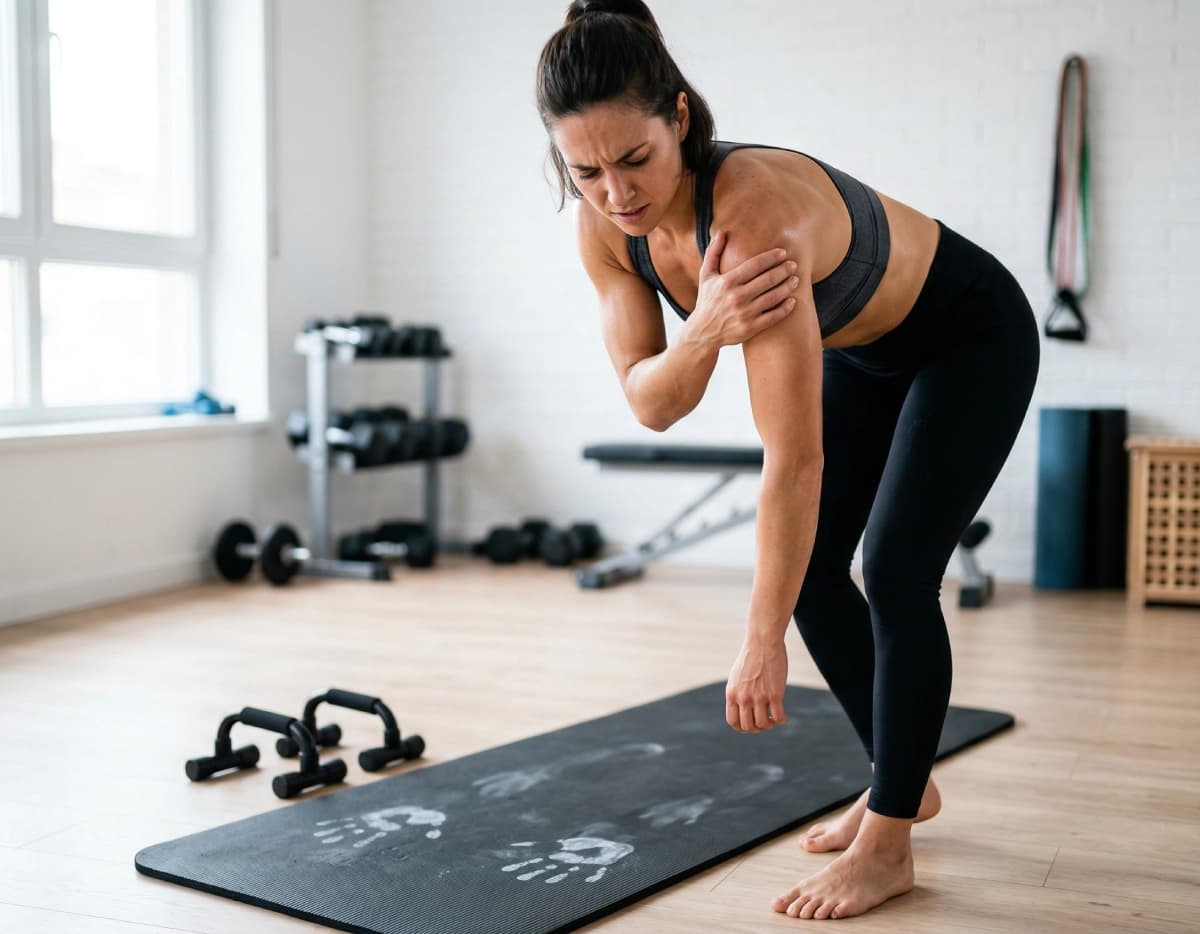
Shoulder pain during push-ups is a signal — not a reason to stop training altogether. Most cases come from identifiable mechanics issues that are entirely fixable. This guide breaks down what's actually happening, why your shoulder hurts, and how to fix it with specific exercises and form corrections.
Where Does It Hurt? (Diagnosis Matters)
Location tells you a lot about what's going on:
- Front of shoulder (anterior): Usually rotator cuff impingement or bicep tendon irritation — common when elbows flare wide
- Top of shoulder (AC joint): Acromioclavicular joint stress — often from hands too wide or collapsing at the bottom
- Deep/diffuse shoulder pain: Rotator cuff muscle strain, often from too much volume too fast
- Pain only at bottom of push-up: Classic impingement — the humeral head is being pinched under the acromion
The Most Common Causes
1. Elbows Flared Too Wide
This is the #1 cause of push-up shoulder pain. When your elbows point out at 90° from your body, the shoulder is forced into internal rotation under load — a position the rotator cuff hates. The fix is simple: tuck your elbows to 45° or less from your torso.
2. Poor Scapular Control (Winging)
If your shoulder blades aren't moving correctly through the push-up, the shoulder joint bears all the stress. At the top of a push-up, scapulae should protract (spread apart) and tip anteriorly — the serratus anterior muscle drives this. Weak serratus = winging = impingement.
3. Collapsed Core and Sagging Hips
When your hips sag, your lumbar spine extends, which changes the angle of shoulder loading and increases anterior shoulder stress. A strong plank position throughout the entire push-up is non-negotiable.
4. Training Volume Too High
Even with perfect form, too many push-ups (especially daily max sets) will inflame the rotator cuff tendons. Volume accumulation without adequate rest is a recipe for chronic shoulder issues.
Immediate Changes to Make
Before touching rehab exercises, fix these:
- Tuck your elbows — aim for 30–45° from your torso, not 90°
- Push the floor away at the top — actively protract your scapulae, don't just lock out elbows
- Keep your body in a rigid plank — squeeze glutes and abs throughout
- Elevate your hands — doing push-ups with hands on a bench reduces shoulder load and lets you train pain-free while you recover
Rehab Exercises: Fix the Root Cause
1. Wall Slides
This teaches proper scapular movement and activates the serratus anterior and lower trapezius — two muscles that are chronically weak in push-up pain sufferers.
- Stand facing a wall, forearms against the wall at shoulder height
- Slide arms up overhead while keeping forearms flush to the wall
- Don't let your lower back arch
- 3 × 10 reps, slow and controlled
2. Serratus Anterior Push-Up Plus
At the top of a push-up position, add extra scapular protraction.
- Get into a push-up top position
- Without bending your elbows, round your upper back by spreading your shoulder blades wide
- Return to neutral
- 3 × 10 reps
3. Band External Rotation
Weak external rotators are almost always present with shoulder impingement. This restores rotator cuff balance.
- Attach a light band at elbow height
- Stand sideways, elbow bent at 90°, upper arm against your side
- Rotate forearm away from your body (externally), keep elbow pinned
- 3 × 15 reps each side, daily
4. Face Pulls (or Band Pull-Aparts)
Targets the posterior rotator cuff and rear delts — the muscles that get neglected when push-ups dominate your training.
- Using a band at head height, pull toward your face with elbows flared high
- Focus on squeezing rear delts and external rotators at end range
- 3 × 20 reps daily
5. Thoracic Extension Mobility
Stiff thoracic spine forces the shoulder to compensate. Spend 2 minutes on this daily.
- Use a foam roller under your mid-back (not lower back)
- Support your head, extend gently over the roller
- Move the roller up 2–3 positions through your mid-back
- 2 minutes daily
Modified Push-Up Progressions for Recovery
Don't stop — modify:
Week 1–2: Elevated push-ups (hands on bench or wall)
- Reduces load on the shoulder, keeps you training
- Focus entirely on form: elbows at 45°, full scapular protraction at top
Week 3–4: Add floor push-ups with controlled tempo
- 3 seconds down, 1 second pause at bottom, 1 second up
- Start with 3 × 5 and build from there
Week 5–6: Return to normal push-ups
- Only progress if each session is pain-free (≤ 2/10 discomfort)
The Shoulder-to-Push Ratio
Push-ups are purely horizontal pressing. If your training lacks any horizontal pulling (rows) and vertical pulling (pull-ups), your internal rotators become dominant over external rotators — creating the exact imbalance that causes shoulder pain.
The minimum ratio: 1 pulling rep for every pushing rep. Ideally, do slightly more pulling than pushing, especially during injury recovery.
When Pain Warrants Medical Attention
See a physiotherapist if:
- Pain is present at rest or at night
- You hear or feel clicking/grinding with movement
- Pain exceeds 6/10 during normal daily activities
- No improvement after 4–6 weeks of consistent rehab
Labral tears, partial rotator cuff tears, and AC joint separations require proper imaging and diagnosis — don't self-treat these indefinitely.
Summary
Shoulder pain from push-ups almost always traces back to elbow flare, poor scapular control, or volume overload. Fix your form first, add the rehab work (serratus, external rotators, rear delts), and modify your training to stay active while you recover. Most cases resolve in 4–8 weeks with consistent effort.
For longer-term shoulder health as you progress in calisthenics, our guide to rotator cuff exercises for calisthenics athletes covers the preventive work that keeps the shoulder joint healthy through rings, dips, and overhead pressing progressions.