

How to Fix Upper Back Pain (Thoracic Stiffness) for Calisthenics
The thoracic spine — the 12 vertebrae that make up your mid-back, attached to the ribcage — is the most commonly neglected segment of the spine in calisthenics. And it's the one that limits performance the most.
When your thoracic spine is stiff, your body compensates. Overhead pressing becomes neck strain. Handstands become lower back compression. Pull-ups become shoulder impingement. Fixing thoracic mobility isn't just about back pain relief — it unlocks your entire upper body performance.
What Is Thoracic Stiffness?
The thoracic spine should have a natural gentle kyphosis (curve forward) and significant capacity for extension, rotation, and lateral flexion. In most adults — particularly desk workers and those who've been training with poor posture — this segment becomes hypomobile. The joints stiffen, surrounding muscles become chronically tight or chronically lengthened-and-weak, and movement is restricted.
Signs you have thoracic stiffness:
- Aching or tightness between the shoulder blades
- Difficulty getting arms fully overhead without the lower back arching
- Rounding of the upper back in overhead movements
- Neck pain that worsens with prolonged sitting
- Shoulder impingement or upper trap tightness that doesn't respond to massage
Why It's a Calisthenics Problem
Every upper body calisthenics movement depends on thoracic spine mobility:
- Handstands: Require significant thoracic extension to stack joints correctly
- Back lever/front lever: Need thoracic extension and shoulder retraction
- Muscle-up: The transition requires thoracic extension to get the chest over the bar
- Overhead pressing (pike push-up, HSPU): Overhead range depends on thoracic extension
- Pull-ups: Shoulder impingement risk increases with thoracic kyphosis
If you're stalling on these skills, thoracic mobility work might be the missing piece.
Mobility Exercises: Restore Thoracic Extension
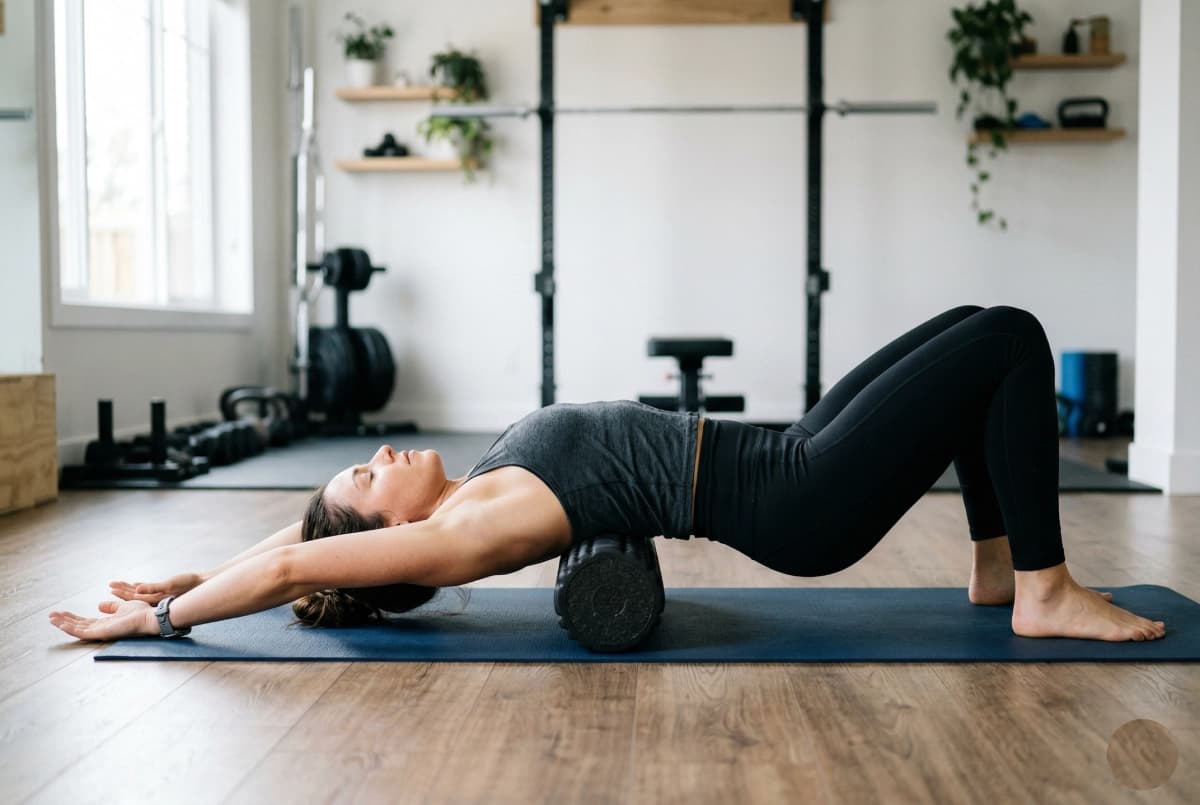
1. Foam Roller Thoracic Extension (Daily)
This is the most direct way to restore extension range.
- Place a foam roller horizontally under your mid-back (not lower back — stop at the bottom of your ribcage)
- Support your head with your hands, feet flat on the floor
- Gently extend over the roller, letting gravity do the work — don't force it
- Take 3–5 deep breaths, then roll up 2–3 cm and repeat
- Work from T6–T12 (mid-back) — never roll the lumbar spine or neck
- 2–3 minutes daily
2. Cat-Cow with Thoracic Isolation
Standard cat-cow tends to be dominated by the lumbar spine. This version targets the thoracic specifically.
- Get on all fours
- Lock your lumbar spine by lightly bracing your core
- Now just flex and extend your mid-back (thoracic only)
- You'll feel the movement between your shoulder blades
- 2 × 10 reps, slow
3. Thoracic Rotation (Thread the Needle)
Restores rotational mobility — essential for pull-up mechanics and overhead movement.
- Start on all fours
- Slide your right arm under your left arm along the floor, following it with your eyes until your right shoulder touches the floor
- Hold 2 seconds, return
- 3 × 8 each side
4. Open Book Stretch
Excellent for thoracic rotation with rib cage opening.
- Lie on your side, knees stacked and bent at 90°, arms extended in front at shoulder height
- Take your top arm and rotate it over and behind you as far as it will go, following with your eyes
- Let your thoracic spine rotate — your knees stay stacked and your lower body stays still
- Hold 3–5 seconds, return
- 3 × 8 reps each side
Strengthening: Build Thoracic Support
Mobility without strength is instability. After restoring range of motion, you need to build the muscles that hold the thoracic spine in extension.
5. Y-T-W Raises (Lower Trap and Mid-Back)
These target the muscles that extend and stabilize the thoracic spine.
- Lie face down on the floor (or a slight incline)
- Arms extended overhead in a "Y" shape — lift both arms, hold 2 seconds, lower
- Arms out to sides in a "T" shape — lift, hold, lower
- Arms bent at 90° down by sides in a "W" shape — retract and depress scapulae, hold 2 seconds
- 3 × 10 of each position, very light weight or bodyweight only
6. Superman Hold
- Lie face down, arms extended overhead
- Simultaneously lift arms, chest, and legs off the floor
- Hold 3–5 seconds, focus on squeezing mid-back
- 3 × 10 reps
7. Prone Cobra
- Lie face down, hands by your hips, palms down
- Lift your chest off the floor using your mid-back (not your hands pushing)
- Hold 5 seconds, lower
- This specifically targets the thoracic erectors
- 3 × 10 reps
Postural Exercises: Retrain Your Default Position
8. Wall Posture Reset
- Stand with your back against a wall: heels 5 cm from wall, shoulders and head touching
- If your head doesn't reach the wall, your thoracic kyphosis is significant — work toward it gradually
- Hold 60 seconds while breathing normally
- Daily — do this immediately after sitting for long periods
9. Chest Opener Doorway Stretch
- Stand in a doorway, arms at 90° (elbows at shoulder height), forearms resting on the doorframe
- Step one foot forward, gently lean through the doorway until you feel a stretch across the chest
- Hold 30–45 seconds
- 2–3 times daily
Programming: How to Include This
Don't treat thoracic work as optional — add it to your training warm-up:
Pre-workout (5–7 minutes):
- Foam roller thoracic extension — 2 minutes
- Cat-cow thoracic isolation — 2 × 10
- Thread the needle — 2 × 8 each side
- Open book — 2 × 6 each side
Post-workout (3–4 minutes):
- Y-T-W raises — 2 × 10
- Wall posture reset — 60 seconds
On rest days:
- Full protocol above
- Doorway chest stretch — 2 × 45 seconds
How Long Does It Take?
- Initial relief (stiffness reduction): 1–2 weeks of daily work
- Measurable mobility improvement: 3–4 weeks
- Significant postural change: 6–8 weeks of consistent daily practice
The thoracic spine can change at any age. Even athletes who've had years of chronic stiffness make substantial improvements within 2 months of targeted daily work.
The Calisthenics Performance Test
Here's how to check if your thoracic mobility is limiting your performance:
- Stand and reach both arms directly overhead — can you get arms fully vertical without your lower back arching?
- In a pike position (hips up, legs straight), can you press your hands overhead from the floor without rounding the upper back excessively?
If either is limited, thoracic extension and shoulder flexion range are your current performance ceiling.
When to Get Professional Help
See a physiotherapist or sports chiropractor if:
- Pain is sharp, radiates around the ribcage (could be intercostal nerve issue)
- You have a history of osteoporosis or vertebral fractures
- Pain is worse after mobility work rather than better
- You have accompanying difficulty breathing or heart palpitations
Upper back pain from stiffness should respond to the exercises above. Structural issues require professional assessment.
If you're a desk worker, a targeted daily routine can prevent thoracic stiffness from accumulating in the first place — see our 15-minute desk worker calisthenics routine. For a comprehensive mobility programme, our Mobility & Flexibility System course covers full-body mobility development for calisthenics athletes.
🎓 Want to become a certified instructor?
Learn the science behind it with our FREE Calisthenics Instructor Certification: anatomy, kinesiology and program design in 15 lessons. Create a free account and earn your certificate!