

How to Fix Wrist Pain for Push-Ups and Planks
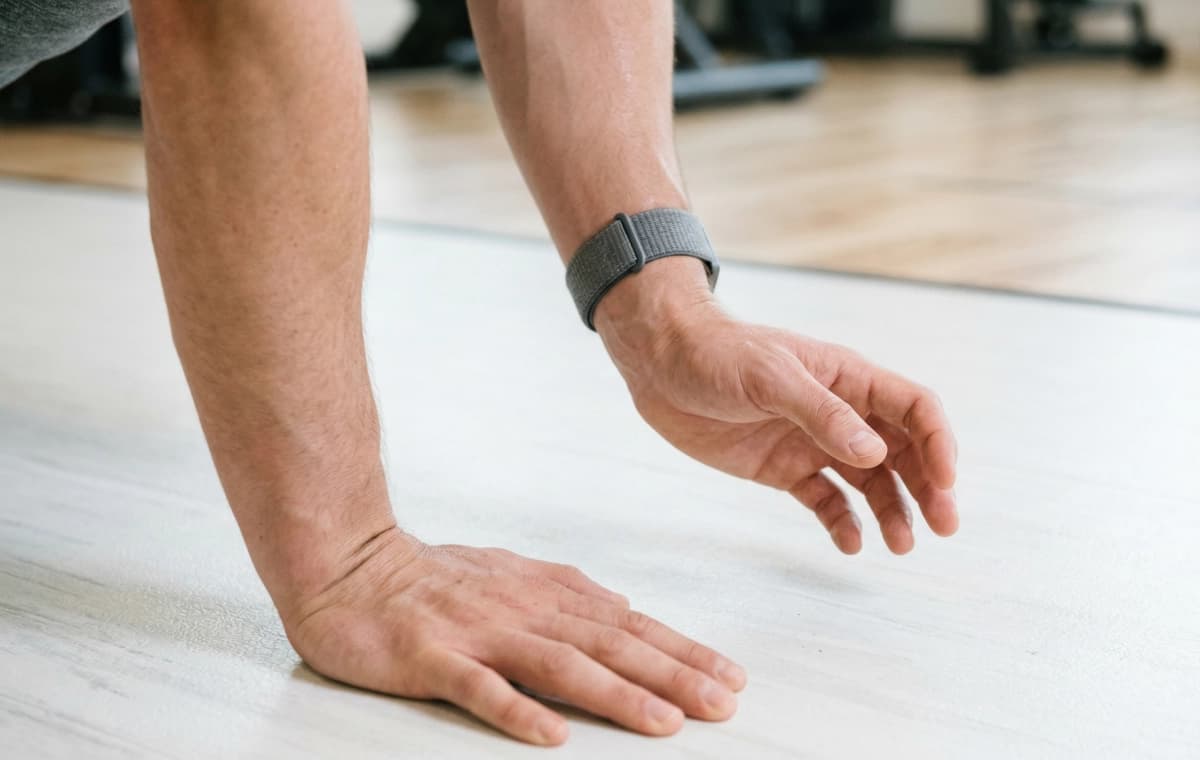
Wrist pain during push-ups and planks is one of the first barriers people hit when starting calisthenics. The wrist joint is asked to support your entire bodyweight in full extension — a position most people never use in daily life. The fix isn't to avoid the position; it's to build the capacity for it.
Why Your Wrists Hurt
The wrist joint in a push-up is at approximately 90° of extension with your full bodyweight pressing through it. For most adults, especially desk workers, the wrists are weak in extension and the surrounding soft tissue (tendons, ligaments, joint capsule) lack the conditioning to handle that load.
Common causes:
- Insufficient wrist extension flexibility — the joint can't reach 90° without compression
- Weak wrist extensors — the muscles that stabilize the wrist in extension fatigue quickly under load
- Carpal tunnel pressure — compression on the median nerve from the loaded wrist position
- Previous wrist injury — old sprains with scar tissue reduce range of motion
- Hands placed too wide — changes the wrist angle and increases radial deviation stress
Immediate Fixes (Do These Before Every Session)
1. Wrist Circles
- On all fours, make slow circles with your wrists — 10 clockwise, 10 counterclockwise each
- This increases synovial fluid distribution in the joint
2. Prayer Stretch
- Press palms together in front of your chest (prayer position)
- Lower hands toward your navel while keeping palms together
- Hold 30 seconds, repeat 3 times
- This lengthens the wrist flexors on the underside of the forearm
3. Reverse Prayer Stretch
- With backs of hands together, raise hands toward chest
- Hold 30 seconds
- This stretches the extensor side and is often overlooked
4. Fingertip Push-Up Warm-Up
- On all fours, support yourself on fingertips rather than flat palms
- Gently shift weight forward and backward for 30 seconds
- Gradually transitions the joint into load without full extension stress
Wrist Strengthening Exercises
Fixing wrist pain isn't about stretching alone — you need to build the muscular capacity to support the joint.
1. Wrist Plank Holds (Progressive Loading)
Start with the goal position but work up to it:
Week 1: Kneeling push-up position on fists (neutral wrist position) — 3 × 20 seconds Week 2: Kneeling with flat palms, hands slightly wider than shoulders — 3 × 20 seconds Week 3: Full plank on flat palms — progress from 20 to 60 seconds over 2–3 weeks
Fist push-ups are a good bridge — the wrist stays neutral, allowing you to build shoulder and chest strength without wrist stress while you condition the joint separately.
2. Wrist Extension Strengthening
Most people only train wrist flexion (gripping). This exercise targets the neglected extensors.
- Kneel beside a bench, forearm resting on bench, hand off the edge, palm facing down, holding a very light dumbbell (0.5–1 kg)
- Let the weight pull the hand down (flex), then raise hand up (extend) as high as possible
- 3 × 15 reps each wrist, daily
3. Rice Bucket (or Sand Bucket) Training
This is the most comprehensive wrist conditioning tool available. Fill a bucket with rice or sand and:
- Plunge hands in and open/close fingers: 30 seconds
- Rotate wrists clockwise/counterclockwise: 30 seconds each
- Scoop and pour motion: 30 seconds
- Do this 3–4 times per week
This builds strength through full wrist range of motion and is used by gymnasts and martial artists for a reason.
4. Push-Up Bar / Parallette Training
Push-up bars or parallettes keep the wrist in a neutral position (like a fist) while allowing full push-up range of motion. This is the best tool if you're currently in pain:
- Use push-up bars for all pressing work while you condition the wrist
- Over 4–6 weeks, gradually shift toward flat-palm push-ups
- Many experienced calisthenics athletes use parallettes permanently for higher-volume work
Planks: Reduce Wrist Stress
If wrists hurt specifically during planks:
- Switch to forearm plank — removes wrist extension entirely, still trains core
- Use fist position — neutral wrist, shoulders still work
- Slightly externally rotate your hands (fingers point slightly outward rather than straight forward) — this reduces compressive stress on the medial wrist
Hand Position for Push-Ups
Most people place their hands wrong. For wrist health:
- Hands slightly wider than shoulder-width
- Fingers spread wide and actively pressing into the floor (this distributes load across the hand)
- Fingers pointing forward or slightly outward — not inward
- Actively "screw" hands into the floor (as if you're trying to rotate them outward) — this creates rotational tension that stabilizes the entire arm chain from wrist to shoulder
The Desk Worker Problem
If you spend 8+ hours daily with wrists in a flexed or neutral position (typing), your wrist flexors are chronically shortened and the extensors are chronically weak. This exact imbalance is what makes push-up wrist pain so common.
Daily desk worker protocol (takes 3 minutes):
- Prayer stretch: 30 seconds × 2
- Reverse prayer stretch: 30 seconds × 2
- Wrist extension exercise with light resistance: 15 reps each
- Do this at your desk mid-morning and mid-afternoon
How Long Does Wrist Conditioning Take?
Unlike muscles, connective tissue (tendons, ligaments, joint capsule) adapts more slowly. Expect:
- Mild discomfort (1–3/10): Resolves in 2–4 weeks with consistent conditioning
- Moderate pain (4–5/10): 4–8 weeks
- Chronic pain or old injury history: 2–3 months
The key is consistency. Doing the wrist prep work 5–6 days per week, even for just 5 minutes, creates adaptation faster than sporadic longer sessions.
When to See a Doctor
Consult a hand therapist or orthopedic doctor if:
- Pain is on the thumb side of the wrist (could be De Quervain's tenosynovitis)
- You have numbness or tingling in fingers (nerve involvement — possible carpal tunnel)
- You had a previous wrist fracture or sprain that never fully resolved
- Pain is present at rest, not just during exercise
Summary
Wrist pain in push-ups and planks is a mobility and strength deficit — not a structural problem for most people. Stretch the flexors, strengthen the extensors, and gradually expose the joint to load using progressive progressions. Use push-up bars as a bridge tool. Within 4–8 weeks, you'll have the wrist capacity for pain-free push-ups and planks.
If you're also dealing with shoulder discomfort during pressing, see our guide to fixing shoulder pain in push-ups. For a structured approach to all upper-body injury prevention, our Calisthenics Injury Prevention & Rehabilitation course is the most comprehensive resource we offer.
🎓 Want to become a certified instructor?
Learn the science behind it with our FREE Calisthenics Instructor Certification: anatomy, kinesiology and program design in 15 lessons. Create a free account and earn your certificate!