

IT Band Syndrome Relief: Exercises & Stretches for Bodyweight Athletes
If you have ever felt a sharp, burning pain on the outside of your knee during squats, pistol squat progressions, or running, you may be dealing with IT band syndrome. It is one of the most common overuse injuries in lower-body training, and bodyweight athletes are particularly susceptible because of the high volume of knee-dominant movements in calisthenics.
This guide covers the anatomy behind IT band syndrome, why it happens, which exercises actually help, and how to modify your calisthenics training so you can recover without losing your progress.
What Is IT Band Syndrome?
Anatomy of the Iliotibial Band
The iliotibial band (IT band) is a thick strip of connective tissue—specifically fascia—that runs along the outside of your thigh. It originates from the tensor fasciae latae (TFL) and gluteus maximus at the hip and inserts into Gerdy's tubercle on the lateral tibia, just below the knee.
The IT band is not a muscle. It is a dense, fibrous band of fascia that cannot contract or relax the way muscles do. Its primary roles are:
- Lateral knee stabilization — Prevents the knee from buckling inward during single-leg stance and dynamic movements
- Force transmission — Transfers force between the hip and knee during walking, running, squatting, and jumping
- Pelvic stabilization — Works with the glute medius and TFL to keep your pelvis level during single-leg activities
How IT Band Syndrome Develops
IT band syndrome (ITBS), also called iliotibial band friction syndrome, occurs when the IT band repeatedly compresses or rubs against the lateral femoral epicondyle—a bony prominence on the outside of the knee. This creates irritation, inflammation, and pain at approximately 20 to 30 degrees of knee flexion, which is exactly the angle where the band passes over the bony landmark.
The condition is not caused by the IT band itself being "too tight." Instead, it results from excessive compression at the knee due to biomechanical issues higher up the chain—primarily at the hip.
Want to understand the full biomechanics? Our free Kinesiology Course covers lower extremity mechanics, including how hip muscle weakness creates problems downstream at the knee.
Symptoms and Self-Assessment
Common Symptoms
- Sharp or burning pain on the outside of the knee, typically starting 10 to 15 minutes into activity
- Pain that worsens with downhill movement, stairs, squatting, or prolonged running
- Snapping or popping sensation on the outside of the knee during bending and straightening
- Pain that subsides with rest but returns immediately when you resume the aggravating activity
- Tenderness when pressing on the lateral knee, about 2 centimeters above the joint line
- Tightness or aching along the outer thigh after training
Self-Assessment Tests
Noble Compression Test
- Lie on your back with the affected knee bent to 90 degrees
- Press your thumb firmly into the outside of your knee, just above the joint line on the lateral femoral epicondyle
- Slowly straighten your knee while maintaining pressure
- Positive test: Sharp pain at approximately 30 degrees of flexion indicates IT band compression
Ober Test (TFL/IT Band Tightness)
- Lie on your non-affected side with the bottom leg bent for stability
- A partner lifts your top leg, extends the hip slightly, and slowly lowers the leg toward the floor
- Positive test: If the top leg cannot lower to horizontal or below, the IT band and TFL are restricted
Single-Leg Squat Observation
- Stand on the affected leg and perform a slow, controlled quarter squat
- Watch your knee in a mirror or record yourself
- Warning signs: Knee dives inward (valgus), hip drops on the opposite side (Trendelenburg sign), or inability to control the movement—all indicating glute medius weakness
Common Causes in Bodyweight Athletes
Understanding why your IT band is irritated is essential for effective treatment. The IT band itself is rarely the problem—it is the victim of dysfunction elsewhere.
1. Weak Glute Medius
This is the number one cause of IT band syndrome. The gluteus medius is the primary hip abductor and pelvic stabilizer. When it is weak:
- The hip drops on the opposite side during single-leg movements (Trendelenburg gait)
- The TFL compensates by working overtime to stabilize the pelvis
- The knee collapses inward (dynamic valgus), increasing compression on the lateral knee
- The IT band experiences greater tensile and compressive forces with every rep
Calisthenics athletes are especially vulnerable because movements like pistol squats, single-leg step-ups, and jumping demand significant glute medius strength that many athletes have not specifically developed.
2. Overuse and Training Volume
IT band syndrome is fundamentally an overuse injury. Common patterns include:
- Rapid increases in squat volume or running mileage
- Adding pistol squat progressions without adequate hip stability
- High-frequency lower body training without sufficient recovery
- Repetitive single-leg work without balancing with hip strengthening
3. Poor Squat and Lunge Mechanics
Bodyweight athletes often develop IT band problems from:
- Knee valgus (knees caving inward) during squats, lunges, and landings
- Excessive forward lean shifting load to the lateral knee structures
- Insufficient ankle dorsiflexion forcing compensatory lateral knee stress
- Rapid descent without control in squat variations
4. Tight TFL and Hip Flexors
The TFL directly connects to the IT band. When the TFL is chronically tight—common in people who sit for extended periods—it increases resting tension on the IT band, pulling it tighter against the lateral femoral epicondyle.
5. Running on Cambered Surfaces
For calisthenics athletes who also run for conditioning, running on roads that slope to one side (cambered surfaces) or always running the same direction on a track places asymmetric stress on the IT band of the downhill leg.
Myth-Busting: You Cannot Really "Stretch" the IT Band
One of the most persistent myths in fitness is that you can stretch the IT band. Research consistently shows that the IT band is extraordinarily stiff. A 2010 study published in the Journal of Anatomy found that it would take approximately 9,000 newtons of force—roughly the weight of a small car—to elongate the IT band by just 1 percent.
What the Research Actually Says
- The IT band is fascia, not muscle. It does not have contractile properties, so it cannot be "released" through stretching the way a tight hamstring can.
- Traditional IT band stretches (like the standing cross-leg stretch) primarily stretch the glute medius, glute minimus, and TFL—the muscles that attach to and influence the IT band. This is actually useful, but for different reasons than most people think.
- Foam rolling the IT band does not physically lengthen it. However, rolling may reduce neural tension and decrease pain perception through descending inhibition. It can also address adhesions between the IT band and the underlying vastus lateralis muscle.
What Actually Helps
Instead of trying to lengthen the IT band directly, focus on:
- Reducing tension on the IT band by releasing and stretching the TFL and hip flexors
- Strengthening the glute medius so the TFL does not have to compensate
- Improving hip and ankle mobility to correct the mechanics that cause excessive IT band loading
- Foam rolling strategically to address neural tension and tissue adhesions, not to "break up" the IT band
Strengthening Exercises for IT Band Syndrome Relief
Strengthening the hip abductors and external rotators is the foundation of IT band syndrome treatment. Research shows that hip-focused strengthening programs resolve IT band syndrome in the majority of cases within 6 to 8 weeks.
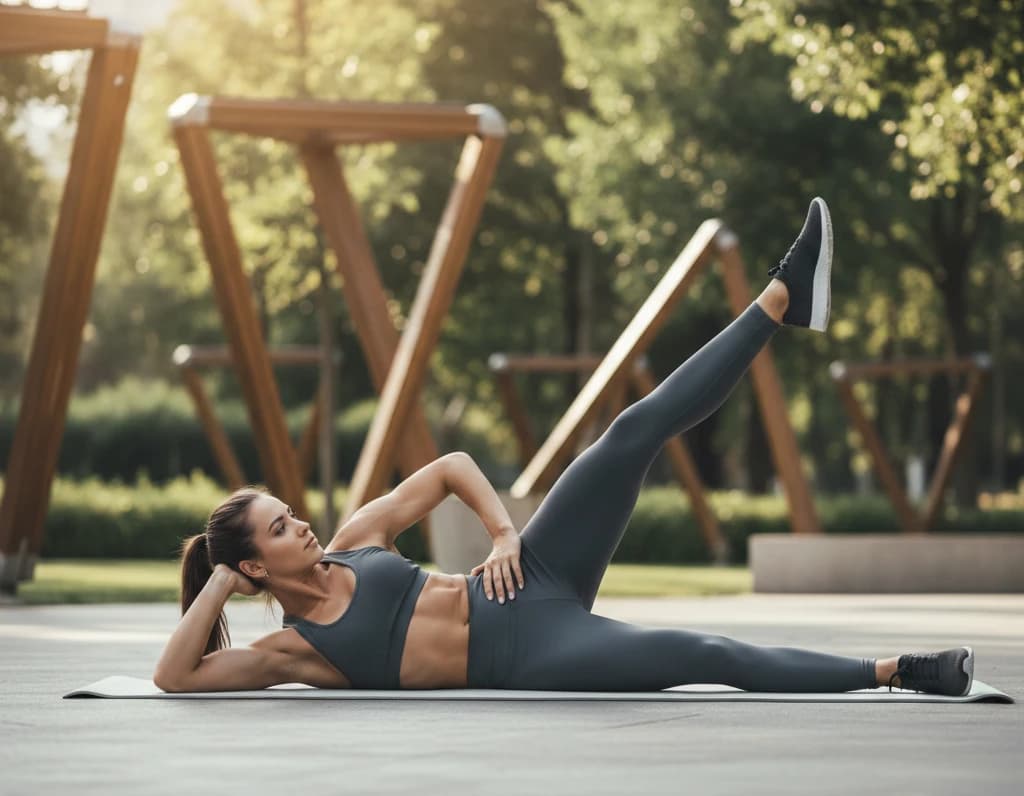
1. Side-Lying Hip Abduction
Target: Gluteus medius (primary), gluteus minimus
This is the most important exercise for IT band syndrome because it directly strengthens the muscle whose weakness causes the problem.
How to perform:
- Lie on your non-affected side with both legs straight and hips stacked vertically
- Keep your top hip slightly forward (10 degrees of extension) to bias the glute medius over the TFL
- Lift your top leg toward the ceiling to approximately 30 to 40 degrees
- Hold at the top for 2 seconds with a conscious glute squeeze
- Lower slowly over 3 seconds
- Perform 3 sets of 15 reps per side
Key tip: Do not let the hip roll backward during the lift. If you feel the work in the front of your hip rather than the side, your TFL is taking over—reduce the range of motion and focus on squeezing the glute.
2. Clamshells with Band
Target: Gluteus medius, deep external rotators
How to perform:
- Lie on your side with hips and knees bent to approximately 45 degrees, heels together
- Place a resistance band just above your knees
- Keeping your heels together and hips stacked, open your top knee like a clamshell
- Hold the open position for 2 seconds
- Close slowly with control
- Perform 3 sets of 15 to 20 reps per side
Progression: Increase band resistance, add a mini-bridge (lift hips off the floor) while performing the clamshell.
3. Single-Leg Glute Bridge
Target: Gluteus maximus, gluteus medius (stabilizer role)
How to perform:
- Lie on your back with one foot flat on the floor, knee bent to 90 degrees
- Extend the opposite leg straight with thighs parallel
- Drive through your heel and squeeze your glute to lift your hips
- Keep your pelvis level—do not let the unsupported side drop
- Hold at the top for 3 seconds
- Lower slowly over 3 seconds
- Perform 3 sets of 10 to 12 reps per side
Why it works: The single-leg variation forces the glute medius to stabilize the pelvis against rotation, mimicking the demands of single-leg calisthenics movements.
4. Banded Lateral Walks (Monster Walks)
Target: Gluteus medius, gluteus minimus, TFL (in a functional context)
How to perform:
- Place a resistance band around your ankles (or just above your knees for less intensity)
- Stand in a quarter-squat position with feet hip-width apart
- Step laterally, leading with one foot, then following with the other—maintain band tension throughout
- Keep your toes pointed forward and knees tracking over your toes
- Perform 15 steps in each direction, 3 sets
Key tip: Stay low in the quarter-squat position. Standing too tall shifts the work away from the glute medius.
5. Single-Leg Romanian Deadlift
Target: Gluteus maximus, gluteus medius, hamstrings
How to perform:
- Stand on one leg with a slight knee bend
- Hinge at the hip, extending the free leg behind you as your torso moves toward the floor
- Keep your hips square—do not let the free leg hip rotate open
- Lower until you feel a stretch in the standing-leg hamstring
- Return to standing by squeezing the glute
- Perform 3 sets of 8 to 10 reps per side
Why it works: This exercise trains the glute medius in its stabilizer role while building posterior chain strength—addressing both lateral hip stability and muscle balance.
6. Copenhagen Side Plank (Advanced)
Target: Hip adductors, gluteus medius, core
How to perform:
- Lie on your side with your top foot on a bench or elevated surface
- Your bottom leg hangs free beneath the bench
- Lift your hips off the ground using your top leg and side core
- Hold for 15 to 30 seconds per side, 3 sets
Why it works: Research links adductor weakness to altered hip mechanics. The Copenhagen plank strengthens the adductors and glute medius simultaneously while training lateral core stability.
Mobility Work: TFL, Hip Flexors, and Quads
Since you cannot meaningfully stretch the IT band itself, focus your mobility work on the muscles that create tension on it.
1. Half-Kneeling TFL Stretch
Target: Tensor fasciae latae
How to perform:
- Kneel on one knee with the opposite foot forward (standard half-kneeling position)
- Tuck your tailbone (posterior pelvic tilt) and squeeze the back glute
- Shift your hips slightly toward the side of the back knee
- Reach the same-side arm overhead and lean away from the back leg
- You should feel a stretch on the outer hip of the kneeling leg
- Hold 45 to 60 seconds per side, 2 sets
2. Pigeon Pose with IT Band Emphasis
Target: Glute medius, TFL, deep external rotators
How to perform:
- From a push-up position, bring one knee forward and place it near the same-side wrist
- Angle the front shin so the foot points toward the opposite hip
- Extend the back leg fully behind you
- Stay upright to emphasize the hip flexor and TFL stretch on the back leg
- Gently lean toward the front knee side to increase the outer hip stretch
- Hold 60 to 90 seconds per side
3. Couch Stretch for Quad and Hip Flexors
Target: Rectus femoris, iliopsoas, TFL
How to perform:
- Kneel facing away from a wall
- Place one knee in the corner where the floor meets the wall, shin going up the wall
- Step the other foot forward into a lunge
- Tuck your pelvis and squeeze the back glute
- Work toward an upright torso
- Hold 60 to 90 seconds per side
Why it matters: Tight quadriceps and hip flexors alter patellar tracking and increase lateral knee stress. Releasing them reduces the overall mechanical load contributing to IT band irritation.
4. Standing Cross-Body Adductor Stretch
Target: Hip adductors (which influence IT band tension through pelvic mechanics)
How to perform:
- Stand with feet wider than shoulder width
- Shift your weight to one side, bending that knee while keeping the other leg straight
- Sink into the stretch, feeling the inner thigh of the straight leg lengthen
- Hold 30 to 45 seconds per side, 2 sets
Foam Rolling Protocol: What Actually Helps
Foam rolling is one of the most debated topics in IT band treatment. Here is what the evidence supports and how to do it effectively.
What Foam Rolling Does (and Does Not Do)
Does:
- Reduces pain perception through neurological mechanisms (descending inhibition)
- Breaks up adhesions between the IT band and underlying vastus lateralis
- Increases short-term range of motion at the hip and knee
- Improves blood flow to surrounding tissues
Does not:
- Permanently lengthen the IT band
- "Break up scar tissue" in the IT band itself
- Fix the underlying cause of IT band syndrome (hip weakness)
Effective Foam Rolling Routine
Perform this routine before training and on rest days. Spend 1 to 2 minutes per area.
1. Vastus Lateralis (Outer Quad)
This is more effective than rolling directly on the IT band because the vastus lateralis lies directly beneath the IT band and adhesions between the two structures contribute to symptoms.
- Lie on your side with a foam roller under your outer thigh, between the hip and knee
- Support your weight with your hands and opposite foot
- Roll slowly, pausing on tender spots for 20 to 30 seconds
- Gently bend and straighten the knee while paused on a tender point
- Focus on the area just above the knee where symptoms are worst
2. TFL and Anterior Hip
- Lie face down with the foam roller positioned just below and in front of the bony point of your hip (ASIS)
- Angle your body slightly to target the TFL—it sits between the hip bone and the outer thigh
- Roll small movements, pausing on tender spots
- This area is often intensely tender—use as much pressure as you can tolerate without guarding
3. Gluteus Medius and Maximus
- Sit on the foam roller with the affected side
- Cross the affected-side ankle over the opposite knee
- Lean into the affected side
- Roll from the top of the hip to the mid-glute area
- Pause on trigger points for 20 to 30 seconds
4. Quadriceps
- Lie face down with the foam roller under both thighs
- Roll from just above the knees to the hip crease
- Rotate slightly inward and outward to cover the full quad group
- Pause on tender spots
Important Foam Rolling Guidelines
- Do not roll directly on the bony outside of the knee where the pain is. This area is already inflamed and direct pressure worsens it.
- Moderate pressure is better than maximum pressure. If you are tensing up and holding your breath, you are pressing too hard.
- Rolling is a supplement, not a treatment. It provides temporary relief but does not address the root cause. Always pair it with strengthening.
How to Modify Calisthenics Training
You do not need to stop training entirely while recovering from IT band syndrome. Smart modifications allow you to continue building strength while the underlying issues resolve.
Squat Modifications
- Reduce depth temporarily. Stay above the 30-degree knee flexion angle where IT band compression peaks. Parallel or slightly above parallel is usually tolerable.
- Widen your stance slightly. A wider stance reduces the valgus moment at the knee and decreases IT band loading.
- Focus on knee tracking. Actively push your knees out over your toes throughout the movement. A light resistance band above the knees provides tactile feedback.
- Slow the eccentric. Use a 3 to 4-second lowering phase to build control and reduce impact forces on the lateral knee.
Pistol Squat Alternatives
Pistol squats are often the biggest aggravator for calisthenics athletes with IT band syndrome because they combine deep knee flexion with single-leg loading. Until symptoms resolve:
- Assisted pistol squats — Hold a door frame, TRX strap, or resistance band for balance and to offload some body weight
- Box pistol squats — Sit to a box or bench at a height that stays above the painful range (usually parallel or above)
- Shrimp squat variations — These keep the working knee more vertically loaded and may be better tolerated
- Bulgarian split squats — A bilateral-supported alternative that still trains single-leg strength with less lateral knee stress
- Step-ups — Load the leg concentrically with minimal IT band compression
Jumping and Plyometric Modifications
- Reduce volume by 50 percent initially
- Replace depth jumps with box jumps (lower impact on landing)
- Focus on landing mechanics — Soft knees, active glute engagement, no knee valgus on landing
- Train on softer surfaces when possible (grass, rubber mats)
What to Keep Doing
- Upper body training — Unaffected and should continue as normal
- Core work — Particularly side planks and anti-rotation exercises, which support lateral hip stability
- Low-impact conditioning — Swimming, cycling (with proper bike fit), walking
- Hip strengthening exercises — These should become the priority in your program
Recovery Timeline and Prevention Strategies
Expected Recovery Timeline
- Weeks 1–2: Reduce aggravating activities, begin foam rolling protocol and hip strengthening. Pain should decrease noticeably with activity modification.
- Weeks 2–4: Continue strengthening with progressive overload. Modified training should be largely pain-free. Return to moderate squat depth.
- Weeks 4–8: Significant improvement in hip stability and reduced symptoms. Begin reintroducing deeper squats and controlled single-leg work.
- Weeks 8–12: Most athletes can return to full training including pistol squat progressions and plyometrics if hip strengthening has been consistent.
The most critical factor is consistency with hip strengthening. Athletes who only foam roll and stretch without addressing glute medius weakness experience recurring symptoms.
Long-Term Prevention Strategies
1. Make Hip Strengthening Permanent
Include 2 to 3 sets of hip abduction or clamshell variations in every lower body warm-up. This takes 3 to 5 minutes and is the single most effective prevention strategy.
2. Balance Bilateral and Unilateral Work
Do not jump straight into high-volume pistol squat training without first building a foundation of bilateral squat strength and hip stability. A good rule: master 3 sets of 15 bodyweight squats with perfect mechanics before progressing to assisted single-leg variations.
3. Progress Gradually
Follow the 10 percent rule—increase training volume (total reps or sets) by no more than 10 percent per week. Rapid jumps in volume are the most common trigger for IT band flare-ups.
4. Warm Up the Hips Before Every Session
A 5-minute lower body warm-up should include:
- 15 banded clamshells per side
- 10 banded lateral walks each direction
- 10 bodyweight glute bridges
- 30-second TFL stretch per side
5. Monitor Your Mechanics
Film your squats and single-leg movements periodically. Watch for knee valgus, hip drop, and trunk lean—the three movement faults most associated with IT band syndrome.
6. Address Ankle Mobility
Limited ankle dorsiflexion forces compensatory knee valgus during squats. Perform wall ankle mobilizations (knee-to-wall) for 2 minutes daily if you cannot pass a basic dorsiflexion test (knee 4 to 5 inches past toes with heel flat).
When to Seek Professional Help
Self-treatment with strengthening and activity modification resolves the majority of IT band syndrome cases. However, see a physiotherapist, sports medicine physician, or orthopedic specialist if:
- Pain persists or worsens after 6 to 8 weeks of consistent hip strengthening and activity modification
- Pain is severe enough to alter your walking pattern
- You experience knee locking, catching, or giving way (which may indicate a meniscus or ligament issue rather than IT band syndrome)
- Symptoms appeared suddenly without a clear overuse pattern
- You have swelling, redness, or warmth around the knee
- Pain is present at rest, not just during activity
These symptoms may indicate conditions that mimic IT band syndrome, such as lateral meniscus tears, lateral collateral ligament sprains, popliteus tendinopathy, or referred pain from the lumbar spine.
Conclusion
IT band syndrome is a frustrating but highly treatable condition. The key insight is that the IT band itself is not the problem—it is a symptom of hip weakness and biomechanical dysfunction. Trying to stretch or foam roll the IT band into submission without addressing glute medius strength is like treating a symptom while ignoring the disease.
The most effective approach combines targeted hip strengthening (especially the glute medius), strategic foam rolling of the surrounding muscles, mobility work for the TFL and hip flexors, and intelligent training modifications that allow you to keep training while you recover.
Start with the strengthening exercises in this guide, modify your squat and single-leg work to stay within pain-free ranges, and commit to making hip strengthening a permanent part of your training. Most athletes see significant improvement within 4 to 6 weeks and full resolution within 8 to 12 weeks.
For a deeper understanding of the biomechanics behind IT band syndrome and other lower extremity injuries, explore our free Kinesiology Course and Anatomy Course. Understanding how your body moves is the foundation of training without pain.
References
- Fredericson, M., and Wolf, C. "Iliotibial band syndrome in runners: innovations in treatment." Sports Medicine 35.5 (2005): 451-459.
- Fairclough, J., et al. "The functional anatomy of the iliotibial band during flexion and extension of the knee: implications for understanding iliotibial band syndrome." Journal of Anatomy 208.3 (2006): 309-316.
- Ferber, R., et al. "Strengthening of the hip and core versus knee muscles for the treatment of patellofemoral pain: a multicenter randomized controlled trial." Journal of Athletic Training 50.4 (2015): 366-377.
- Fredericson, M., et al. "Hip abductor weakness in distance runners with iliotibial band syndrome." Clinical Journal of Sport Medicine 10.3 (2000): 169-175.
- Beers, A., et al. "Effects of multi-modal physiotherapy, including hip abductor strengthening, in patients with iliotibial band friction syndrome." Physiotherapy Canada 60.2 (2008): 150-159.
- Falvey, E. C., et al. "Iliotibial band syndrome: an examination of the evidence behind a number of treatment options." Scandinavian Journal of Medicine & Science in Sports 20.4 (2010): 580-587.
- Baker, R. L., et al. "Iliotibial band syndrome: soft tissue and biomechanical factors in evaluation and treatment." PM&R 3.6 (2011): 550-561.
🎓 Want to become a certified instructor?
Learn the science behind it with our FREE Calisthenics Instructor Certification: anatomy, kinesiology and program design in 15 lessons. Create a free account and earn your certificate!