

Plantar Fasciitis Relief: Bodyweight Exercises & Stretches
Plantar fasciitis is one of the most common causes of heel pain, affecting roughly 1 in 10 people at some point in their lives. For calisthenics athletes and bodyweight training enthusiasts, it can be especially frustrating—every jump, squat, and calf raise loads the plantar fascia, and ignoring it only makes things worse.
The good news is that plantar fasciitis responds well to a targeted approach combining stretching, strengthening, and smart training modifications. This guide walks you through everything you need to relieve the pain, rebuild foot strength, and return to full training.
What Is Plantar Fasciitis?
The plantar fascia is a thick band of connective tissue that runs along the bottom of your foot, connecting the heel bone (calcaneus) to the base of your toes. It functions as a passive spring mechanism—when you walk, run, or jump, the plantar fascia stores and releases elastic energy, supporting the arch of your foot with every step.
Plantar fasciitis occurs when this tissue becomes irritated and inflamed, typically at its attachment point on the heel bone. Despite the "-itis" suffix suggesting pure inflammation, research shows the condition is often degenerative rather than inflammatory—a process called plantar fasciopathy. The tissue breaks down from repetitive overload faster than the body can repair it.
Key Anatomy
- Plantar fascia — A flat band of tissue approximately 2 to 4 millimeters thick that maintains the longitudinal arch of the foot. It consists of three bands: medial, central, and lateral, with the central band being the thickest and most commonly affected.
- Calcaneal attachment — The point where the plantar fascia anchors to the heel bone. This is where most pain occurs because stress concentrates at this insertion point.
- Windlass mechanism — When your toes extend (dorsiflexion) during walking, the plantar fascia tightens and raises the arch, creating a rigid lever for push-off. Dysfunction of this mechanism contributes to plantar fasciitis.
Want to understand foot mechanics in depth? Our free Anatomy Course covers the muscles of the lower extremity in detail, including the structures that support the foot and ankle.
Symptoms and Self-Diagnosis
Plantar fasciitis has a distinctive symptom pattern that sets it apart from other causes of foot pain.
Classic Symptoms
- Sharp heel pain with the first steps in the morning — This is the hallmark symptom. After a night of rest, the plantar fascia stiffens in a shortened position. Your first steps stretch it abruptly, causing sharp pain at the heel.
- Pain that improves after warming up — The initial sharp pain often eases after 10 to 15 minutes of walking as the fascia loosens.
- Pain that returns after prolonged sitting — Any period of rest allows the fascia to stiffen again, so standing up after sitting at a desk triggers the same start-up pain.
- Pain after (not during) exercise — Many people feel fine during a workout but experience significant heel pain in the hours afterward or the next morning.
- Tenderness at the inner heel — Pressing your thumb firmly into the bottom of the heel, slightly toward the inner (medial) side, reproduces the pain.
What Plantar Fasciitis Is Not
- Heel spurs — Bony growths on the heel bone are common on imaging but are usually not the source of pain. Many people with heel spurs have no symptoms, and many people with plantar fasciitis have no spurs.
- Fat pad syndrome — Bruising or thinning of the heel's fat pad causes pain directly under the center of the heel, rather than at the medial attachment point. Fat pad pain doesn't have the same morning stiffness pattern.
- Nerve entrapment — Baxter's nerve entrapment can mimic plantar fasciitis with burning or tingling in the heel. If your pain has a burning or electrical quality, consider seeing a specialist.
Common Causes
Understanding what caused your plantar fasciitis helps you prevent it from recurring once it resolves.
Tight Calves and Achilles Tendon
This is the single biggest risk factor. Tight calf muscles—the gastrocnemius and soleus—limit ankle dorsiflexion (the ability to pull your toes toward your shin). When your ankle can't dorsiflex enough during walking or squatting, the plantar fascia absorbs the excess tension. Studies consistently show that limited ankle dorsiflexion is the strongest predictor of plantar fasciitis.
Weak Foot Intrinsic Muscles
The small muscles within the foot—abductor hallucis, flexor digitorum brevis, quadratus plantae, and the lumbricals—actively support the arch and control toe function. Modern footwear with cushioned soles, arch support, and narrow toe boxes weakens these muscles over time. Without strong intrinsics, the plantar fascia bears more load than it can handle.
Training Overload
Increasing training volume or intensity too quickly is a common trigger. In calisthenics, this often means adding plyometrics, high-rep calf raises, or extensive jump training without adequate preparation. Running on hard surfaces and excessive hill work are also common culprits.
Improper Footwear
Shoes with poor arch support, worn-out soles, flat sandals, and high heels all contribute to plantar fascia overload. For calisthenics athletes who train barefoot or in minimal shoes, transitioning too quickly from cushioned shoes can overload unprepared foot structures.
Body Weight and Load
Higher body weight increases the compressive and tensile load on the plantar fascia with every step. This doesn't just apply to excess body fat—adding a weighted vest for calisthenics progression or carrying heavy loads also increases foot loading.
Prolonged Standing
Occupations that require standing on hard surfaces for hours—teaching, healthcare, retail, construction—are a significant risk factor, especially when combined with unsupportive footwear.
Immediate Relief Techniques
These techniques provide short-term pain relief and are most useful during the acute phase when pain is at its worst.
1. Frozen Water Bottle Roll
How to perform:
- Fill a water bottle and freeze it
- Place the frozen bottle on the floor
- Roll the arch of your foot over the bottle with moderate pressure
- Focus on the area from the heel to the ball of the foot
- Perform for 5 to 10 minutes per foot
Why it works: Combines ice therapy with massage. The cold reduces pain signaling and any acute inflammation, while the rolling provides a massage effect that loosens the fascia.
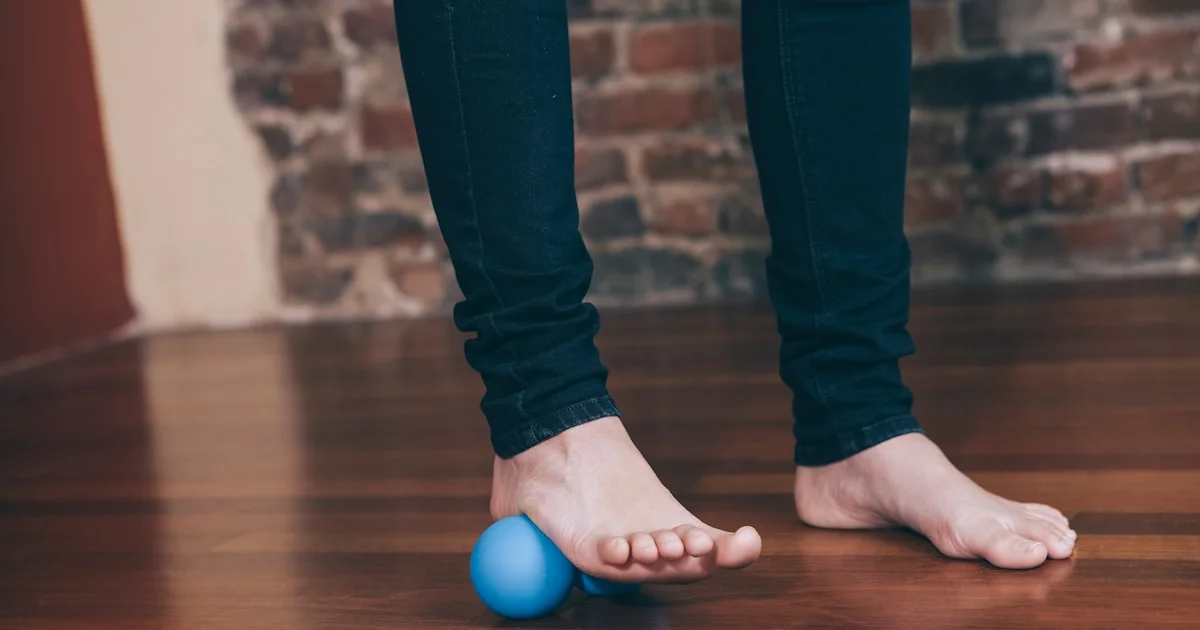
2. Massage Ball Release
How to perform:
- Place a lacrosse ball, golf ball, or dedicated foot massage ball under your foot
- Stand and apply as much pressure as you can tolerate
- Roll slowly along the entire plantar surface—heel to toes
- When you find a particularly tender spot, hold steady pressure for 20 to 30 seconds
- Spend 3 to 5 minutes per foot
Key tip: A golf ball provides more targeted pressure than a tennis ball, but start with something softer if your pain is severe.
3. Plantar Fascia Taping
Taping supports the arch and offloads the plantar fascia, providing immediate pain relief during weight-bearing activities.
How to perform (low-dye taping):
- Anchor a strip of rigid sports tape around the ball of the foot
- Apply strips from the ball of the foot around the heel, pulling gently to support the arch
- Add 2 to 3 cross strips on the bottom of the foot from the outer edge to the inner edge
- Cover with a final anchor strip around the ball of the foot
When to use: During training sessions, long walks, or any activity that aggravates symptoms. Taping is a temporary tool—it does not replace stretching and strengthening.
4. Night Splints
Wearing a night splint holds the foot in a neutral or slightly dorsiflexed position while you sleep. This prevents the plantar fascia from tightening overnight and significantly reduces morning start-up pain. Over-the-counter night splints are widely available and most people adapt to wearing one within a few nights.
Stretches for Plantar Fasciitis
Stretching addresses the two primary mechanical contributors to plantar fasciitis: tight calves and a stiff plantar fascia. Consistency matters more than intensity—gentle, sustained stretches performed daily produce better results than aggressive, occasional stretching.
1. Wall Calf Stretch (Gastrocnemius)
Target: Gastrocnemius (upper calf)
How to perform:
- Stand facing a wall with your hands on the wall at shoulder height
- Step one foot back about 2 to 3 feet, keeping the back knee straight and the heel on the ground
- Lean into the wall until you feel a deep stretch in the upper calf of the back leg
- Keep the back foot pointed straight ahead—not turned out
- Hold 45 to 60 seconds per side, 2 to 3 sets
Key tip: If you can't feel the stretch with your back heel down, step further back. The back knee must remain completely straight to target the gastrocnemius.
2. Soleus Stretch (Bent-Knee Calf Stretch)
Target: Soleus (deep calf)
The soleus is often the forgotten calf muscle, but it plays a critical role in ankle dorsiflexion and plantar fascia loading.
How to perform:
- Stand facing a wall in the same position as the gastrocnemius stretch
- Step the back foot closer to the wall (about 1 to 2 feet back)
- Bend the back knee while keeping the heel firmly on the ground
- Lean into the wall until you feel a deep stretch lower in the calf, near the Achilles tendon
- Hold 45 to 60 seconds per side, 2 to 3 sets
Why both calf stretches matter: The gastrocnemius crosses the knee and the ankle, while the soleus only crosses the ankle. Both muscles merge into the Achilles tendon, which directly influences plantar fascia tension through the calcaneus. Stretching only one leaves half the problem unaddressed.
3. Plantar Fascia Stretch (Seated)
Target: Plantar fascia directly
How to perform:
- Sit in a chair and cross the affected foot over the opposite knee
- Grab the base of your toes with one hand
- Pull the toes back toward your shin until you feel a stretch along the bottom of your foot
- With your other hand, press your thumb along the plantar fascia—you should feel it become taut like a guitar string
- Hold 30 to 45 seconds, 3 sets
- Perform this stretch before getting out of bed in the morning and after any period of prolonged sitting
Evidence: This specific stretch has been studied in randomized controlled trials and shown to be more effective than standard calf stretching alone for plantar fasciitis relief.
4. Towel Stretch (Morning Routine)
Target: Plantar fascia, calves
How to perform:
- Before getting out of bed, loop a towel around the ball of your foot
- Keep your knee straight
- Gently pull the towel toward you, dorsiflexing your ankle and toes
- Hold 30 seconds, repeat 3 times on each foot
- Then stand up—this prepares the plantar fascia for loading
Why this matters: Performing this stretch before your first steps of the day reduces the sharp morning pain that is plantar fasciitis's most disruptive symptom.
5. Step Stretch (Eccentric Calf Stretch)
Target: Calves, Achilles tendon, plantar fascia
How to perform:
- Stand on a step with the balls of your feet on the edge and heels hanging off
- Slowly lower your heels below the level of the step over 3 to 4 seconds
- Hold the bottom position for 15 to 20 seconds
- Rise back up using both legs (or assist with your arms if needed)
- Perform 3 sets of 10 reps, once or twice daily
Note: This stretch should produce a strong pulling sensation but not sharp pain. If it significantly aggravates your heel pain, reduce the range of motion or perform it on flat ground instead.
Strengthening Exercises
Stretching alone provides temporary relief. Long-term resolution requires strengthening the intrinsic foot muscles and the calf complex to increase the load capacity of the plantar fascia and surrounding structures. Research shows that heavy, slow resistance exercises are among the most effective treatments for plantar fasciopathy.
1. Toe Curls (Towel Scrunches)
Target: Flexor digitorum brevis, flexor hallucis brevis
How to perform:
- Sit in a chair with a towel laid flat on the floor under your foot
- Using only your toes, scrunch the towel toward you
- Spread the towel back out and repeat
- Perform 3 sets of 10 to 15 scrunches per foot
Progression: Place a small weight (water bottle or book) on the far end of the towel to increase resistance.
2. Foot Doming (Short Foot Exercise)
Target: Intrinsic foot muscles, arch support
This is the single most important strengthening exercise for plantar fasciitis. It directly trains the muscles that support the arch.
How to perform:
- Sit with your foot flat on the floor, toes relaxed
- Without curling your toes, try to shorten your foot by drawing the ball of the foot toward the heel
- The arch should rise—imagine creating a dome under the center of your foot
- Your toes should remain flat on the ground throughout
- Hold each contraction for 5 seconds
- Perform 3 sets of 10 reps per foot
Progression: Perform while standing on one leg. Then progress to performing during single-leg calf raises.
Key tip: This exercise is subtle and takes practice. If your toes are curling, you are using the wrong muscles. Focus on the muscles in the arch itself.
3. Single-Leg Calf Raises (Heel Raise Protocol)
Target: Gastrocnemius, soleus, plantar fascia
A landmark 2014 study by Rathleff et al. demonstrated that high-load calf raises with a towel under the toes were superior to plantar fascia stretching for long-term plantar fasciitis outcomes.
How to perform:
- Stand on one leg on the edge of a step
- Place a rolled towel under your toes to activate the windlass mechanism
- Rise onto your toes over 3 seconds
- Hold at the top for 2 seconds
- Lower slowly over 3 seconds
- Start with 3 sets of 12 reps, progressing to 4 sets of 8 with added weight (backpack)
Progression over 12 weeks:
- Weeks 1–2: Both legs, flat ground, 3 sets of 12
- Weeks 3–4: Both legs, step edge with towel, 3 sets of 12
- Weeks 5–6: Single leg, step edge with towel, 3 sets of 10
- Weeks 7–12: Single leg, step edge with towel, added weight, 4 sets of 8
Important: Mild heel discomfort during this exercise is acceptable (up to 5 out of 10 on a pain scale). Sharp or worsening pain means you need to reduce the load or range of motion.
4. Marble Pickups
Target: Toe flexors, intrinsic foot muscles
How to perform:
- Place 10 to 20 marbles (or small objects) on the floor
- Pick them up one at a time with your toes and place them in a bowl
- Use each foot separately
- Perform 2 to 3 rounds per foot
Why it works: Trains fine motor control and strength of the toe flexors in a way that towel curls cannot replicate. The varied sizes and positions of the marbles challenge the foot muscles through multiple ranges of motion.
5. Toe Yoga (Big Toe Independence)
Target: Abductor hallucis, flexor hallucis brevis
How to perform:
- Sit or stand with your foot flat on the floor
- Lift your big toe while keeping the other four toes pressed down
- Then reverse—press the big toe down while lifting the other four toes
- Alternate for 10 reps each direction
- Perform 2 to 3 sets per foot
Why it works: Independent toe control is essential for proper foot mechanics during walking and push-off. Most people with plantar fasciitis have poor big toe motor control, which compromises the windlass mechanism.
How to Modify Calisthenics Training with Plantar Fasciitis
You do not need to stop training entirely. Smart modifications allow you to maintain fitness while your plantar fascia heals.
Exercises to Modify or Avoid Temporarily
- Plyometrics (box jumps, burpees, jump squats) — Eliminate these until pain is below 3 out of 10 on the pain scale. Plyometrics generate 3 to 5 times body weight in ground reaction forces through the foot.
- Running and sprinting — Switch to low-impact cardio: cycling, swimming, or rowing.
- Barefoot training on hard surfaces — Wear supportive shoes or train on softer surfaces until symptoms improve.
- High-rep calf raises — Pause until you begin the progressive calf raise protocol described above.
- Deep pistol squats — The extreme ankle dorsiflexion at the bottom loads the plantar fascia heavily. Substitute with box pistol squats to a higher target.
Safe Exercises That Maintain Training
- Upper body work — Push-ups, pull-ups, dips, handstands, and rows place minimal load on the feet. Continue these as normal.
- Seated and lying leg work — Glute bridges, Nordic curls, and lying hip abduction work the lower body without foot loading.
- Wall sits and isometric squats — Static holds distribute force more evenly and avoid the impact loading that aggravates plantar fasciitis.
- Ring or TRX rows — Keep your feet flat to reduce forefoot loading.
- Hanging leg raises and L-sits — Core work with no foot contact.
Return-to-Training Guidelines
- Pain monitoring: Use the 24-hour rule. If your heel pain is worse the morning after training than it was the morning before, you did too much. Scale back.
- Gradual reintroduction: Add impact activities back one at a time, starting with low-intensity versions. For example, start with step-ups before progressing to jump squats.
- Warm up the feet: Before every training session, perform 2 minutes of massage ball rolling and the seated plantar fascia stretch. This prepares the tissue for loading.
- Calf stretching between sets: During lower body work, stretch your calves between sets for 20 to 30 seconds. This maintains ankle mobility and reduces cumulative plantar fascia loading.
Recovery Timeline
Plantar fasciitis is notoriously slow to heal because the plantar fascia has limited blood supply. Set realistic expectations to avoid frustration.
- Weeks 1–2: Morning pain begins to decrease with consistent stretching and ice massage. Start-up pain improves but does not disappear.
- Weeks 3–6: Noticeable improvement in daily pain levels. Walking becomes more comfortable. Begin the progressive calf raise protocol.
- Weeks 6–12: Significant reduction in symptoms for most people. Gradual return to impact activities.
- 3–6 months: Full resolution for the majority of cases with consistent treatment. Some people recover faster, some slower.
- 6–12 months: A small percentage of cases take this long, particularly if treatment was delayed or if contributing factors (calf tightness, weak intrinsics) are not adequately addressed.
When to See a Specialist
Consult a physiotherapist, podiatrist, or sports medicine physician if:
- Pain has not improved after 6 to 8 weeks of consistent home treatment
- Pain is worsening despite treatment
- You experience numbness or tingling in the foot
- Pain is present at rest, not just during weight-bearing
- Both feet are affected and pain is severe
- You suspect a stress fracture (pain that worsens with every step and does not improve with rest)
Professional treatment options include custom orthotics, shockwave therapy, corticosteroid injections (used cautiously), and in rare cases, surgical release of the plantar fascia.
Prevention Strategies
Once your plantar fasciitis resolves, prevention is straightforward if you address the root causes.
Maintain Calf Flexibility
Perform calf stretches (both straight-knee and bent-knee) for 2 to 3 minutes daily. This is the single most effective preventive measure. Treat it like brushing your teeth—non-negotiable daily maintenance.
Strengthen Your Feet
Continue foot doming and toe exercises 3 to 4 times per week. Strong intrinsic foot muscles share the load with the plantar fascia, reducing stress on the tissue.
Progress Training Gradually
Follow the 10 percent rule: increase training volume (total reps, sets, or impact activities) by no more than 10 percent per week. Sudden increases in plyometric volume or running mileage are the most common training-related triggers.
Wear Appropriate Footwear
Choose shoes with adequate arch support and cushioning for daily wear. If you prefer minimalist or barefoot shoes for training, transition gradually over 8 to 12 weeks, allowing your foot structures to adapt. Replace worn-out shoes before the midsole collapses—typically every 500 to 700 kilometers for running shoes.
Manage Body Composition and Load
If you use a weighted vest or external load in calisthenics progressions, increase load gradually and monitor your foot response. Higher loads mean higher plantar fascia stress.
Address Tight Calves Early
If you notice your ankle dorsiflexion decreasing or your calves feeling chronically tight, intervene immediately with stretching and foam rolling. Don't wait for heel pain to develop.
Morning Foot Preparation
Even after recovery, performing 30 seconds of towel stretches before getting out of bed is a simple habit that protects the plantar fascia from the repeated micro-trauma of cold morning loading.
Complete Plantar Fasciitis Recovery Protocol
Combine the techniques above into a daily routine. This protocol takes approximately 15 to 20 minutes and addresses all three pillars of recovery: pain relief, flexibility, and strength.
Morning Routine (3 minutes)
- Towel stretch in bed — 30 seconds per foot
- Seated plantar fascia stretch — 30 seconds per foot, 2 reps
Daily Treatment Session (15 minutes)
Phase 1: Release (3 minutes)
- Frozen water bottle roll or massage ball — 2 to 3 minutes per foot
Phase 2: Stretch (5 minutes)
- Wall calf stretch (straight knee) — 45 seconds per side
- Soleus stretch (bent knee) — 45 seconds per side
- Seated plantar fascia stretch — 30 seconds per side, 2 reps
Phase 3: Strengthen (7 minutes)
- Foot doming — 3 sets of 10 reps per foot
- Toe curls with towel — 2 sets of 12 reps per foot
- Progressive calf raises — follow the 12-week protocol above
Pre-Training (2 minutes)
- Massage ball roll — 1 minute per foot
- Seated plantar fascia stretch — 30 seconds per foot
Conclusion
Plantar fasciitis is a common and frustrating condition, but it is highly treatable with a consistent, evidence-based approach. The combination of targeted stretching, progressive strengthening, and smart training modifications produces results for the vast majority of people—without needing injections, custom orthotics, or surgery.
Start with the stretching and immediate relief techniques to manage your current pain. Add the strengthening exercises as pain allows, particularly the progressive calf raise protocol, which has the strongest research support for long-term outcomes. Modify your calisthenics training rather than abandoning it entirely, and use the 24-hour pain rule to guide your return to full activity.
Your plantar fascia adapted to overload by breaking down. With patience and the right stimulus, it will adapt again—this time by getting stronger.
For a deeper understanding of the foot and lower leg anatomy that underlies these exercises, explore our free Anatomy Course. Knowing why each exercise works makes the recovery process more effective and the prevention strategies more intuitive.
References
- Riddle, D. L., et al. "Risk factors for plantar fasciitis: a matched case-control study." Journal of Bone and Joint Surgery 85.5 (2003): 872-877.
- Rathleff, M. S., et al. "High-load strength training improves outcome in patients with plantar fasciitis." Scandinavian Journal of Medicine & Science in Sports 25.3 (2015): e292-e300.
- Digiovanni, B. F., et al. "Tissue-specific plantar fascia-stretching exercise enhances outcomes in patients with chronic heel pain." Journal of Bone and Joint Surgery 85.7 (2003): 1270-1277.
- McKeon, P. O., et al. "The foot core system: a new paradigm for understanding intrinsic foot muscle function." British Journal of Sports Medicine 49.5 (2015): 290.
- Wearing, S. C., et al. "The pathomechanics of plantar fasciitis." Sports Medicine 36.7 (2006): 585-611.
- Martin, R. L., et al. "Heel pain—plantar fasciitis: clinical practice guidelines." Journal of Orthopaedic & Sports Physical Therapy 44.11 (2014): A1-A33.